
Network Assessment Checklist: Six Areas to Review in 2026

Your team has a current-looking network diagram, a firewall report with no urgent findings, and a monitoring dashboard full of green indicators. Then a branch loses connectivity during a routine change. The backup circuit doesn't carry the application traffic, the switch configuration backup won't restore, and an undocumented device turns out to sit on the affected path.
Nobody verified that the reports described what was connected, how critical services performed under load, or whether recovery procedures worked.
A useful network assessment checklist specifies evidence to collect, tests to run, and conditions that count as passing. It connects technical findings to business services, so an infrastructure manager can distinguish an inconvenient defect from a failure that would stop production or interrupt patient care.
Start with the inventory, establish performance, then examine security, wireless, resilience, and configuration management. Close those six technical reviews with governance: named owners, remediation decisions, and proof that fixes worked. Each review should build on evidence collected earlier, rather than become another disconnected inspection.
1. Network Topology and Asset Inventory
Collect a reconciled inventory and a dependency map, not just a discovery export. Include routers, switches, firewalls, access points, servers, operational technology, endpoints, and cloud connections. Record each asset's role, location, management address, software version, business owner, and upstream dependencies.

Combine approved discovery scans with SNMP, LLDP/CDP neighbors, ARP tables, DHCP records, and switch forwarding tables. Reconcile the results against NetBox or your CMDB, then ask site operations to validate equipment that automated discovery can't confidently identify.
Prove what connects to what
- Validate physical and logical paths: Map switch uplinks, VLANs, subnets, routing boundaries, WAN circuits, and cloud gateways.
- Resolve unknown assets: Identify the owner and purpose of unfamiliar MAC addresses before classifying them as harmless.
- Preserve the baseline: Save dated exports and diagrams, then compare recurring discovery results against approved changes.
For a manufacturer, this might mean checking production-switch tables against the controls team's PLC inventory. An unidentified printer is a management gap; an undocumented controller sharing a general-purpose VLAN may require a different security and maintenance approach.
The usual failure is mistaking discovery coverage for inventory completeness. Quiet devices, restricted management interfaces, and cloud resources outside the scanning boundary can remain invisible. Coordinate active scans with clinical or production teams, and use passive evidence where probing could disrupt sensitive equipment.
A useful enterprise network design starts with these verified dependencies. A diagram that omits the authentication server or cloud gateway behind a critical application isn't ready to support design decisions.
2. Bandwidth, Latency, and Performance Baseline
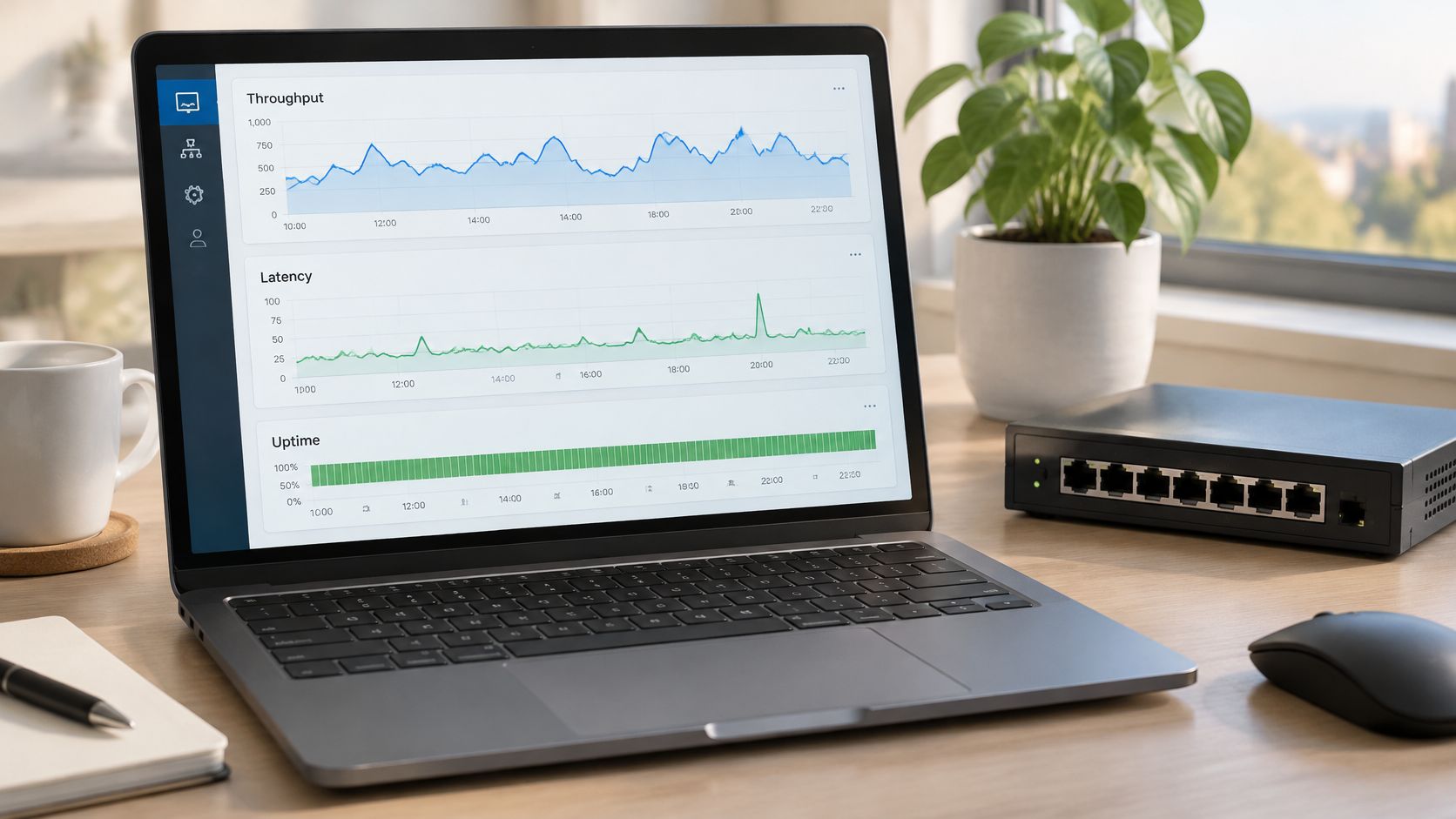
A link can look lightly utilized while users experience poor calls, delayed transactions, or application timeouts. Collect time-aligned throughput, latency, jitter, packet-loss, queue-drop, and utilization records, then correlate them with application behavior and business schedules.
Use NetFlow, sFlow, or IPFIX to identify traffic sources and destinations. Place synthetic probes on representative user paths, and capture normal activity, peak demand, backups, and maintenance traffic rather than testing only during a quiet window.
Separate capacity problems from visibility problems
EMA's network observability study found that 87% of network teams use multiple monitoring tools, while only 43% consider their organizations completely successful with network observability. Test whether an engineer can follow a critical transaction from the user through the network path without manually reconciling contradictory timestamps and device names.
For a retailer, compare point-of-sale response times with video traffic and WAN queue drops. If congestion is the cause, validate application classification and QoS markings through the carrier path before buying bandwidth.
Practical rule: Upgrade capacity when the evidence shows a capacity constraint, not simply because an interface graph looks busy.
Compare WAN optimization and SD-WAN against the actual failure mode: inefficient transfers, unsuitable path selection, or contention. To reduce downtime with proactive monitoring, alerts must identify service degradation and reach someone authorized to act.
For planned AI workloads, add concurrent data-movement and inference tests. Record tail latency, packet loss, and cloud-path visibility rather than accepting a successful bulk-transfer test as proof of readiness.
3. Security Posture and Access Control Review
A firewall rule shows intent; an authorized test shows whether traffic stops. Build the evidence set in the order an assessor uses it: zone matrix and dependency map, admin access paths, rule base and hit counters, exposed services, remote-access policy, authentication logs.
Start from identity and reachability. Define which user, guest, device, application, and management networks may communicate, then run permitted and denied probes from representative subnets. A permit that works proves little unless the denied path fails too.
- Inspect administrative access: check named accounts, privileged authentication, restricted management paths, and departed-admin removal; the usual find is a shared credential or a device that still accepts logins over an out-of-band path.
- Validate segmentation: test alternate routes, remote-access tunnels, and shared services segments, since labels often survive after routing has changed.
- Review exposure: every internet-facing service needs purpose, owner, and remediation path; the recurring failure is an old portal or test API no one can justify but everyone fears touching.
Measure exposure, not just completed checks
NIST's network-security measurement model identifies vulnerable host percentage, CVSS severity score, and compromised host percentage as primary measures. Record the assessed population beside findings so a lower count reflects real improvement, not a smaller scan scope.
In a hospital, do not accept "clinical VLAN" as proof: test whether an office or admin endpoint can reach device-management interfaces through shared services.
The common failure is keeping broad exceptions because dependencies are unknown. Use flow records and owner validation before tightening, keep a rollback plan, and treat zero rule hits cautiously when the window misses quarterly processes.
Include SD-WAN security policies in the same review rather than treating the overlay as trusted. A security tooling guide for SRE teams can help compare utilities, but tools don't replace authorized testing and documented access decisions.
4. Wireless Network Site Survey and Coverage Assessment
A warehouse scanner disconnects near the loading dock, but the survey laptop shows acceptable signal strength. That discrepancy is exactly why wireless evidence must include real client behavior, not just controller status and a predictive heat map.
Collect floor plans, access-point locations, antenna details, channel assignments, transmit-power settings, association logs, and measured signal-to-noise conditions. Survey during representative occupancy and activity, including spaces where stock, machinery, doors, or crowds affect propagation.

Test the application while the client moves
Walk operational routes with the actual scanner, handset, or mobile workstation. Record roaming events, retransmissions, authentication delays, packet loss, and application interruptions, then correlate those events with the survey location.
- Check coverage and capacity separately: Strong signal doesn't establish that airtime is available during a busy meeting or shift change.
- Inspect channel reuse: Review channel width, neighboring radios, interference, and power settings before adding access points.
- Verify client compatibility: Confirm supported bands, authentication methods, and roaming behavior on the devices users carry.
The usual failure is treating more access points or higher transmit power as the universal fix. Additional radios can worsen contention, and a client may hear an access point without being able to transmit reliably back to it.
A heat map should explain an observed client experience, not substitute for testing one.
For the loading-dock scenario, compare stationary and moving tests with doors in their normal operating positions. Preserve annotated heat maps, client logs, and before-and-after application results so the next assessor can distinguish an improvement from a relocated problem.
5. Redundancy, Resilience, and Failover Validation
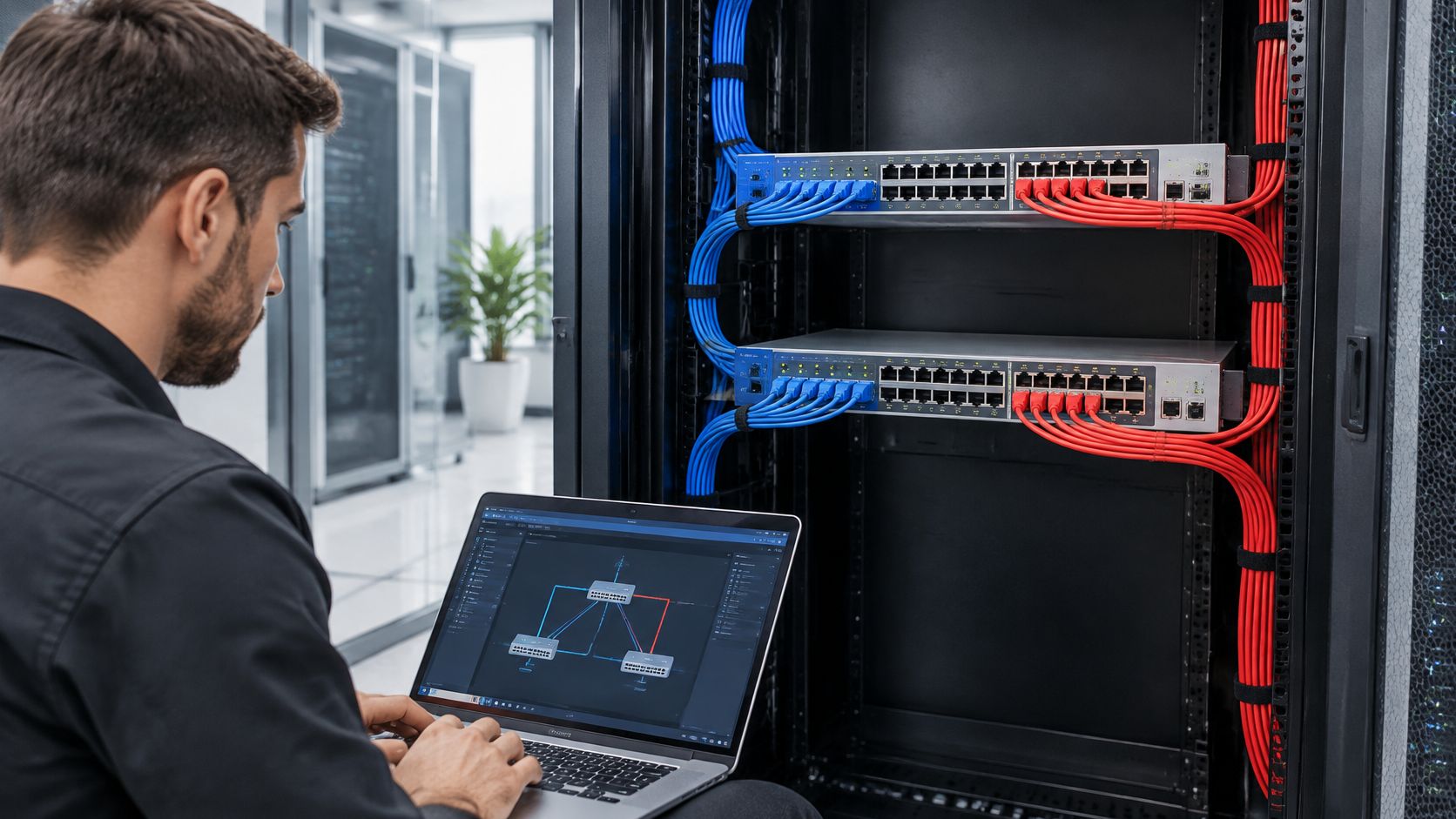
Collect proof that services survive failure, not a list of redundant components. Review circuit paths, power feeds, routing behavior, firewall state synchronization, controller dependencies, independent management access, and recovery runbooks.
In Opengear's multinational survey of CIOs, security executives, and network engineers, 84% reported rising network outages over the prior two years, and 27% identified configuration changes as the most common cause. Include a bad-change scenario alongside hardware and circuit failures.
Run a controlled service-level test
Define the failure to introduce, expected application behavior, stop conditions, stakeholder notifications, and rollback procedure. During an approved maintenance window, withdraw the selected path or component and record detection, convergence, application interruption, and restoration.
For a regional bank, apparently diverse internet circuits may still share a building entry or carrier facility. Obtain physical-path documentation and record any shared dependencies instead of assuming different circuit identifiers mean independent infrastructure.
- Test management access: Confirm engineers can reach affected equipment when production WAN or cloud identity services are unavailable.
- Measure user impact: Compare actual service recovery with agreed recovery objectives, including existing sessions.
- Exercise rollback: Demonstrate that the team can reverse a failed change using available credentials, backups, and access paths.
The usual failure is testing link recovery while ignoring application recovery. Routing may converge while sessions, name resolution, or authentication remain broken. Preserve event logs and application-probe results, then repeat affected tests after material design changes.
6. Configuration Management, Firmware, and Patch Currency
A successful backup job doesn't prove you can recover a device. Collect readable configuration backups, restore-test results, software inventories, support-status records, approved templates, and configuration differences between comparable devices.
Compare running configurations against saved startup configurations and the intended standard. Investigate drift in routing, management access, logging, time synchronization, authentication, and security settings, but distinguish legitimate site-specific exceptions from unauthorized changes.
Verify recoverability before changing software
- Build a version matrix: Record hardware models, installed releases, support status, and vendor lifecycle information.
- Check patch applicability: Match security advisories to installed software, enabled features, exposure, and compensating controls.
- Restore in isolation: Verify that backups contain the configuration and supporting material needed to recover service.
- Protect configuration records: Restrict access, encrypt sensitive backups, and maintain version-controlled templates.
Say a public agency discovers unsupported switches at remote offices. The assessment should identify replacement dependencies, interim access restrictions, spare-equipment options, and procurement needs, not merely flag the devices as obsolete.
The usual failure is closing findings when a patch installs or a backup completes. Validate routing, authentication, telemetry, application reachability, and rollback readiness after the change. A clean automation run can still distribute an incorrect template consistently.
Recovery test: Have an engineer rebuild an isolated replacement using the documented procedure, without relying on undocumented knowledge.
Patching also involves trade-offs. An urgent security update may warrant accelerated testing, while a feature release may introduce unnecessary operational risk. Document why the chosen release fits the device's role, and give deferred remediation an owner, compensating controls, and a review trigger.
7. Compliance, Documentation, and Governance Alignment
The evidence package should let another engineer reproduce the finding and let a risk owner make a decision. Collect dated test records, scope boundaries, policy mappings, exceptions, remediation assignments, and retest results.
NIST's Guideline on Network Security Testing emphasizes consistent testing methods and prioritizing activities when resources are limited. Apply that discipline by distinguishing a control that passed from one that wasn't tested or couldn't be observed.
Connect technical evidence to accountable decisions
Map relevant findings to your organization's applicable obligations and chosen frameworks, such as NIST CSF, ISO/IEC 27001, PCI DSS, or healthcare security requirements. Don't treat a framework mapping as a compliance verdict; involve the accountable security, legal, or compliance owner where interpretation is required.
- Record the finding precisely: State the affected service, observed condition, evidence location, and plausible business impact.
- Assign remediation: Name an accountable owner, target date, dependencies, and the evidence required for closure.
- Document exceptions: Identify who accepted the residual risk, which compensating controls apply, and what triggers reconsideration.
For a payment processor, compare the documented cardholder-data boundary with routing, firewall policy, and authorized segmentation tests. If the evidence doesn't support the claimed boundary, escalate the discrepancy rather than copying the existing scope statement into a new report.
The usual failure is counting report delivery as assessment completion. Sample device records against diagrams and policies, and require retesting before marking technical findings resolved. Keep inaccessible assets and untested scenarios visible as coverage gaps rather than excluding them from the final assessment.
How the seven network assessment areas compare in purpose, tooling, and limitations
Use the rows in assessment order: earlier evidence changes what later tests must prove, and the limitation column is where scope usually gets overstated.
| Assessment Area | Primary Goal | Example Tools and Evidence | Main Limitation |
|---|---|---|---|
| Network Topology and Asset Inventory | Build a device, link, and dependency map that matches observed traffic | Nmap, SolarWinds, NetBox | Discovery ages quickly, and unmanaged assets stay invisible |
| Bandwidth, Latency, and Performance Baseline | Measure normal behavior and isolate bottlenecks by path and time window | PRTG, SolarWinds Network Performance Monitor, Wireshark | Short measurement periods can miss peak demand |
| Security Posture and Access Control Review | Prove who can reach what and which rules still permit stale access | Tenable Nessus, Rapid7 InsightVM | Tightening controls may disrupt legacy applications |
| Wireless Network Site Survey and Coverage Assessment | Validate coverage, capacity, roaming, and interference where users work | Ekahau, Fluke Networks, NetAlly AirMagnet | Results may not reflect changing occupancy |
| Redundancy, Resilience, and Failover Validation | Prove service continuity when a link, node, power supply, or path fails | iPerf for traffic generation during controlled failover drills | Drills can create the outage they are meant to prevent |
| Configuration Management, Firmware, and Patch Currency | Catch drift, stale firmware, missing patches, and unusable backups | Oxidized, RANCID, Ansible | Upgrades carry operational risk |
| Compliance, Documentation, and Governance Alignment | Tie controls and records to obligations an accountable owner can defend | NIST CSF, ISO/IEC 27001, PCI DSS | Documentation may not reflect actual practices |
Treat every limitation as a test condition to record and keep the row.
Turning the Checklist Into a Running Assessment Program
A network assessment earns its value when the team repeats the tests, assigns ownership, and funds the necessary changes. A polished report without those commitments is a snapshot, not an operating program.
Keep the sequence intact. Inventory establishes what exists and what depends on it; performance testing establishes how services behave; security and wireless testing validate access boundaries and user connectivity; resilience and configuration reviews establish whether the team can sustain and recover those services.
Governance connects those six technical areas to decisions. Each finding should end with remediation, a documented exception, or an explicit decision to collect more evidence.
Give each review an operating rhythm
- Name accountable owners: Assign responsibility for inventory quality, performance baselines, access policy, wireless validation, recovery testing, and configuration standards.
- Set review triggers: Combine scheduled reviews with checks after significant application, site, carrier, security-policy, or infrastructure changes.
- Retain comparable evidence: Keep scope, collection methods, test conditions, and exclusions consistent enough to explain changes in results.
- Tie findings to budgets: Separate configuration fixes from investments requiring procurement, architecture work, operational capacity, or replacement equipment.
Prioritize by service impact and exposure, not solely by the order a scanning tool presents findings. An untested recovery path supporting a critical service may deserve attention before a larger collection of low-impact housekeeping defects.
Our networking approach follows Assess, Design, Evaluate, Deploy, and Optimize. MR2 Solutions offers no-obligation technology assessments to benchmark an environment, a Security Assessment to identify posture gaps, and Network Assessments within that broader process.
Keep the first cycle manageable, but don't hide its limitations. Establish the critical-service scope, preserve the evidence, and give every unresolved dependency a visible owner. Start the inventory and performance baseline this month, then schedule security, wireless, failover, configuration, and governance reviews with the teams responsible for acting on the results.
MR2 Solutions offers vendor-neutral assessments and technology evaluation to help your team connect network findings with practical remediation and investment decisions. Visit MR2 Solutions to discuss a no-obligation technology assessment, starting with your inventory, performance baseline, and critical-service dependencies.