
Virtual CIO Consulting Services: A Practical Buyer’s Guide

Your IT lead is buried in support tickets, a major software renewal is approaching, and finance wants to know which technology investments can wait. Nobody can confidently name the systems the business can't operate without, let alone explain who has authority to replace them.
Virtual CIO consulting services should solve that leadership gap. You're buying a repeatable way to make technology decisions, approve funding, hold suppliers accountable, and preserve knowledge after the advisor leaves. Another presentation isn't enough.
What Virtual CIO Consulting Services Cover
Say you're running a distributor with a small IT team. Its lead spends the day restoring access, fixing warehouse printers, and answering help desk requests. Leadership wants better reporting and stronger security, but nobody owns the trade-offs between those priorities.
A virtual CIO, or fractional CIO, is a senior technology executive working part time who takes responsibility for technology strategy, governance, and budget discipline within an agreed mandate. The peer-reviewed study published by Springer defines fractional CIOs as highly experienced professionals who perform CIO responsibilities part time, serve multiple clients simultaneously, and may manage client IT employees and suppliers.
Think of a part-time CFO who establishes financial controls and challenges major expenditures, not a bookkeeper who processes invoices. The distinction is executive judgment versus transaction processing.
Require artifacts you can use
Use this menu to scope the engagement. The cadences below are recommended starting points, not obligations to buy every service.
| Deliverable area | What the client receives | Typical cadence |
|---|---|---|
| Technology roadmap | Three-year roadmap tied to the budget and business goals | Annual plan, reviewed quarterly |
| IT policy and governance pack | Decision rights, acceptable-use rules, data ownership | Set initially, reviewed annually and after material changes |
| Vendor and contract review | Renewal calendar, consolidation options, exit terms | Quarterly |
| Budget and total-cost model | Scenario budget and cost per service | Annual, with quarterly variance review |
| Risk and security governance | Risk register and gap plan aligned to NIST CSF | Quarterly |
| Executive reporting | Board-ready dashboard of spend, risk, and delivery | Monthly or quarterly |
For the distributor, the first useful output might be a business-service map showing how order entry, inventory, identity, and connectivity support shipments. That gives leadership a basis for deciding which outage risks deserve attention before approving another application.
The vCIO should also establish who recommends a change, who approves spending, who implements it, and who accepts residual risk. Responsibility without delegated authority is an advisory arrangement, not executive ownership.
Keep documents in company-controlled repositories, with editable source files and named internal custodians. Every deliverable should support a concrete business decision. If nobody can explain what a document helps leadership approve, reject, or prioritize, remove it from scope.
Why Companies Hire a vCIO Instead of Alternatives
The immediate choice usually isn't between a vCIO and doing nothing. Your existing setup handles operations, but nobody has enough time or authority to settle strategic questions. Buy the missing capability rather than another overlapping service.
| Option | Strategic ownership | Commitment | Best fit |
|---|---|---|---|
| Full-time CIO | Full executive authority, direct hire | Ongoing employment with fixed salary and benefits | Enterprises with a constant executive agenda |
| Fractional vCIO | Executive guidance and governance on scheduled days | Retainer or scheduled hours, scalable by agreement | Mid-market firms needing strategy without a full-time seat |
| Managed service provider | Accountability for contracted services, not automatically enterprise strategy | Commonly per-device or per-user fees | Organizations that need operations run for them |
| Internal IT manager | Daily operational ownership, with strategic scope set by leadership | Salaried role with benefits | Teams needing continuous operational supervision |
| Project IT consultant | Ownership of a scoped deliverable | Project fee ending at delivery | Discrete assessments or implementations |
Buy judgment, not a substitute technician
A fractional arrangement lets you purchase executive attention without creating a permanent executive position. That doesn't automatically make it economical. Compare the proposed workload and authority with the fee, rather than comparing job titles.
Relevant experience matters just as much. An advisor who can explain migration dependencies, audit evidence, and outage decisions offers something different from additional engineering capacity. Ask what decisions they personally owned, not merely which projects they attended.
Independence must be demonstrated. An MSP recommending its own tools has a commercial interest in the outcome. That doesn't invalidate its recommendation, but you should require disclosure and a comparison against credible alternatives.
Buying rule: If the gap is strategy, governance, and vendor judgment, consider a vCIO. If the gap is hands-on capacity, buy operations first.
A vCIO doesn't replace help desk coverage, server patching, or network monitoring. Internal staff or an MSP still need to execute those tasks. Likewise, a business with a continuous executive technology agenda shouldn't force that workload into a fractional contract just to avoid hiring.
Four Engagement Models and When Each Fits
Choose an engagement around the business trigger. A merger requires different work from steady growth, and an advisor shouldn't sell both situations the same package.
The fractional CIO engagement framework summarized by Flamingo identifies four recurring types for SMEs: strategic IT management, restructuring, scaling, and hands-on support. It also highlights trust, support from top management, and the advisor's integrity as central success factors.
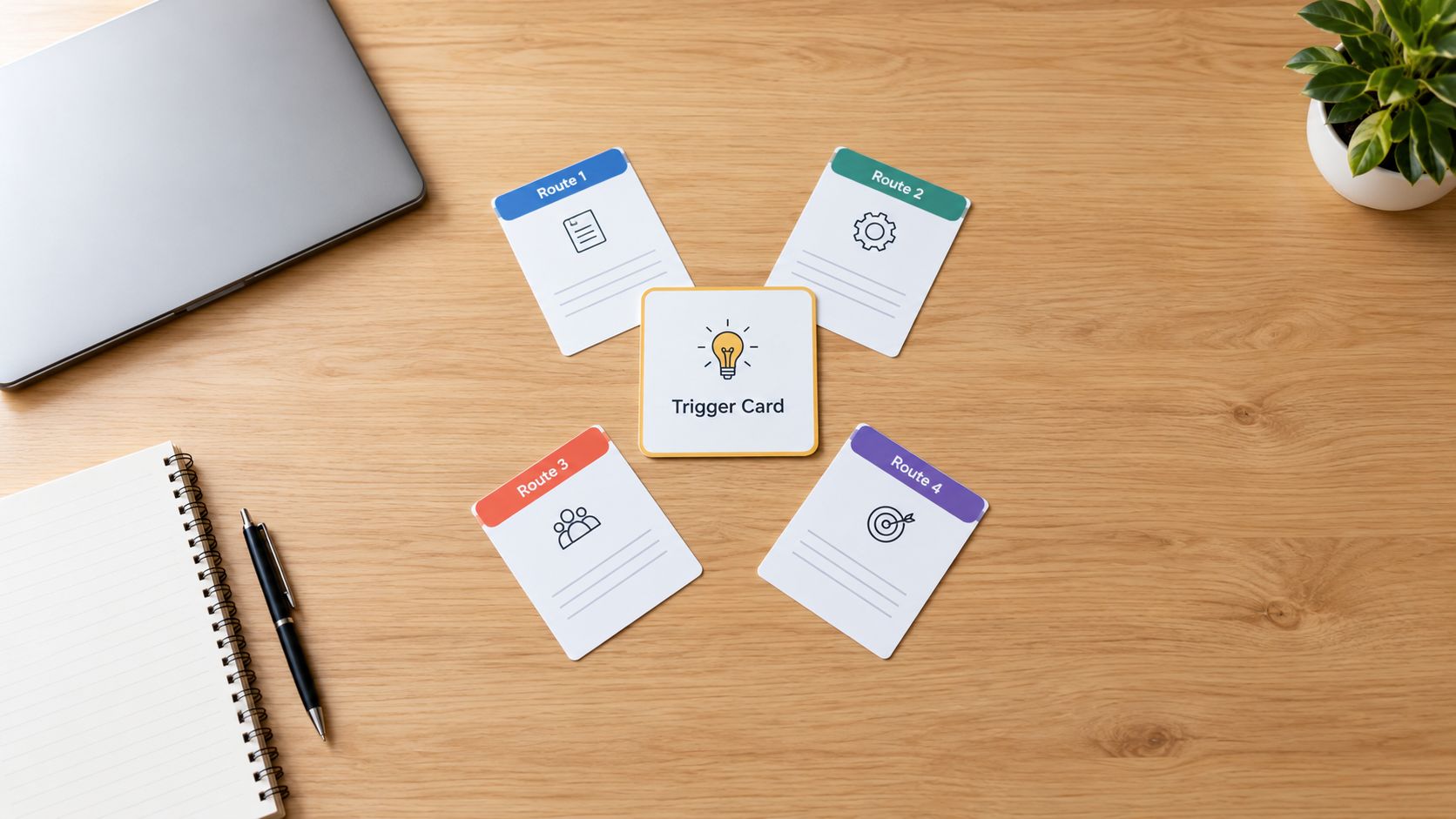
| Engagement type | Typical trigger | Core work | Commitment pattern |
|---|---|---|---|
| Strategic IT management | Steady growth with no multi-year roadmap | Roadmap, budget cycle, vendor strategy | Ongoing monthly retainer |
| Restructuring | Merger, failed legacy system, or audit finding | System inventory, consolidation, triage | Time-boxed phase with defined exit |
| Scaling | Headcount or site count growing faster than IT | Capacity plan, procurement gates, architecture | Ramp-up, then taper as the team matures |
| Hands-on support | A specific project needs independent oversight | Vendor oversight, go-live readiness, benefits check | Project-length engagement |
Follow the trigger through to completion
Consider a manufacturer acquiring a competitor. It starts with restructuring: identify systems, map dependencies, reconcile supplier contracts, and decide how to consolidate separate identity directories. The advisor shouldn't begin by proposing an ambitious transformation while acquired employees still lack reliable access.
Once leadership approves the target environment and transition responsibilities, the engagement can move into strategic IT management. The work shifts from urgent integration decisions to investment sequencing and supplier performance.
A logistics firm opening regional sites needs scaling support instead. The advisor should establish connectivity requirements, procurement lead times, capacity assumptions, and site-readiness acceptance criteria before operations commits to opening dates.
Hands-on support needs careful wording. Here, it means close involvement in project decisions and supplier oversight. It doesn't silently transfer implementation responsibility from the delivery team to the advisor.
Make executive access part of the agreement
Trust isn't permission to operate without scrutiny. Give the advisor access to the executive sponsor, require disclosure of commercial conflicts, and record consequential recommendations with their assumptions.
Contracts should allow an engagement to change type through a documented scope adjustment. Specify the trigger, revised workload, acceptance criteria, and revised fee. Otherwise, temporary restructuring work can become a permanent retainer with no clear purpose.
Measuring Governance Results Quarter by Quarter
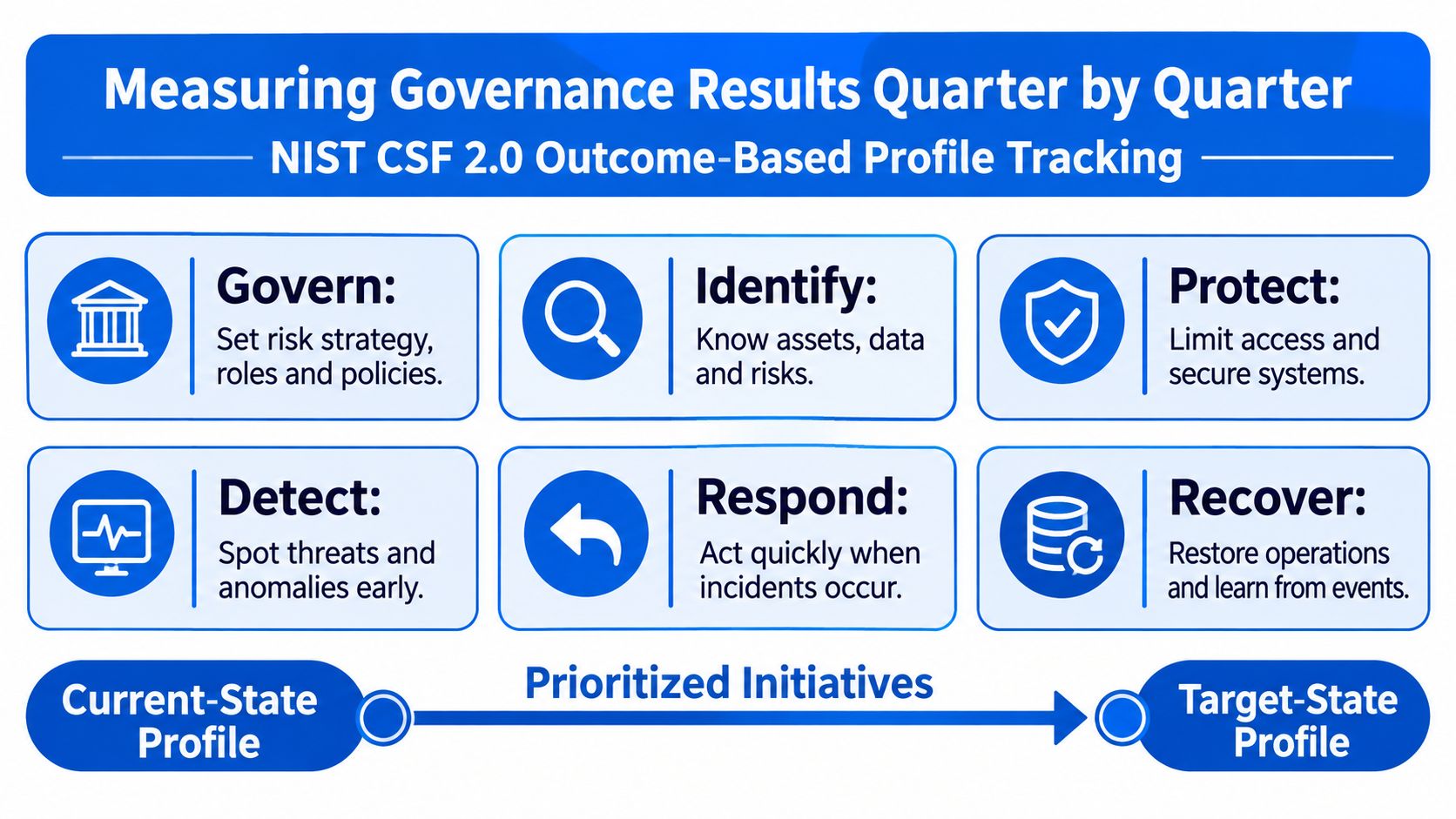
Count decisions implemented and risks reduced, not meetings held. The NIST Cybersecurity Framework 2.0 is outcome-based rather than prescriptive and organizes cybersecurity outcomes into Govern, Identify, Protect, Detect, Respond, and Recover. It places cybersecurity governance within enterprise risk management, making executive oversight essential.
A vCIO can use current-state and target-state Organizational Profiles to identify gaps, prioritize initiatives, and attach an accountable owner to each outcome. Don't confuse completing an assessment with correcting its findings.
Translate controls into executive measures
Govern establishes decision rights and risk expectations. Identify establishes which assets and dependencies matter. Protect and Detect support prevention and timely discovery, while Respond and Recover prepare people to contain disruption and restore services.
Ask for a quarterly dashboard containing:
- Critical-asset coverage: Which essential systems have confirmed owners, monitoring, and required safeguards?
- High-risk remediation time: How long do significant findings remain open, including overdue items?
- Recovery evidence: Did restoration tests meet the business's agreed service requirements?
- Supplier assessments: Which critical providers have completed reviews, and which findings remain unresolved?
- Exceptions: Who accepted each exception, when does approval expire, and how old is it?
These are leadership measures, not a replacement for technical telemetry. Define the denominator, evidence source, and owner for every metric so an apparent improvement can't come from excluding difficult systems.
Separate exposure reduction from guaranteed savings
Suppose a critical vulnerability closes much sooner than its original remediation target. Report the reduced exposure window and the evidence supporting closure. Don't call the entire potential breach cost a realized saving.
Compare the engagement fee and implementation costs with scenario-based outage losses, using finance-approved assumptions for operational disruption and recovery. Reduced risk is valuable without pretending an avoided incident is certain.
The board should receive the exceptions and decisions requiring executive action. A written CIO responsibility charter helps distinguish what the advisor recommends from what management must approve.
Sorting Legacy Systems Into the Right Disposition
Consider a distributor with an unsupported order-management platform, a reporting tool maintained by a single analyst, and a healthy file server. Replacing everything would be disruptive. Keeping everything would leave leadership accepting risks it hasn't assessed.
The U.S. Government Accountability Office's legacy-system review describes federal agencies' maintenance-heavy IT spending and documents systems with unsupported components and known cybersecurity vulnerabilities. Treat that as a warning about unmanaged portfolios, not a private-sector budget benchmark.

Score before choosing a destination
Assess business criticality, technical obsolescence, vendor support status, cyber exposure, operating cost, integration dependency, and modernization complexity. Record evidence and confidence levels, not just a color-coded score.
| Disposition | What it means | Choose it when | Main risk to watch |
|---|---|---|---|
| Retain | Keep as is with monitoring | Stable, supported, and low criticality | Hidden drift in support status |
| Remediate | Patch or harden without changing the platform | Supported but with known vulnerabilities | Fixes that defer the real decision |
| Rehost | Move to a supported environment with little code change | Hardware or hosting is failing but logic is sound | Carrying old design into new hosting |
| Refactor | Rework code or architecture to modernize | Core logic is valuable but brittle | Scope growth and long timelines |
| Replace | Move to a new platform and decommission the old system | Obsolete, unsupported, and costly to integrate | Transition outages and migration errors |
| Retire | Shut down and archive the system | Duplicated functions or unused reports | Losing data or required records |
For the distributor, retire the reporting tool only after users validate replacement reports and archive requirements. Retain the healthy file server if its operating environment remains supported; rehost it if infrastructure support is the problem.
Contain the order system's immediate exposure through isolation and tighter access while planning phased replacement. Don't label compensating controls a permanent fix for an unsupported platform.
Release modernization funding against evidence of readiness, not a supplier's confidence in the launch date.
Require migration reconciliation, user acceptance, recovery testing, and a workable rollback decision before releasing the next funding tranche. Refactor only where the retained business logic justifies the engineering effort.
Every disposition needs a named end-state owner. Without someone accountable for the resulting service, leadership can finish a migration and still inherit an unmanaged system.
Governing AI Adoption Before Pilots Scale
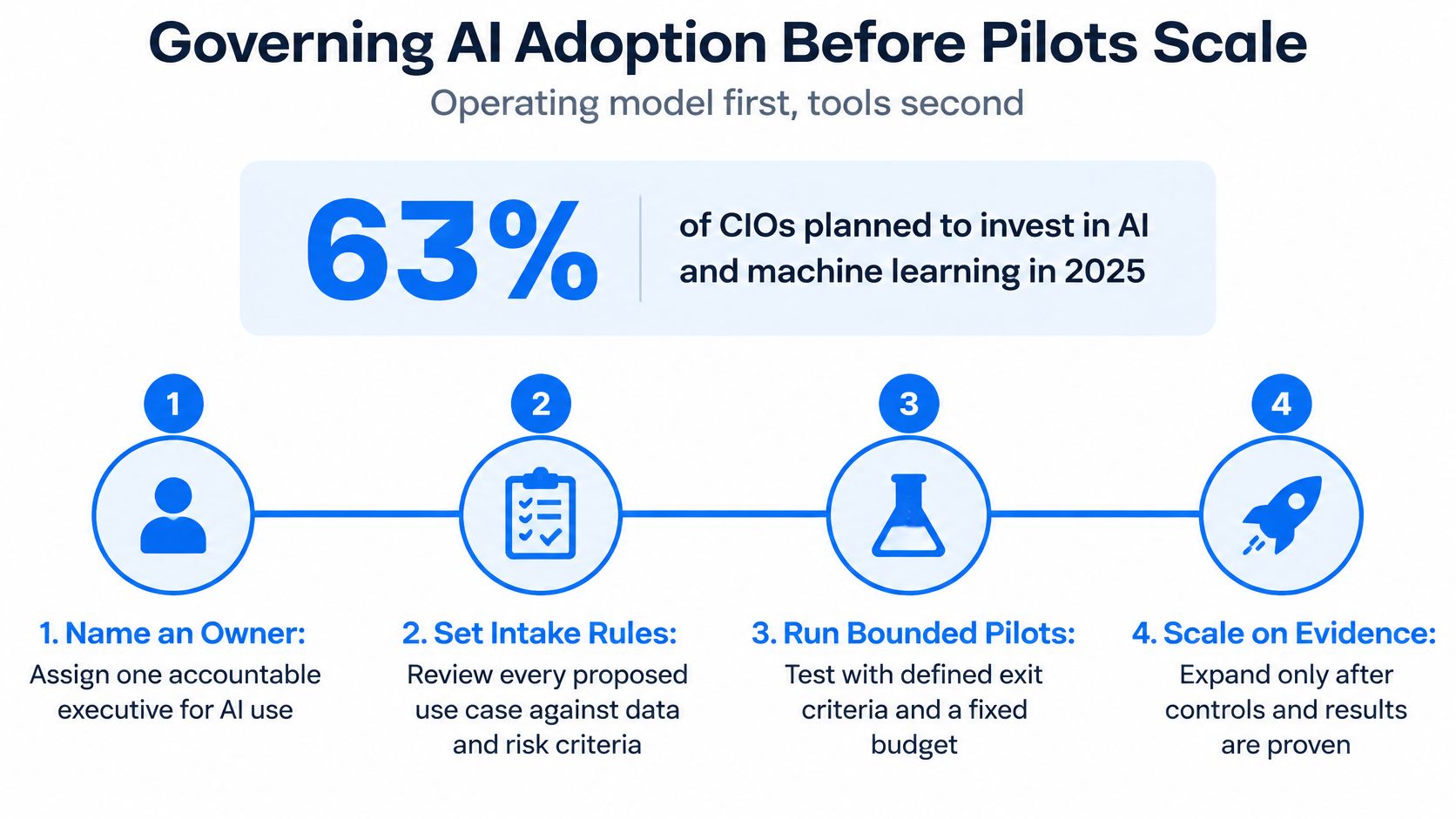
AI adoption is primarily an operating-model problem, not a tool-selection contest. A successful demonstration doesn't establish who owns the output, whether the data is appropriate, or who responds when the system produces a harmful answer.
In Evanta's CIO leadership perspectives, 63% of CIOs planned to invest in AI and machine learning in 2025, while cybersecurity and risk management remained the top priority. The practical response is to establish authority and controls before expanding access.
Use a staged governance launch
Treat this as a recommended implementation sequence, not a deadline for approving deployment:
- Days 1 to 30: Form a steering group with business, IT, security, legal, and data representatives. Inventory existing and proposed uses, establish acceptable-use rules, and assign approval rights.
- Days 31 to 60: Rank use cases by business value and risk. Assign data owners, classify model risk, and inspect supplier terms covering retention, training use, subprocessors, deletion, and access.
- Days 61 to 90: Establish procurement gates, human-review checkpoints, and incident procedures. Capture a benefits baseline and agree on evidence required to expand each pilot.
For an AI-assisted customer-service workflow, measure whether employees resolve cases more accurately and efficiently, not merely whether they use the tool. Define which answers require human approval and how reviewers report incorrect output.
A practical AI transformation plan should connect those controls to changes in workflows and responsibilities. Installing an application doesn't settle either.
Make pausing a legitimate outcome
Pause a pilot when data quality fails agreed acceptance criteria, no business owner accepts responsibility, or employees lack a route for reporting AI errors. A supplier that can't clearly explain its use of client data hasn't passed due diligence.
Stopping an unready pilot is evidence that governance works, not evidence that innovation failed.
Restart only when the owner can demonstrate that the blocking condition has been resolved. Executive enthusiasm isn't a substitute for that evidence.
Hiring Criteria for a vCIO Provider
Interview the person who will lead the engagement, not just the salesperson. Ask candidates to walk through an anonymized decision record, a budget model, and a difficult recommendation they made against a supplier's interests.
Test the operating model
- Relevant experience: Request examples from organizations with comparable complexity and regulatory obligations. Distinguish senior IT leadership responsibility from time spent advising someone else who held authority.
- Independence: Ask about referral payments, resale income, and product quotas. Require written conflict disclosures and an explanation of how competing proposals are evaluated.
- Executive access: Confirm the reporting line to the CEO, CFO, or designated executive sponsor. Put escalation rights and delegated authority in writing.
- Framework fluency: Have the advisor demonstrate how they use NIST CSF, financial scenarios, and risk acceptance in actual deliverables. Framework vocabulary alone proves little.
- Contract quality: Define artifacts, review cadence, availability, ownership of working files, transition assistance, and data-return obligations.
When evaluating an advisor who also coordinates resellers, GoSafe Dark Web monitoring's practical supplier checks for technology resellers can help structure diligence questions. Ask who investigates supplier concerns and who decides whether the organization can accept them.
Demand financial comparisons that survive scrutiny
IDC's CIO Pulse survey reported that 63% of CIOs still plan IT budgets annually. Ask candidates how they maintain rolling scenarios and rebalance the portfolio between budget cycles.
Their comparison of managed services and internal staffing should include loaded compensation, tooling, coverage, recruitment, and turnover costs. Their switching-cost model should include migration, retraining, overlapping subscriptions, termination penalties, and transition support.
Vendor consolidation deserves the same discipline. Fewer contracts may simplify administration while increasing dependence on a single provider. Require the advisor to document that trade-off and name the internal architecture owner after exit.
Ask whether pricing uses a fixed retainer, scheduled hours, or a project fee, what triggers additional charges, and whether any payment component depends on accepted outcomes. Don't accept savings promises without a baseline.
Reject proposals with unmeasured roadmaps, unwritten decision rights, unsupported savings claims, or no exit plan. Attractive presentation doesn't compensate for missing accountability.
Confirm the Scope and Exit Terms Before You Sign
- Name the decisions. List the business choices the engagement must support, such as platform replacement, sourcing, or recovery investment.
- Choose the engagement type. Match the mandate to the immediate trigger and specify when that mandate should change.
- Agree on artifacts and cadence. Select only deliverables executives will use, with clear acceptance criteria.
- Assign internal ownership. Name approval authorities and the person responsible for architecture after departure.
- Define reporting. Specify measures, evidence, review dates, and the executive audience.
- Write the exit clause. Cover editable documentation, data return, access revocation, transition assistance, and outstanding decisions.
- Pilot before extending. Use a bounded initial engagement with a formal go-or-no-go review.
For service-management tooling, the DataLunix guide to Freshservice costs can inform procurement questions. Validate current supplier quotes and include implementation, administration, integrations, and departure costs in your comparison.
Use documented IT vendor management practices to turn the scope into enforceable supplier obligations. A vendor-neutral fractional leadership firm can facilitate this process, but management must approve the mandate.
Extend only when the pilot produces usable decisions, credible evidence, and accountable owners. The scope and handover records should preserve value after the advisor leaves.
MR2 Solutions offers fractional CIO leadership alongside vendor-neutral evaluation, procurement, and technology governance. Visit MR2 Solutions to discuss a scoped engagement built around your pending business decisions, reporting requirements, and exit terms.