
What Is Sovereign Cloud? Meaning, Models and Use Cases

Sovereign cloud keeps data, infrastructure and operations under the control of a specified country, region or legal jurisdiction. If your data stays inside your country but an overseas administrator can access it, how much control do you have?
That question separates a hosting location from a sovereignty commitment. For technology leaders, the useful answer to what is sovereign cloud isn't a provider label. It's evidence that the environment meets your requirements for location, law, administration and technology independence.
Sovereign Cloud Defined in Plain Language
Sovereign cloud is a computing model built around control within a defined jurisdiction. Think of renting a secure locker in a building someone else runs: your belongings may be protected, but the building owner controls entry, maintenance and the building's rules. Owning the building gives you more authority over those decisions.
The analogy has limits. You don't necessarily need to own cloud infrastructure to establish sovereignty, but you do need enforceable authority over the decisions that matter. A provider's promise to keep your files nearby doesn't establish who can administer the service or which authorities can compel disclosure.
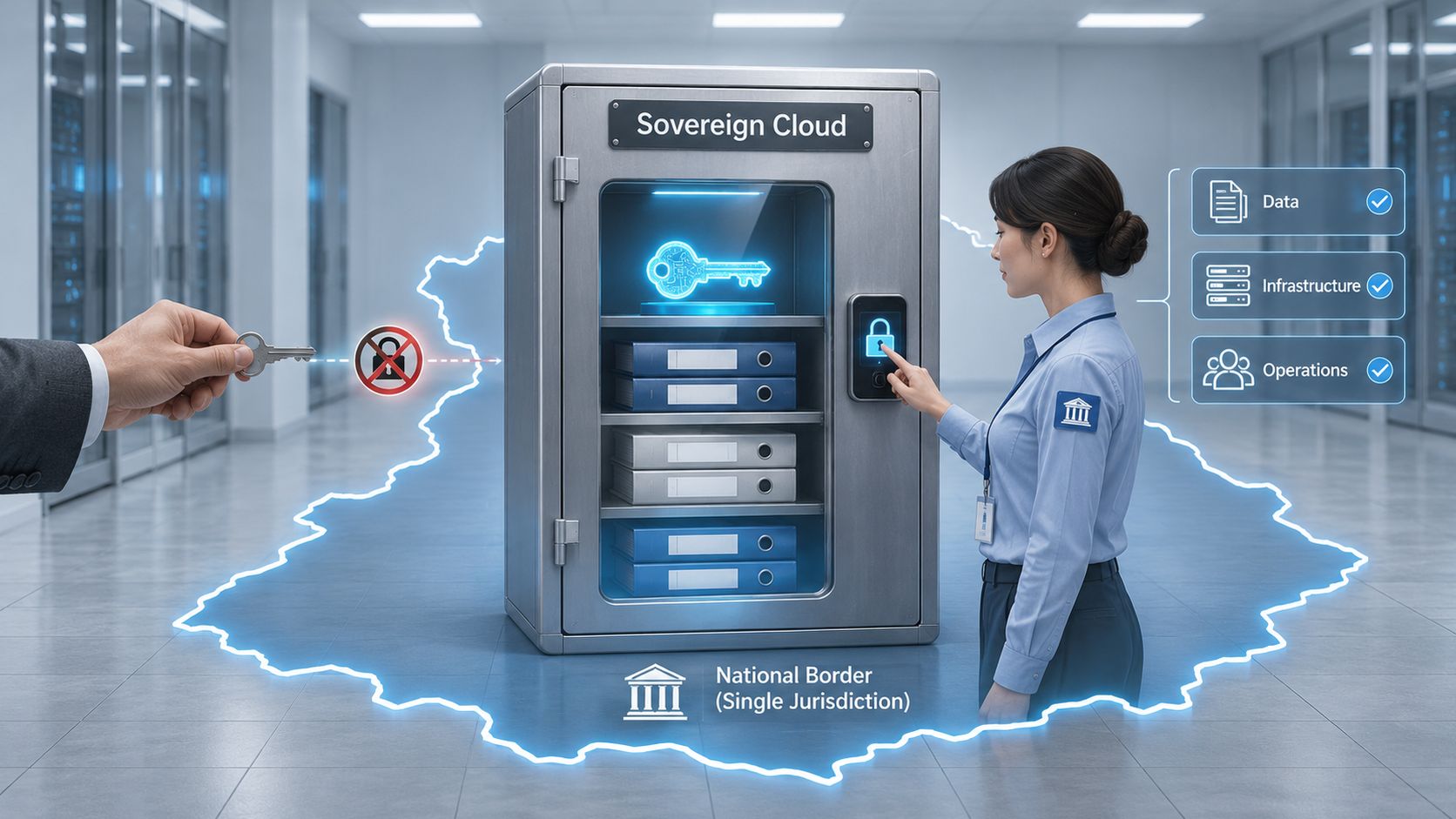
Control means more than ownership
Say a public agency selects a domestic cloud facility. Its procurement team still needs to establish where processing happens, who operates the infrastructure and whether the provider's corporate structure introduces another country's legal authority. These are separate questions, even when the servers share an address.
The European Union Institute for Security Studies analysis of cloud certification describes the competing legal, technical and political expectations behind sovereignty requirements. There's no universally accepted definition, and the necessary safeguards change with the jurisdiction and workload.
A practical way to distinguish models is by their required scope:
- Location-focused model: Storage and processing must remain inside an approved boundary.
- Locally controlled model: Local personnel and entities must control administration and support.
- Strict sovereignty model: Requirements may extend to locally headquartered, majority locally owned providers, independent operations and protection against foreign access requests.
Those models aren't interchangeable certifications. They're useful descriptions of increasingly demanding requirements that buyers must turn into contractual and technical tests.
Sovereign cloud is a set of verifiable conditions, not a single product feature. The right conditions depend on what you're protecting, whose authority applies and which dependencies you're prepared to accept.
Four Sovereignty Dimensions and Why Residency Falls Short
Treat sovereignty as a stack: data residency forms the foundation, legal jurisdiction establishes authority, operational control governs administration, and technology independence addresses your ability to keep operating or leave. Passing a lower layer doesn't prove that a provider passes the layers above it.
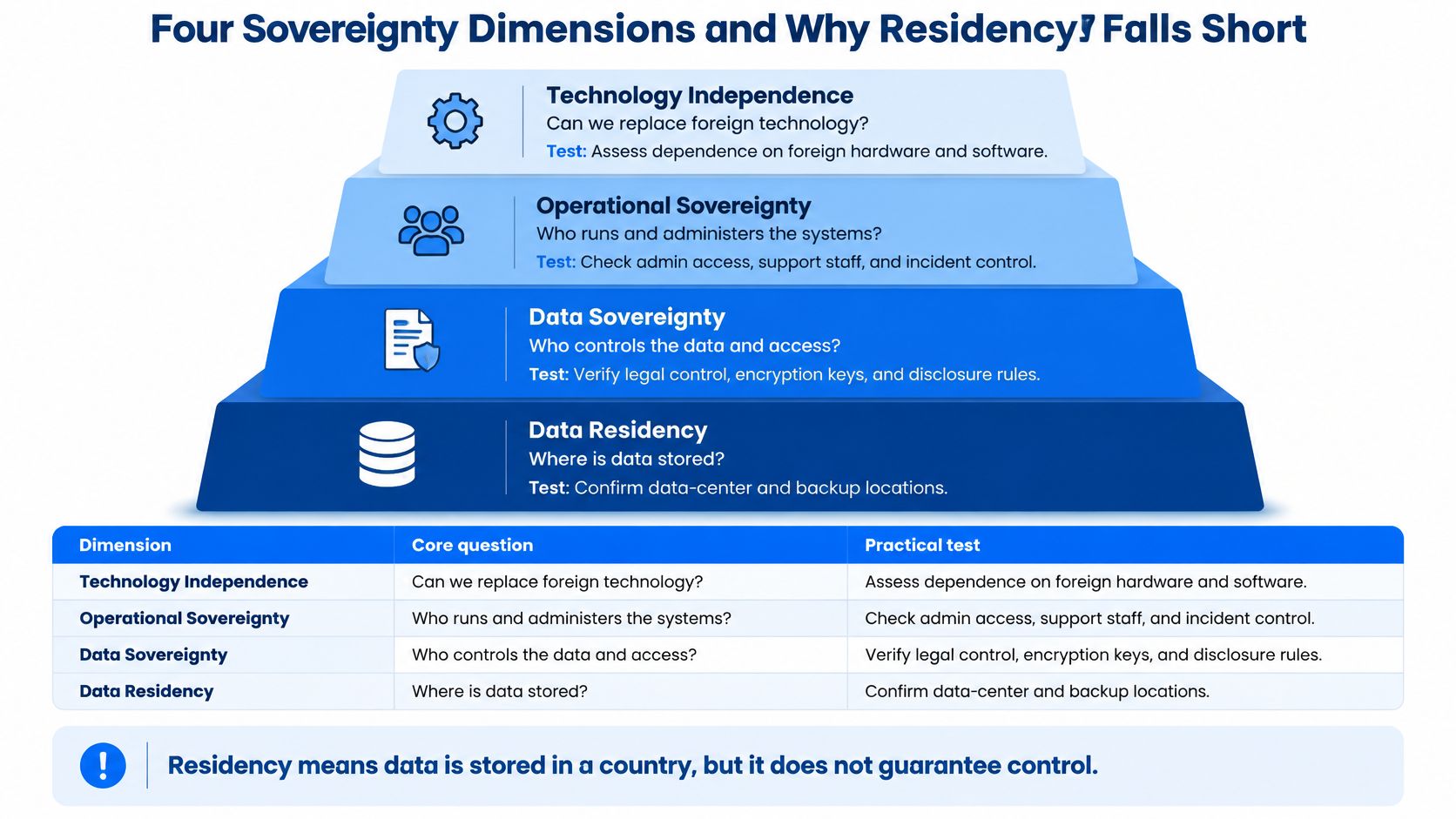
Four sovereignty dimensions, the question each answers and how to test it
| Dimension | Core question | Practical test |
|---|---|---|
| Data residency | Where do production data, backups, metadata and logs sit? | Map every storage, backup and log location |
| Legal jurisdiction | Which laws can compel the provider to disclose data? | Review governing law and foreign-access clauses |
| Operational control | Who can administer, patch and recover the platform? | Check administrator nationality and support escalation locations |
| Technology independence | Can you run, audit and exit without proprietary services? | Test portability and contractual exit assistance |
Residency includes more than the main database. A service can keep customer records locally while sending diagnostic logs, account metadata or backup copies elsewhere. Your boundary must cover storage and processing across the service chain, not just the location selected in a deployment screen.
Legal review examines ownership, governance and enforceable obligations. Operational review examines actual access paths, including subcontractors, emergency support and privileged accounts. Technology review asks whether identity services, updates, hardware maintenance or proprietary application components create dependencies you can't replace.
Assurance is a scale, not a switch
The European Commission's Cloud Sovereignty Framework distinguishes SEAL-0, control by non-EU entities under non-EU jurisdictions, from SEAL-4, complete EU control of technology and operations with no critical non-EU dependencies. That framing makes the degree of control explicit rather than reducing every deployment to a yes-or-no label.
Consider a secure domestic facility whose overseas engineers retain privileged access. It may satisfy the location requirement while failing an operational requirement that administration remain locally controlled. If its essential identity platform also depends on a foreign-operated service, it raises a separate technology-dependency issue.
The European Parliament resolution on technological sovereignty notes that technical controls alone can't resolve extraterritorial legal regimes and calls for a formal definition and scope for sovereign cloud. Encryption is important, but it doesn't settle every question about corporate authority or disclosure obligations.
A highly secure local facility can still be strategically non-sovereign if you can't operate, audit or exit it independently.
Record a result for each dimension. Don't let strong physical security compensate for an unresolved legal or operational failure.
How Sovereign Cloud Differs From Public Cloud
| Factor | Standard public cloud | Sovereign cloud |
|---|---|---|
| Data location | Customer chooses from available regions, potentially across countries | Confined to a defined national or regional boundary |
| Legal exposure | Provider ownership and operating jurisdictions require review | Jurisdiction assessed against your legal and threat model |
| Operator access | May include global support teams and remote administration | Locally controlled personnel with vetted access |
| Encryption keys | Provider-managed or customer-managed options | Customer- or locally controlled, with hardware-backed protection |
| Provider choice | Broad options and access to global scale | Narrower options, potentially higher cost |
| Service breadth | Broad managed-service catalogue, subject to regional availability | Services available within the approved sovereign environment |
These are deployment patterns, not guarantees attached to a category. Public cloud can support demanding security and compliance requirements, and a service marketed as sovereign can still fall short of your obligations. Sovereignty adds constraints to the operating model; it doesn't replace ordinary security engineering.
Operator access changes incident response
A globally distributed support team can be useful when a service fails outside local business hours. However, if your requirements prohibit administration from outside an approved territory, the usual escalation route may be unacceptable. Establish who can troubleshoot the platform when the local team can't resolve an incident.
The important distinction is between a restriction that exists in policy and one enforced through access controls. A contractual promise needs a matching technical design, documented exceptions and audit evidence.
Service breadth changes application design
A sovereign environment may not offer every managed database, analytics feature or integration available elsewhere. That can mean replacing a service, running it yourself or redesigning the application. Compare the complete operating cost, including staffing and recovery, rather than just infrastructure rates.
For example, a hospital might accept a smaller managed-service catalogue to keep its patient-record system under required local control. A startup hosting public product documentation may gain little from the same restrictions and take on unnecessary operational work.
The decision isn't whether one cloud category is better. Ask what class of data is involved, which legal regime applies and who must be able to administer the platform. If ordinary public-cloud controls satisfy those answers, a more restrictive deployment may not be justified.
Common Sovereign Cloud Use Cases
The strongest case for sovereign cloud starts with a workload requirement, not an industry label. A hospital's patient-record application and its public careers website don't automatically need identical controls. Classify the information and service before choosing the environment.
Public services and sensitive records
Government agencies handle citizen records, benefits applications and administrative information. Where local retention, privacy or procurement rules apply, the agency needs an enforceable account of legal authority and operational access. Administrator nationality can become a procurement condition rather than a staffing preference.
Healthcare organizations need to protect patient records and associated clinical information. Where applicable health-data rules restrict storage or processing, the architecture must respect those boundaries throughout the patient's workflow. An appointment platform, laboratory integration and clinical backup process all need review, not just the electronic record database.
Financial services firms handle customer identities, account information and transactions. Their assessment should connect confidentiality with supervisory access, auditability and recovery. A platform that protects records but can't demonstrate a compliant recovery process may still be unsuitable.
Essential services and national security
For defense and national-security workloads, an unacceptable foreign-access path may disqualify a deployment regardless of its performance or price. Operational authority and encryption-key custody deserve particular attention. The relevant security classification and governing requirements should determine the architecture.
Critical-infrastructure operators, including energy and transport organizations, must also consider continuity of essential services. Evaluate whether approved operators can maintain the environment during connectivity disruption and whether recovery depends on an unavailable external service.
- Legal trigger: A law, contract or procurement condition requires particular controls.
- Sensitivity trigger: Disclosure or loss of control creates an unacceptable security risk.
- Supervisory trigger: An oversight body requires demonstrable access, audit or recovery arrangements.
Practical rule: Apply sovereign controls to the workloads that need them, rather than treating an entire organization as a single sensitivity class.
A multi-cloud strategy can separate tightly controlled workloads from services that benefit from broader cloud capabilities. Keep the connections between those environments in scope, especially identity, integration and data transfer.
A workload without regulated or strategically sensitive information usually won't need the strictest sovereignty model. Document that decision rather than assuming either universal restriction or universal freedom.
Controls That Make Sovereignty Work and Their Costs
A sovereign label proves nothing on its own. Each control below answers a different question: who can reach the data, who can operate the platform, where workloads run and where information can travel. A provider can satisfy one of these and fail another, so auditors test each mechanism individually rather than accepting a single designation.
| Control | What it establishes | Operational cost |
|---|---|---|
| Key custody | Customer- or locally controlled encryption keys with hardware-backed protection | Ownership, rotation and recovery procedures for the keys |
| Administrative access | Privileged-access management, personnel vetting and recorded approvals | Enough vetted personnel to cover maintenance and incidents |
| Isolation | Separate workloads and segmented networks to limit unauthorized movement | Ongoing policy maintenance as applications change |
| Outbound restrictions | Policy-based controls on data leaving the approved environment | Filtering rules that need review as integrations evolve |
| Telemetry bounds | Limits on what crash reports, snapshots and diagnostics can export | Validation of data flows during testing, including exceptional events |
| Recovery protection | Immutable local backups and independently tested restoration | Additional local capacity and proof that restores work inside the boundary |
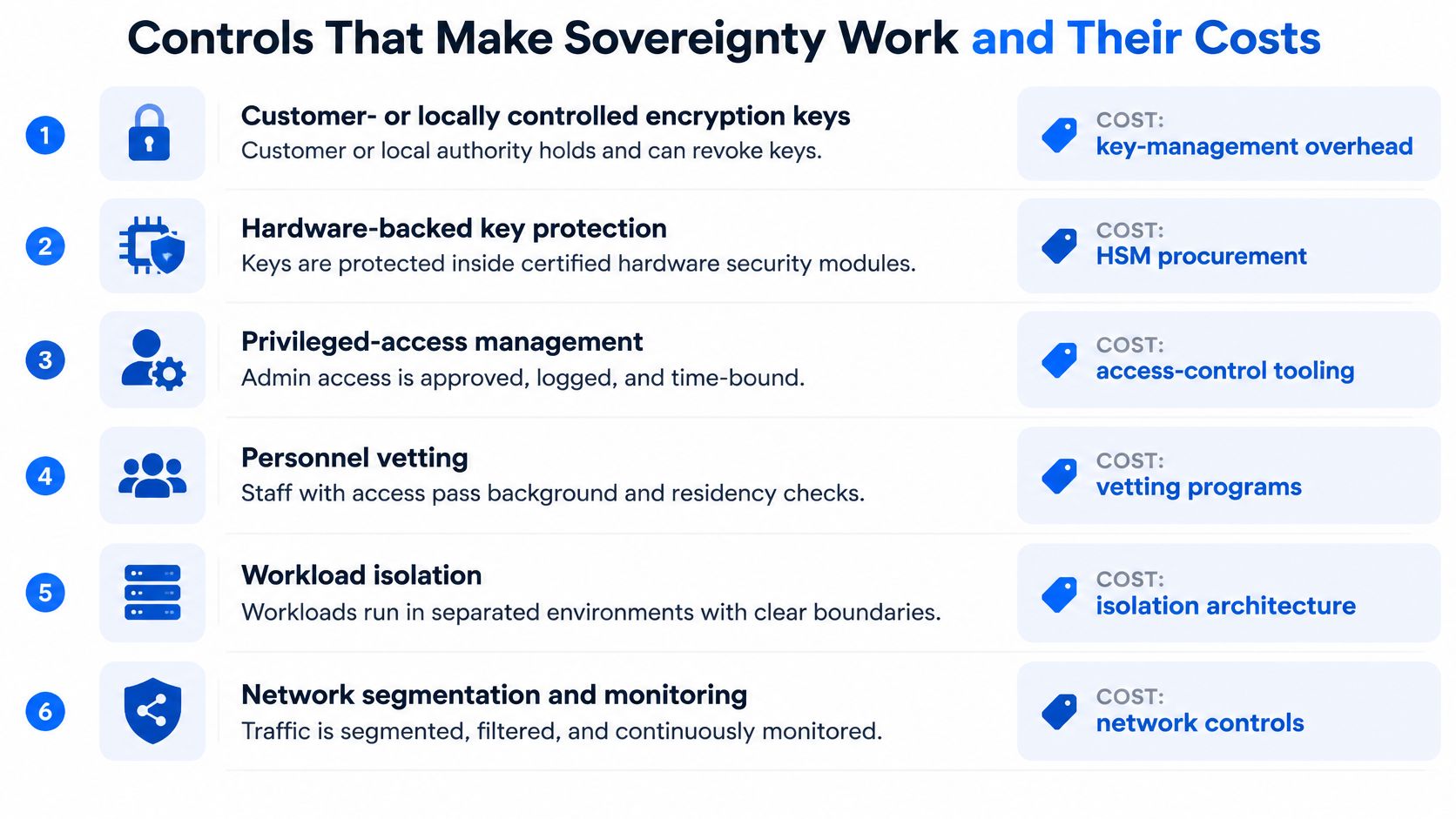
Confinement changes resilience design
The European Commission's implementation guidance identifies strict confinement of storage and processing, with no fallback to third countries, as a criterion for strong sovereignty. An architect cannot assume the usual overseas recovery region remains available.
Confinement works like a spare key that may never leave the property: the backup plan has to live inside the boundary too. An application that fails over into a neighboring country during an outage may improve continuity, yet breach a requirement to remain within national boundaries. The recovery team must instead build sufficient redundancy inside the permitted area and prove it can restore the service there.
Global observability and support tools need the same scrutiny. A locally hosted application can export sensitive details through crash reports, snapshots or diagnostic telemetry. Validate these flows during testing, including exceptional events, rather than relying only on a diagram of normal production traffic.
Budget for the operating work
Key management requires ownership, rotation and recovery procedures. Restricted administration requires enough approved personnel to handle maintenance and incidents. Isolation and outbound filtering require ongoing policy maintenance as applications change.
Connect these activities to your broader approach to compliance in IT security so each obligation has an owner and an evidence trail. Teams building out that wider skill base can find general security coverage through the DilicheckRep cybersecurity resources, while sovereignty evidence itself should come from your provider's audits and contracts.
The architectural trade-offs should be explicit:
- Availability options: Fewer permitted recovery destinations can require additional local capacity.
- Interoperability limits: Approved components may need custom integration work.
- Recovery responsibility: Your team must validate restoration within the boundary, not merely confirm that backups exist.
A control is useful only if someone can operate it under pressure. Include emergency access, key loss and regional disruption in the acceptance tests.
Why the Definition of Sovereign Cloud Keeps Changing
Buying a sovereign label today doesn't guarantee that the same service will satisfy your next procurement cycle. There's no universally accepted global definition, and legal requirements, assurance schemes and sector expectations don't necessarily evolve together.
The European Parliament's legislative tracker for the Cloud and AI Development Act describes a proposed four-level Union cloud-sovereignty assurance scheme, with higher levels requiring independent third-party audits rather than provider self-assessment. A proposal isn't an enacted obligation, but it illustrates why buyers need more than a vendor's own designation.
Procurement needs an upgrade path
Consider a provider that meets a current requirement to keep a workload within an approved region. A later public-sector tender could require evidence about independent operations or impose a stronger assurance level. The provider's existing location commitment wouldn't, by itself, establish compliance with the new condition.
That creates a practical contract question: what happens if your required controls change? Establish whether the provider can supply additional evidence, modify the operating model or support migration without making an application rebuild your only option.
- Map obligations separately: Record national law, sector requirements and contractual commitments without assuming they are equivalent.
- Track assurance scope: Identify which service, location and operating entity an assessment covers.
- Preserve adaptability: Favor documented interfaces, exportable information and feasible replacement paths.
- Assign review ownership: Give legal, security and procurement teams responsibility for monitoring relevant changes.
Don't confuse technical assurance with legal certainty
The continuing debate about extraterritorial authority makes absolute promises especially difficult to assess. A provider can demonstrate restricted access and still need legal analysis of its ownership and obligations. Buyers should distinguish a measurable technical safeguard from a legal conclusion.
Evaluate sovereignty against a jurisdiction, a threat model, an assurance level and a time horizon.
That framing also prevents overbuying. The strongest conceivable control set may unnecessarily restrict geographic flexibility or service choice for a low-sensitivity application. Conversely, a cheap deployment that can't adapt to a known procurement requirement can become expensive to replace.
A durable decision records both what the service proves now and what must change if your obligations become stricter. Periodic reassessment is more useful than treating the original designation as permanent.
Score Providers and Confirm Requirements Before You Buy
Sovereign cloud evaluation scorecard
| Criterion | What to ask the provider | Evidence to request |
|---|---|---|
| Legal control | Who owns and governs the provider? | Ownership structure and governing-law statement |
| Data location | Where do backups, logs and snapshots reside? | Data-flow map covering metadata and backups |
| Operator control | Who administers and supports the platform? | Administrator nationality and access-path documentation |
| Technology dependency | Which proprietary services are hard to replace? | Dependency map across identity, updates and maintenance |
| Exit and recovery | Can you move workloads and recover elsewhere? | Documented exit assistance and a tested recovery procedure |
Use this as a procurement method, not an official certification scheme. Keep the evidence beside each rating so reviewers can distinguish a demonstrated capability from a promise. Our vendor evaluation template can help organize the comparison.
Build a workload-specific decision
Name the applicable regimes. Record the legal, sector and contractual requirements in every relevant operating region. Have legal and compliance owners resolve ambiguous obligations before technical teams select controls.
Classify each workload. Identify its information, business purpose, integrations and sensitivity. Include supporting services that can expose the same information, such as search indexes and support exports.
Set the target assurance and deadline. Define the required control outcomes and when they must be operational. Distinguish mandatory procurement conditions from preferences that can be traded against cost or service capability.
Score documentary evidence. Use a proposed internal scale from zero to three: zero for no evidence, one for a documented commitment, two for implemented controls with supporting records, and three for independently tested evidence. These are suggested evaluation ratings, not regulatory thresholds.
Set minimum results per workload. Don't rely on an average that hides a disqualifying weakness. Mark legal or operational requirements as mandatory where failure would make the service unacceptable.
Put requirements into the contract. Translate the sovereignty dimensions into enforceable commitments, evidence rights and change-notification obligations. Include exit assistance, export formats, responsibilities and a recovery acceptance test.
Reassess after change. Schedule an annual review and rescore after a relevant regulatory change, acquisition, subcontractor change or material architecture revision. Keep the previous assessment so reviewers can see what changed.
Test the decision before committing
For a hypothetical patient-records workload, require strong evidence of approved administration and a demonstrated exit process. For low-sensitivity analytics using properly de-identified inputs, the organization might accept a less restrictive support model. That exception still needs an owner and a documented rationale.
Run a representative migration test before purchase. Export application data, verify configuration dependencies and confirm that another environment can restore the workload. Compare architecture, pricing models and integration capabilities alongside the sovereignty results.
Our TBaaS™ Consulting is a flagship vendor-neutral advisory framework offering structured discovery and curated solutions to simplify complex technology decisions. It helps CIOs, IT leaders and business executives evaluate modernization, cost and operational choices without vendor bias, including comparing architecture, pricing models and integration capabilities before committing to reduce vendor lock-in.
A passing result means the workload meets every mandatory requirement, evidence supports the ratings, and residual risks have named approval. It doesn't mean the provider wins every category. MR2 Solutions can help map those requirements before procurement so the final choice reflects business needs rather than an untested label.
We offer vendor-neutral discovery and technology evaluation to help you translate sovereignty requirements into practical cloud decisions. Visit MR2 Solutions to discuss your sensitive workloads, compare deployment options and establish the evidence you need before procurement.