Multi Cloud Strategy: A Practical Implementation Guide

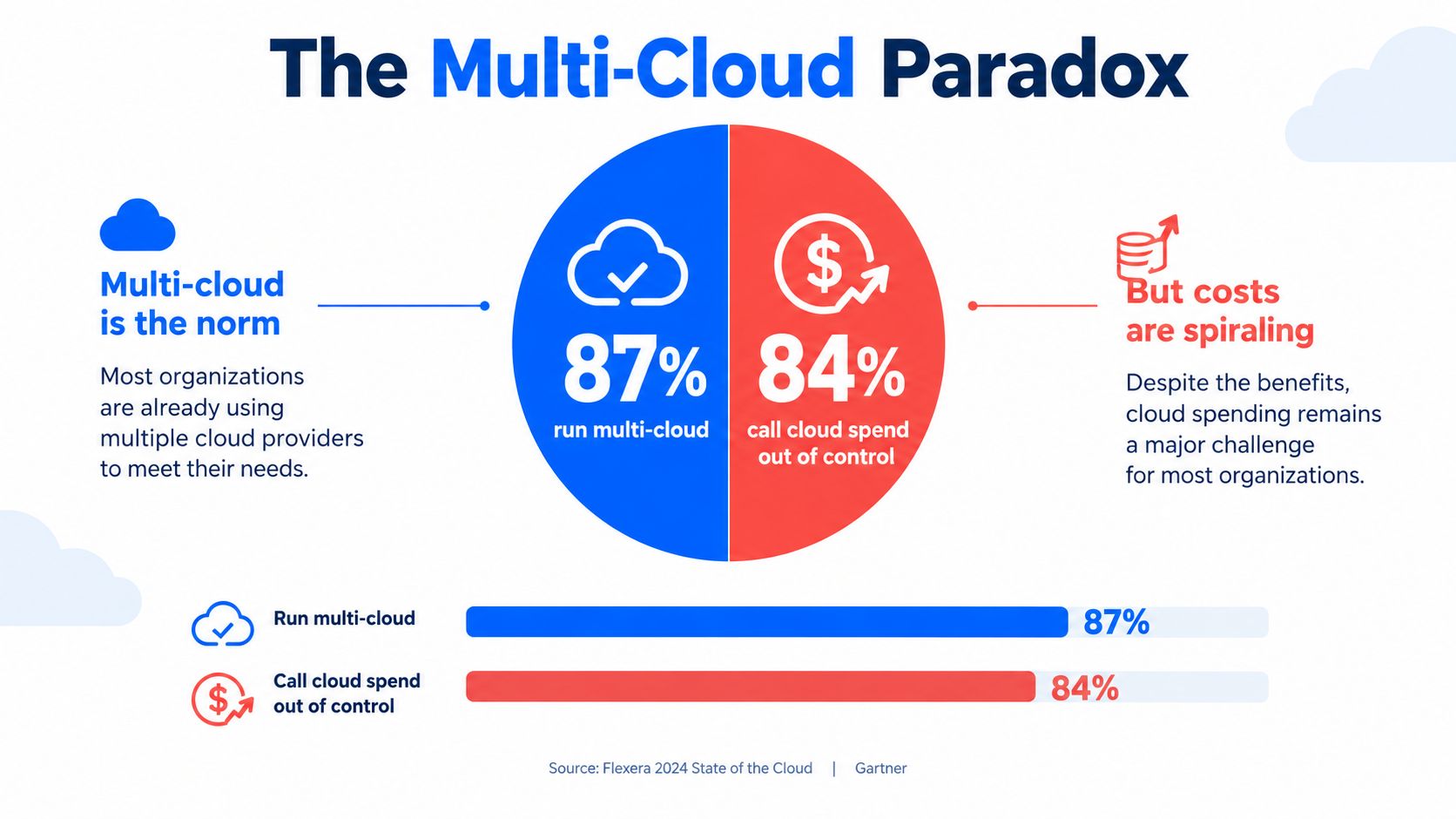
Multi-cloud environments can carry about 30% higher operational overhead than single-cloud environments, even as 87% of organizations report having a multi-cloud strategy. The answer isn't to avoid multiple providers, but to build the governance, FinOps, placement, and exit controls that keep added complexity from outrunning business value.
Multi-cloud has moved from an experimental architecture to a normal enterprise operating model. A 2023 Flexera cloud report found that 87% of respondents had a multi-cloud strategy, while 72% used a hybrid approach combining public and private clouds. This approach can deliver resilience, provider flexibility, regional reach, and access to specialized capabilities. It can also create duplicated identity systems, inconsistent policies, fragmented monitoring, and bills nobody can explain.
The practical question isn't, “Which two clouds should we use?” It's, “Which workloads justify another provider, and what control plane will govern them?” This guide treats multi-cloud strategy as an operating-model discipline. The recommendations focus on workload placement, egress modeling, policy enforcement, financial accountability, phased migration, and a credible way to leave or consolidate a provider.
Why Most Multi Cloud Programs Quietly Fail
Multi-cloud adoption is no longer the difficult part. Operating it consistently is. The HashiCorp State of Cloud Strategy survey found that 76% of more than 3,000 respondents were already working in multi-cloud environments in 2021, and 86% expected to use multi-cloud within two years. Adoption was even stronger among larger organizations, with 90% of companies employing more than 5,000 people already using multi-cloud, compared with 60% of businesses with fewer than 100 employees.
The adoption figures don't prove that multiple clouds create resilience by themselves. They prove that organizations are using them. Independent industry coverage places multi-cloud operational overhead at about 30% above single-cloud environments, while cost control is identified as the top cloud challenge for 82% of organizations, ahead of security at 79%, skills shortages at 78%, compliance at 73%, and governance at 71% (industry coverage of multi-cloud management challenges).
The five patterns behind the failure
Most programs accumulate governance debt before they gain meaningful redundancy. These failure patterns appear repeatedly:
- Vendor-led sprawl: A provider's sales roadmap becomes the architecture roadmap. Teams adopt services because they're available, not because a workload has a documented placement rationale.
- Accidental multi-cloud from M&A: Acquired business units retain their providers, identity directories, networks, and billing structures. The parent company calls the result a strategy before anyone designs a common operating model.
- AI workload drift: Data scientists move training or inference workloads toward specialized services without modeling data movement, access controls, or long-term portability.
- DR-driven duplication: Leaders duplicate production infrastructure in another cloud but don't rehearse failover, validate dependencies, or fund the operational team needed to run it.
- The platform team of one: One architect or engineer becomes the unofficial owner of identity, networking, automation, cost, and incident response across providers. That person eventually becomes the bottleneck.
Practical rule: A second cloud is a business decision only when the workload has a documented reason to use it.
A useful external multi cloud planning guide can help frame the strategic discussion, but planning material won't replace workload-level decisions or enforceable controls. Start with the estate you have, identify the workloads that benefit from provider diversity, and refuse to expand the footprint until ownership and policy are explicit.
Assessing Workloads Before You Add a Second Cloud
Provider selection should follow workload assessment, not precede it. Build a production inventory that includes applications, data stores, integration points, recovery dependencies, owners, regulatory obligations, and the services each workload consumes. Don't accept “cloud agnostic” as a label unless the team can explain how the workload would be rebuilt, tested, and operated elsewhere.
Score the reasons to move
Use four primary axes:
- Data gravity: Record where the authoritative data resides, how often the workload reads and writes it, and whether moving that data creates latency or egress exposure.
- Compliance and residency: Identify sector rules, contractual restrictions, retention requirements, encryption expectations, and approved processing regions.
- Capability fit: Document dependencies on specialized machine learning services, GPU availability, proprietary databases, operating-system support, or deep ecosystem integration.
- Egress and cost sensitivity: Compare steady data movement, burst traffic, replication, analytics, training, and the effect of provider-specific commitments.
Give each axis a score from 1 to 5, then apply weights that reflect the organization's priorities. A regulated data platform might weight compliance more heavily than capability fit. An event-processing service might give latency and data gravity greater influence. The numbers in the matrix are decision scores, not industry benchmarks.
| Workload | Data Gravity (1-5) | Compliance & Residency (1-5) | Capability Fit (1-5) | Egress & Cost Sensitivity (1-5) | Weighted Total | Recommended Placement |
|---|---|---|---|---|---|---|
| Customer transaction platform | 5 | 5 | 3 | 5 | 4.6 | Single primary cloud with tested secondary recovery |
| Analytics warehouse | 4 | 4 | 5 | 4 | 4.2 | Primary-plus-secondary, with controlled data replication |
| AI inference service | 2 | 3 | 5 | 3 | 3.8 | Secondary cloud if capability and latency justify it |
| Internal development environment | 1 | 1 | 2 | 2 | 1.6 | Consolidated placement |
| Regional reporting application | 3 | 4 | 3 | 3 | 3.4 | Provider selected by residency and user latency |
Apply a strict placement rule
If a workload has no clear, quantifiable reason to leave its current cloud, it stays there. This isn't a bias toward consolidation. It's a defense against turning every application into a cross-cloud operating problem.
Most mature programs find that only a subset of workloads justify a second provider. Keep those exceptions visible, funded, and governed. Don't force portability where it adds cost without reducing risk, and don't accept proprietary dependency where the business expects an exit option.
Designing the Reference Architecture
Build the architecture in dependency order. A landing zone is not the first layer in a multi-cloud design. Without unified identity and policy, it creates two well-organized silos.
Start with identity and policy
Create a federated identity plane that connects the organization's identity authority to each provider through standards such as SAML and OIDC. Depending on the environment, that may involve Microsoft Entra ID, Okta, or IAM Identity Center. Establish common role names, privileged-access workflows, lifecycle ownership, service-account controls, and break-glass procedures before teams deploy workloads.
Policy must be expressed in a provider-neutral control model and translated into provider-specific rules. Use policy-as-code with tools such as OPA or Cedar where they fit, then run continuous assessment against a common benchmark. Microsoft's cloud security benchmark overview places governance and strategy at the control layer that sustains security assurance across cloud environments.
Add connectivity, structure, and evidence
Once identity and policy are stable, build the network layer. Use a Cloud WAN or equivalent interconnect design, define routing ownership, standardize segmentation, and document how applications reach shared services. For organizations connecting offices, data centers, and multiple providers, MR2 Solutions' SD-WAN edge services are one option to evaluate alongside other network architectures.
Then establish landing zones, account and subscription topology, naming, tagging, service limits, and separation between production and nonproduction. The landing zone should inherit the control model rather than invent its own exceptions.
Observability comes next. Select one platform, or a deliberately integrated toolchain, that aggregates logs, metrics, traces, security findings, and audit events across providers. A fragmented dashboard makes incident correlation and compliance evidence painfully slow.
Finally, design the data layer and workload orchestration. Use replicated object storage where replication is justified, document the egress budget for each data flow, and automate deployments through infrastructure as code. Workload orchestration belongs last because it depends on the identity, network, account, policy, and evidence layers beneath it.
Building the FinOps Control Plane
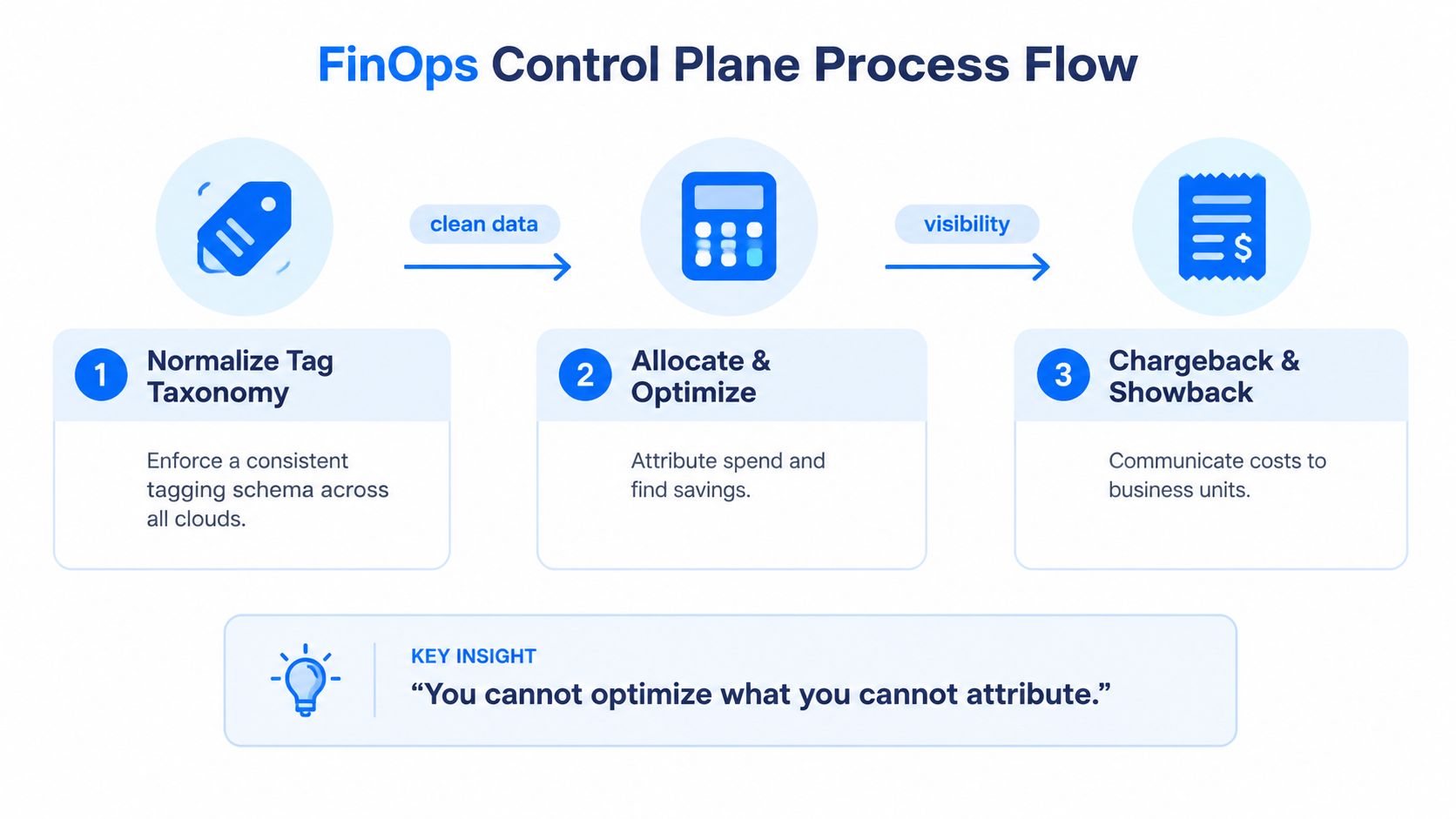
Multi-cloud FinOps fails before the optimization meeting if teams can't attribute spend. Every provider uses different billing structures, service names, discount models, and account hierarchies. A normalized taxonomy turns those incompatible records into a usable management view.
Make tagging a deployment requirement
Define required fields such as business unit, application, environment, owner, and data class. Enforce them through Terraform modules, admission controls, CI checks, and provider policies so resources are created correctly. Retrofitting tags after deployment produces incomplete history and creates arguments over ownership.
Aggregate billing exports into a warehouse or FinOps platform. Tools such as Cloudability, Apptio, Vantage, and native provider tooling can support the process, but the operating rule matters more than the product. Establish daily showback first, reconcile anomalies with application owners, and introduce chargeback only when teams trust the allocation logic.
Model movement, not just compute
Cross-cloud analytics, AI training, backups, and replication can make data movement a material cost and performance concern. Include source, destination, frequency, volume, protocol, regional path, failure retries, and retention in the model. An architecture that looks inexpensive at the compute layer can become unattractive once repeated transfers and duplicated storage enter the calculation.
Commitment discounts also need an enterprise view. Savings Plans, committed-use discounts, and reservations are provider-specific instruments, so procurement teams should compare them against workload stability, migration plans, and exit requirements. Where regulations and contracts permit, third-party brokers or marketplace resellers can provide another purchasing route, but they don't remove the need for internal allocation discipline.
Flexera's 2025 recap reports that cloud spend is the top challenge for 84% of organizations, while 75% cite governance, software licensing, and lack of resources or expertise as top issues (Flexera 2025 State of the Cloud recap). The control plane should expose idle resources, unowned services, unexpected transfer, commitment utilization, and variance against approved budgets.
You can't optimize what you can't attribute.
For organizations that need broader oversight across technology costs, technology expense management from MR2 Solutions is one service category to compare with internal FinOps capabilities and specialist platforms.
Choosing a Governance Operating Model
Governance structure should match engineering maturity. A centralized team can impose consistency quickly, but it becomes a queue. A federated model distributes decisions, but it drifts without automated enforcement. Policy-as-code with delegated autonomy gives product teams speed inside guardrails, but it requires strong platform engineering and delivery practices.
| Model | Consistency | Speed to Ship | Headcount Cost | Failure Mode |
|---|---|---|---|---|
| Centralized platform team | High while the team keeps pace | Slows as demand grows | Concentrated specialist cost | Bottleneck, dependency on a small team, single point of failure |
| Federated cloud center of excellence | Moderate to high with shared standards | Good for domain-led delivery | Distributed cost across teams | Policy drift, inconsistent exceptions, duplicated expertise |
| Policy-as-code with delegated autonomy | High when controls are codified | Fast inside approved patterns | Higher initial engineering investment | Weak pipelines, unclear ownership, guardrails that teams bypass |
Centralized control works early
Use a centralized platform team when the estate is still being standardized or the organization lacks cross-cloud engineering depth. Give the team authority over identity patterns, network connectivity, account structure, logging, baseline policies, and FinOps data. Don't make it the permanent approver for every infrastructure change.
The centralized model breaks when every product team waits for one network engineer, one security architect, or one cloud specialist. At that point, the organization has consistency on paper but slow delivery and growing shadow infrastructure.
Federated ownership scales with discipline
A cloud center of excellence can distribute accountability among application, security, network, finance, and compliance leaders. This works when the group publishes reference patterns, defines exception criteria, and reviews actual control evidence rather than debating architecture preferences.
The weak version is a committee that issues guidance without enforcement. Shared standards must become reusable modules, admission rules, pipeline checks, and dashboards.
Policy-as-code is the destination state
Let product teams deploy independently when pipelines automatically verify identity, encryption, network exposure, tagging, data classification, and logging requirements. OPA, Cedar, Sentinel, and Cloud Custodian can participate in this model, but tools won't compensate for ambiguous ownership or missing remediation paths.
My recommendation is blunt: use centralized governance to establish the baseline, federate domain ownership as teams mature, and invest toward policy-as-code. That combination preserves accountability without making the platform team the permanent gatekeeper.
Running a Phased Migration Without Firefighting
Consider a regulated healthcare analytics workload moving from AWS to Azure while clinical systems remain on AWS. Azure will host a disaster recovery capability and an AI inference tier, but the organization won't move everything to demonstrate that it can operate two clouds.
The migration gates
Phase one, read-only parity: Replicate approved data into Azure without sending production writes there. Validate checksums, schema behavior, query results, access controls, retention, and audit records against the source. Install the same observability agents or equivalent telemetry collection in both environments so the team can compare performance and failures using a common baseline.
Phase two, shadow traffic: Send a defined cohort of production requests to the Azure inference path without making Azure the system of record. Keep the cohort deliberately limited, and connect automated rollback to service-level objective breaches, data-quality failures, security alerts, or unacceptable latency. Don't make a human incident commander decide whether to continue while users are waiting.
Phase three, controlled cutover: Move noncritical analytics components first. Collect compliance evidence, obtain sign-off from security and clinical stakeholders, and only then cut over regulated processing. Keep the original path operational until validation confirms that the secondary path handles the required workload and dependencies.
What the rollback decision should say
A rollback runbook must name the trigger, owner, sequence, communications path, data reconciliation method, and recovery point. Rehearse it before the cutover. A document nobody has executed is an assumption, not a recovery capability.
| Gate | Evidence required | Decision |
|---|---|---|
| Read-only parity | Data validation, access review, telemetry comparison | Proceed, remediate, or stop |
| Shadow traffic | SLO results, error analysis, security findings | Expand cohort or roll back |
| Noncritical cutover | Operational stability and support readiness | Continue waves or pause |
| Regulated cutover | Compliance evidence and formal approval | Authorize or defer |
| DR validation | Rehearsed failover and rollback results | Accept, remediate, or redesign |
Mid-market teams often skip shadow traffic because it feels slower and treat cutover as a one-way door. That shortcut transfers testing into production. For operational support after migration, managed services and operations from MR2 Solutions are one option to evaluate when internal teams lack the capacity to monitor and govern both environments continuously.
Planning Exit, Portability, and Consolidation
Exit planning belongs in the original business case, not in a contingency binder opened after a contract dispute. The Cloud Security Alliance financial services study found that 48% of respondents changed their cloud provider strategy in the previous 12 months. Among the reported actions, 44% migrated workloads between providers, 37% added exit or contingency plans, and 31% consolidated providers.
Those findings describe active portfolio management, not theoretical lock-in anxiety. A provider you can't leave is a provider you can't negotiate with effectively.
Define portability by workload
Portability doesn't mean every application must run identically everywhere. It means leadership understands what would be required to move a workload and has chosen whether that effort is worth funding.
Evaluate each critical workload against these dimensions:
| Portability Dimension | Low Risk (1) | Medium Risk (2) | High Risk (3) |
|---|---|---|---|
| Runtime dependency | Containerized or based on portable runtime | Some provider-specific integrations | Deep proprietary platform dependency |
| Data layer | Replicated, documented, and independently accessible | Partial replication or conversion required | Large, tightly coupled proprietary data store |
| Infrastructure definition | Complete infrastructure as code | Partial automation with manual steps | Manual rebuild or undocumented configuration |
| Identity and access | Federated roles and portable authorization model | Provider-specific mappings require redesign | Embedded identities and opaque permissions |
| Exit execution | Tested runbook and known dependencies | Theoretical plan with open questions | No sequencing, owner, or validation method |
Set consolidation triggers
Consolidation should follow evidence. Define triggers such as sustained underutilization, overlapping services after an acquisition, an unfavorable commitment position, repeated policy exceptions, or operating costs that exceed the workload's business value. Don't consolidate a regulated workload merely to simplify a diagram when residency, certification, or air-gapped recovery requirements constrain the decision.
For each workload, record estimated rebuild effort, data extraction and transfer steps, contractual notice windows, licensing implications, dependency owners, and parallel-run requirements. Sequence data repatriation before application traffic when the data set is large or authoritative. Validate reconciliation, security controls, performance, and operational support before decommissioning the original environment.
A credible exit plan also names the consolidation authority. If no executive owns the decision, provider sprawl will persist because every team can defend its exception indefinitely. Review portability during architecture changes, renewals, acquisitions, and major workload refactors. Multi-cloud strategy remains flexible only when the organization can deliberately rebalance it.
MR2 Solutions helps organizations evaluate, procure, implement, and govern multi-cloud, hybrid networking, security, and technology expense solutions through a vendor-neutral advisory model. Visit MR2 Solutions to assess workload placement, build the control plane, and coordinate the providers needed for a disciplined multi-cloud rollout.