
Procurement in IT: The Modern Leader’s Playbook

75% of business leaders struggle with manual procurement processes, and 63% lack early spend controls. That makes procurement in IT an operational governance gap before it becomes a negotiation problem.
The popular advice is to negotiate harder, collect more bids, and push vendors for a lower price. That advice is incomplete. A cheaper contract can still create uncontrolled renewals, duplicated SaaS, weak security protections, difficult integrations, and expensive exits.
The global procurement software market was estimated at USD 10.06 billion in 2025 and is projected to reach USD 21.29 billion by 2033, with roughly 10.0% compound annual growth from 2026 to 2033, according to Grand View Research's procurement software market analysis. Organizations are not just buying purchasing tools. They're building systems for sourcing, approvals, contract management, supplier collaboration, and ongoing technology control.
The practical question for a CIO isn't, “How do we get the lowest quote?” It's, “How do we make every technology decision deliberate, traceable, secure, and economically sound from intake through retirement?”
Rethinking the Procurement Mindset
Procurement in IT fails when leaders treat it as a transaction instead of a management system. The transaction ends at signature. The risk, cost, and operational responsibility continue through implementation, renewal, support, integration, compliance reviews, and decommissioning.
That distinction matters because technology buying has changed. The shift from mainframes to distributed computing, followed by virtualization, containers, SaaS, and cloud, fragmented IT purchasing into many recurring decisions. The history of enterprise IT procurement shows why modern teams manage a portfolio of subscriptions, services, platforms, and infrastructure rather than a small number of major hardware acquisitions.
The manual process trap
Manual procurement usually begins with good intentions. An employee submits a request by email, a manager approves it in a chat message, procurement asks for quotes, IT performs a security review, legal edits the contract, and finance discovers the purchase after the invoice arrives.
Each handoff creates a control gap. Nobody has a complete view of the request, its business owner, its data access, its renewal date, or its relationship to existing tools. The organization may negotiate successfully and still lose control after purchase.
The evidence is direct. Ramp's 2025 survey found that 75% of business leaders struggle with manual procurement processes and 63% lack early spend controls. The issue isn't merely slow sourcing. It's fragmented intake, approval, and policy enforcement across SaaS, cloud, and services, as discussed in this enterprise IT sourcing analysis.
Practical rule: If your team can't explain who requested a technology purchase, why it exists, who owns it, and what happens at renewal, the procurement process hasn't finished.
Replace price-first thinking
Price still matters. It just shouldn't be the first or only decision criterion. A low license fee may conceal implementation work, integration dependencies, premium support charges, migration effort, restrictive exit terms, or a second platform that duplicates capabilities you already own.
A stronger operating model evaluates the intended business outcome, the architecture fit, the risk profile, and the full lifecycle cost before negotiating commercial terms. Leaders who want a useful grounding in enterprise workflows can review these practical SAP procurement insights alongside their own intake and approval design.
The shift is simple to state but demanding to execute: stop asking only whether a vendor offers a good deal. Ask whether the organization can govern the decision after the deal is signed.
The Brokerage Framework for Governance
Technology Brokerage-as-a-Service, or TBaaS, provides a practical model for making procurement a governed capability. It separates the work into three connected pillars: People, Process, and Portfolio.
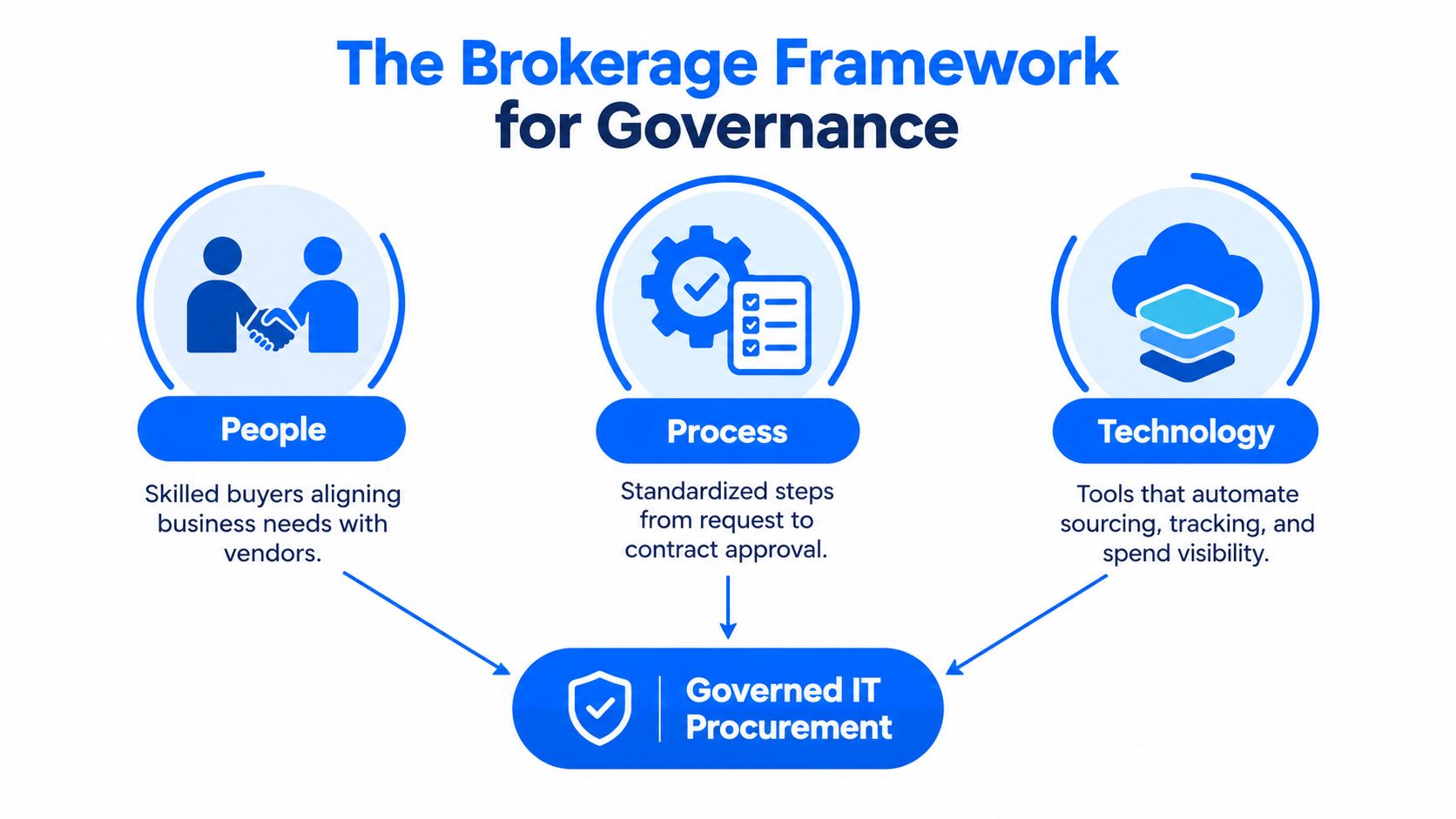
The framework doesn't require every organization to build a large internal department. A mid-market company may combine internal owners with fractional leadership, specialist advisers, managed services, and a curated provider ecosystem. The important point is that the capability must be explicit. Someone must own the decision quality.
People create judgment
The People pillar assigns the right expertise to the decision. A software buyer may understand commercial terms but miss identity architecture. An infrastructure architect may understand integration but overlook renewal mechanics. A security leader may identify control weaknesses without knowing whether the proposed service duplicates an approved platform.
A brokerage model brings those perspectives together without forcing one vendor to define the problem. The working group should include:
- Business ownership: Define the outcome, users, constraints, and success conditions.
- Technology expertise: Test architecture, integration, data flows, interoperability, and operational fit.
- Security and compliance: Evaluate access, data handling, resilience, auditability, and regulatory obligations.
- Commercial discipline: Compare pricing structures, contractual protections, renewal terms, implementation commitments, and exit costs.
The team doesn't need to overengineer every purchase. It does need a proportional review path so a routine standardized buy doesn't receive the same treatment as a platform that touches sensitive data or critical operations.
Process creates repeatability
Process turns professional judgment into a system other people can follow. Start with a single intake channel. Capture the requester's objective, required capabilities, data classification, users, expected term, budget owner, existing alternatives, and deadline.
Then apply decision gates:
- Clarify the need: Convert a product request into a business and technical requirement.
- Check the portfolio: Identify existing licenses, preferred suppliers, approved architectures, and overlapping capabilities.
- Classify risk: Route the request according to security, operational, financial, compliance, and concentration risk.
- Select the sourcing path: Use a proportionate evaluation rather than defaulting to a full RFP.
- Record the decision: Preserve assumptions, scoring, approvals, exceptions, and contract obligations.
- Manage the outcome: Track implementation, performance, spend, renewal, and retirement.
This creates an auditable path without turning every request into bureaucracy.
Portfolio makes context visible
A portfolio view answers questions a contract file can't. Which vendors support a critical business process? Where do several teams buy similar tools? Which subscriptions renew soon? Which suppliers have access to sensitive information? What happens if one provider fails?
The portfolio is also where architecture and procurement meet. A vendor that looks attractive in isolation may increase integration complexity or create concentration risk. A slightly more expensive option may align with existing identity, data, monitoring, and support capabilities.
Govern the portfolio, not just the purchase order.
Alternatives to the Traditional RFP
The RFP is useful when the requirement is complex, the market needs a formal comparison, and the organization must document a defensible competitive process. It becomes wasteful when teams use it for every standardized technology purchase.
Public-sector benchmark data illustrates the difference. The median cycle time for an IT sole-source procurement was 5 business days, compared with 12 business days for an IT small purchase and 90 business days for an IT invitation for bids, according to Speclens' procurement KPI benchmark. The same benchmark reported a 30-month median initial IT contract length, a useful reminder that contract duration should support ongoing market testing rather than lock the organization into avoidable dependence.
Match the path to the risk
A tiered sourcing model is more effective than a universal RFP requirement.
| Buying situation | Appropriate path | Governance focus |
|---|---|---|
| Standardized, low-risk product or service | Approved catalog, benchmarked quote, or sole-source justification | Price reasonableness, approval, and portfolio fit |
| Moderate complexity with several viable suppliers | Structured comparison or short-form RFQ | Functional fit, integration, service levels, and commercial terms |
| Critical platform, sensitive data, or major transformation | Formal RFP or competitive bid | Architecture, resilience, security, implementation, TCO, and exit strategy |
The fastest path isn't automatically the least rigorous. A well-designed sole-source record can document why a known platform is appropriate, what alternatives were considered, and which commercial protections still need negotiation. Conversely, a long RFP can produce a false sense of diligence if the requirements are vague or the evaluation team lacks technical expertise.
Improve the work, not just the document
Formal bids often consume time because teams start with a template instead of a decision. Before issuing anything, define the few requirements that clearly differentiate suppliers. Separate mandatory controls from preferences, specify how responses will be scored, and decide who has authority to resolve trade-offs.
For teams that still need to produce formal bid documents, Bidwell's bid writing tool can support the drafting workflow. It shouldn't replace requirement ownership, security review, or commercial judgment.
The same discipline applies to managed services. Buyers evaluating managed IT services cost should compare scope, response obligations, escalation, tooling, transition support, and termination assistance, not just the monthly fee.
A good sourcing path is the shortest route that preserves the controls the decision requires.
Mastering Lifecycle Cost Models
A discount at contract signature doesn't prove value. IT leaders should model Total Cost of Ownership, or TCO, as a lifecycle decision metric that includes acquisition, operation, and end-of-life costs.
Independent literature reviewed in research on TCO and technology supplier selection describes TCO as a combination of one-time acquisition costs, recurring operating costs, and disposal or end-of-life costs. That approach is more useful than comparing initial quotes because implementation, maintenance, support, and decommissioning can dominate the economics over the useful life of a technology.
Build the cost model before the negotiation
Start with the cost drivers that the vendor's proposal may separate across different documents:
- Acquisition: Licenses, subscriptions, hardware, onboarding, configuration, and professional services.
- Implementation: Internal project time, data migration, integrations, testing, training, and change management.
- Operation: Support tiers, maintenance, usage charges, administration, monitoring, storage, and connectivity.
- Expansion: Additional users, environments, modules, consumption, geographic coverage, or premium features.
- Exit: Data export, replacement systems, migration services, contract termination, and secure decommissioning.
Assign an owner to each assumption. If the business can't estimate internal implementation effort, record that uncertainty instead of treating it as zero. If pricing depends on usage, model how demand could change and identify the threshold at which the commercial structure becomes unattractive.
Negotiate the expensive parts
Procurement teams often spend too much energy reducing the initial quote and too little time controlling recurring exposure. Negotiate price, but also negotiate usage definitions, renewal mechanics, price adjustment language, service credits, support response, implementation milestones, data portability, termination rights, and assistance with transition.
Commercial test: The strongest contract makes future cost and future choices visible.
Use the TCO model during vendor evaluation, not after a preferred supplier has already won. A vendor with a higher starting price may offer a better lifecycle position if it reduces integration work, simplifies administration, or provides credible exit support. A low starting price may be poor value if the organization needs expensive customization to make the product usable.
For ongoing visibility, technology expense management should connect invoices, contracts, users, assets, renewals, and consumption data. That gives finance and IT a shared view of whether the organization is paying for what it still needs.
Navigating Risk and Vendor Complexity
IT procurement is now an architecture and risk decision with commercial consequences. A supplier can offer an attractive price and still introduce unacceptable exposure through weak security, opaque AI behavior, regulatory gaps, operational fragility, or dependence on a concentrated provider ecosystem.
The 2025 to 2026 procurement environment reflects that shift. Procureability's procurement outlook identifies technology complexity, cybersecurity, supplier pricing power, budget constraints, misaligned systems, and incomplete technology as central procurement challenges. Deloitte's CPO research describes procurement as being at an inflection point driven by generative AI and agentic AI, while market commentary highlights concerns about AI integration and opaque software publisher pricing.
Evaluate the dependency, not only the supplier
A vendor review should examine the relationship the organization is about to create. Ask:
- What business processes stop if the service becomes unavailable?
- Which data enters the platform, and how does the supplier use it?
- Can the organization export data in a usable format?
- Which subcontractors support delivery?
- Does the supplier depend on another cloud, identity, or data provider?
- What happens if pricing changes or a key feature moves into a higher tier?
- How many critical functions would depend on the same provider?
This analysis exposes vendor concentration risk, which a standard feature comparison often misses. It also forces the team to consider resilience at the architecture level. A backup supplier may not help if every alternative depends on the same underlying platform.
Put controls into the contract
Security and compliance cannot remain informal promises from a sales call. Require evidence appropriate to the service, define notification and cooperation obligations, establish access and audit expectations, and make responsibilities clear between the customer, primary supplier, and subcontractors.
Use a risk-based delivery strategy to match controls to the consequences of failure. A low-impact internal tool may need a light review. A system supporting regulated data, customer operations, or critical infrastructure demands deeper validation, stronger contractual language, tested continuity arrangements, and named executive ownership.
The compliance requirements for IT security should be translated into procurement questions before supplier selection. Waiting until implementation often means the organization has already accepted an architecture that cannot meet its obligations without expensive rework.
The right vendor is not simply affordable. The right vendor is governable when conditions change.
Building a Future-Proof Strategy
A mid-market organization usually doesn't need a dramatic procurement redesign. It needs a controlled operating rhythm that prevents reactive buying from becoming permanent.
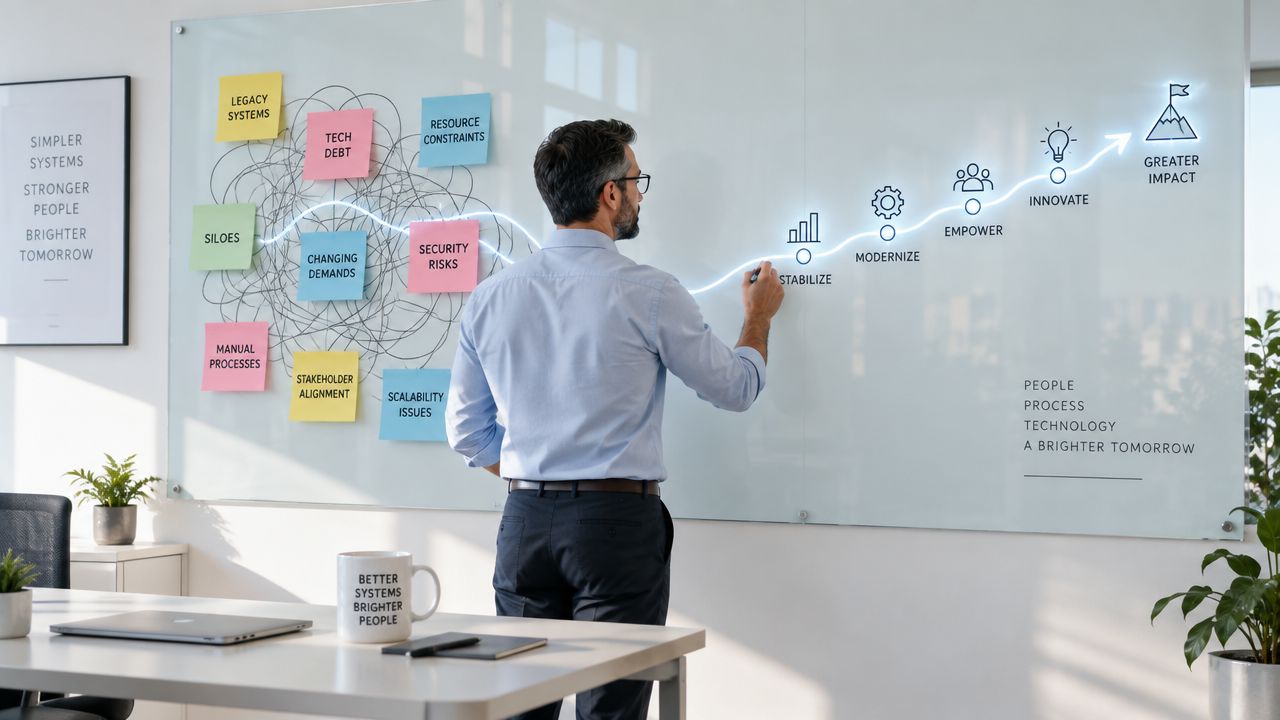
Consider a company with separate teams purchasing cloud services, collaboration tools, security products, and managed infrastructure. Each team may be acting reasonably, but the organization has no shared intake, no dependable portfolio record, and no consistent renewal calendar. A new AI initiative then adds more suppliers, more data flows, and more contractual dependencies.
A brokerage model changes the sequence. The business starts with an outcome, not a preferred product. A cross-functional group establishes requirements, checks the current portfolio, classifies risk, and selects an appropriate sourcing path. The commercial review uses lifecycle economics, while security and architecture teams define essential controls before the shortlist is finalized.
Make governance part of delivery
The contract is only the midpoint. Assign a business owner and technical owner, confirm implementation milestones, document integrations, track service performance, and schedule renewal decisions early enough to preserve options.
A future-proof strategy also treats AI and cloud as governed portfolio capabilities. New tools should pass through the same questions as any other technology: What problem does this solve? What information does it access? Who validates its output? How does it fit the target architecture? What is the exit plan?
MR2 Solutions offers Technology Brokerage-as-a-Service, including vendor-neutral discovery, evaluation, procurement, implementation coordination, and ongoing technology governance. Its broader services include fractional IT and security leadership, cybersecurity, managed services, technology expense management, and project coordination.
Use a practical operating cadence
Build the capability around a small set of recurring management activities:
- Weekly intake review: Resolve new requests, identify duplicates, and assign accountable owners.
- Monthly portfolio review: Examine active vendors, spend visibility, risks, performance, and unused capability.
- Quarterly renewal planning: Review upcoming renewals, usage, alternatives, contract position, and exit readiness.
- Post-implementation review: Compare the delivered service with the original business case and record lessons for future decisions.
The result is not slower procurement. It is fewer surprises, clearer accountability, and better alignment between technology investment and business direction. Procurement becomes part of the organization's operating backbone rather than an administrative checkpoint at the end of a buying process.
MR2 Solutions helps organizations evaluate, procure, implement, and govern IT through a vendor-neutral Technology Brokerage-as-a-Service model. Visit MR2 Solutions to discuss your procurement controls, technology portfolio, vendor risks, and lifecycle cost decisions with an experienced technology brokerage team.