
Sd Wan Gateway
Most advice about an SD-WAN gateway starts with throughput, tunnel scale, and latency. That's the wrong starting point for a CIO. The gateway is where encrypted overlays terminate, routes are aggregated, policies are enforced, and traffic crosses the boundaries that matter to auditors, security teams, and business continuity planners.
A gateway can make a distributed WAN simpler to operate. It can also concentrate risk into an outage domain you haven't properly documented. Placement affects where sensitive traffic travels, who patches the software, how quickly a failed node is replaced, and whether a brownout triggers a controlled failover or a disruptive rebalance. Treat the gateway as a governance decision with networking consequences, not as another checkbox on a connectivity bill of materials.
Why the SD-WAN Gateway Deserves More Attention Than It Gets
Vendor diagrams often reduce the gateway to a cloud icon between branches and applications. That portrayal hides its real importance. The gateway is the point where tunnel termination, route distribution, segmentation, service insertion, and path policy converge. It determines more about your failure boundaries and audit obligations than the marketing slide usually admits.
The market's growth makes this oversight harder to justify. One estimate valued the global SD-WAN market at USD 2.9 billion in 2021 and projects USD 30.4 billion by 2030, implying a 30.9% CAGR from 2022 to 2030, while another forecast places the market at USD 7.91 billion in 2025 and USD 21.67 billion in 2030, with a 22.3% CAGR over that period. These are projections from Grand View Research's SD-WAN market analysis, not reasons to buy a particular platform. They do show why gateway architecture has become a board-level infrastructure concern rather than a niche networking detail.
Large enterprises accounted for more than 71.0% of revenue in 2021, according to the same market reference. Enterprise adoption also accelerated quickly. TeleGeography data cited by SDxCentral's SD-WAN adoption analysis projected SD-WAN at 61% of WAN sites for the 5,000 largest global enterprises by the end of 2023, rising to 81% by 2026. The important conclusion isn't the forecast itself. It's that more organizations now depend on gateway behavior during cloud outages, underlay degradation, and policy changes.
Architect's rule: If the RFP scores a gateway only on throughput and concurrent tunnels, the RFP is incomplete.
A neglected gateway design can create data sovereignty drift, inconsistent failover between regions, and rebalance events that move traffic into an unacceptable jurisdiction or overloaded provider PoP. Teams exploring the foundations of programmable networking can use this SDN explained for small businesses resource for background, but enterprise gateway selection needs to go further. It must connect control-plane behavior to legal, operational, and financial exposure.
What an SD-WAN Gateway Actually Does
Think of the gateway as a regional airport hub. Branches are smaller airports, encrypted tunnels are incoming flights, and applications in clouds or data centers are onward destinations. The gateway receives the traffic, applies security and routing decisions, and sends it through the appropriate connection rather than forcing every journey through headquarters.
A branch edge establishes overlay tunnels toward the gateway, commonly using IPsec and, depending on the platform, other tunnel mechanisms such as GRE. The gateway terminates those sessions and maintains the routing relationships needed to reach other branches, private networks, cloud workloads, or the public internet. In a multicloud design described by Cisco's SD-WAN multicloud reference, each edge builds two IPsec VPNs to an AWS Transit Gateway for resiliency. When the design spans two availability zones, that produces four VPN connections for the paired arrangement.
The gateway's operating layers
The data plane carries packets. It handles tunnel encryption and decryption, forwarding, NAT, firewall inspection where supported, and traffic steering. The control plane distributes reachability and policy information, helping edges learn where destinations live and which paths are preferred.
That separation matters during an incident. A control-plane decision can change the preferred route without rebuilding every forwarding session. A data-plane failure, by contrast, can interrupt established flows unless the platform and application tolerate the transition. Buyers should ask vendors to demonstrate both behaviors rather than accepting a generic claim of “automatic failover.”
A gateway also supports services that a simple pass-through router doesn't provide:
- Tunnel aggregation: It terminates overlay sessions from multiple branch edges.
- Policy enforcement: It applies segmentation, access rules, and application-aware routing.
- Route coordination: It distributes paths for branch-to-branch, cloud, and data-center traffic.
- Internet breakout: It can send selected traffic directly to the internet instead of hairpinning it through a central site.
- Service insertion: It can steer flows through firewall, inspection, or other network services.
Fortinet's enterprise secure SD-WAN architecture reference describes these gateway roles, including IPsec dialup service, centralized routing, firewall protection, and remote internet breakout. For a practical explanation of how the broader architecture fits together, see how SD-WAN works.
The gateway usually isn't a physical box sitting beside a branch router. It's commonly software running in a provider PoP, a cloud environment, a customer data center, or a regional colocation facility. That flexibility is useful, but it shifts the procurement question from “which appliance?” to “which operating location and failure domain can we govern?”
SD-WAN Gateway vs Edge Device in Plain Terms
Consider a retailer with 40 sites, local internet needs at each branch, and headquarters plus three regional hubs that require deterministic access to SAP and AWS. The branch edge and the regional gateway have different jobs. Combining them may look efficient on a diagram, but it usually makes failure analysis and segmentation more difficult.
The edge device sits near users, phones, payment systems, and local servers. It manages underlay links such as broadband, private circuits, or cellular connectivity. It can provide local LAN services and break out approved internet traffic close to the users.
The gateway sits at a regional, cloud, or provider hub. It handles many incoming tunnels, coordinates routes between sites, applies cross-site policy, and directs traffic toward cloud or private workloads. It's the aggregation point, not merely a larger branch router.
| Function | SD-WAN Gateway | Edge Device |
|---|---|---|
| Tunnel scope | Terminates tunnels from many branches or remote sites | Builds tunnels toward gateways, hubs, or peers |
| Policy scope | Applies regional, cross-site, cloud, and service-insertion policy | Applies site-level access, QoS, and local breakout policy |
| NAT | Performs centralized or service-specific translation where required | Performs branch NAT for local internet and LAN services |
| Internet breakout | Provides regional or cloud egress for selected traffic | Provides direct local breakout when policy allows |
| Routing | Aggregates routes and advertises cloud, data-center, and branch reachability | Advertises local subnets and consumes centrally distributed routes |
| Failure role | Defines a major regional or cloud outage domain | Limits failure to a branch when redundant paths exist |
The distinction becomes critical when SAP traffic must follow a controlled path while ordinary web traffic exits locally. The edge can classify the application and send the flow toward the appropriate gateway. The gateway can then enforce the regional route, inspect the traffic, or hand it to AWS through the selected cloud attachment.
The edge protects the site's autonomy. The gateway protects the organization's shared policy.
A gateway may still provide local breakout, but that doesn't make it an edge device. Its breakout serves a broader population and creates a larger operational consequence if the egress policy is wrong. A misconfigured branch NAT rule affects one site. A misconfigured regional gateway policy can affect every site attached to it.
Teams comparing branch architectures should review SD-WAN edge options alongside gateway design. The practical default is separation: keep site functions at the edge, keep aggregation and shared policy at the gateway, and document the exceptions instead of allowing the platform's default topology to decide for you.
Where Gateways Live in a Modern WAN
Placement determines more than packet distance. It decides who patches the gateway, where traffic is inspected, which jurisdiction handles the data, and how much of the network fails when a node or provider location becomes unavailable.
Provider PoP gateways
A provider PoP is operationally attractive. The carrier or SD-WAN provider hosts the gateway close to its backbone, manages much of the infrastructure, and can offer regional diversity without forcing your team to operate every virtual instance.
The trade-off is control. You may accept a small amount of additional path distance in exchange for simpler operations, but you need contractual visibility into data location, maintenance windows, software versions, and failover behavior. Ask whether a rebalance can move traffic between countries or inspection zones without an explicit customer policy.
Cloud transit gateways
Cloud placement works well when applications already live in the same cloud ecosystem. An AWS, Azure, or GCP hub can place routing and inspection close to workloads and reduce unnecessary trips through a data center.
Cloud gateways still need disciplined route-table design. A cloud region can become a convenient aggregation point and a concentrated outage domain at the same time. Keep application, inspection, and management paths distinct where the platform supports it, and confirm how the gateway behaves when a cloud attachment or availability zone becomes impaired.
Data-center gateways
A data-center gateway remains sensible when heavy east-west traffic, regulated workloads, legacy systems, or existing private WAN contracts anchor the network on premises. It provides direct access to firewalls, storage, identity systems, and older routing domains.
It also preserves old operational burdens. Your team owns the maintenance window, hardware or virtualization capacity, replacement process, and physical failure model. Don't call this “high availability” until you've tested the loss of power, hypervisor capacity, upstream routing, and the inspection service behind the gateway.
Regional hub gateways
A regional hub near a cluster of branches can provide a useful middle ground. It keeps tunnel termination close to users, creates a clear failover anchor, and can connect to cloud and data-center networks without making every branch a direct participant in every routing decision.
The danger is hidden centralization. A regional hub becomes a single point of policy failure if both gateway instances share the same host, power domain, provider circuit, or software lifecycle. Model the outage domain as a physical and administrative boundary, not as a count of virtual machines.
| Placement Pattern | Typical Latency Cost | Sovereignty Control | Failover Domain | Patch Ownership |
|---|---|---|---|---|
| Provider PoP | May add path distance to the provider location | Contract and provider policy | Provider region or PoP group | Usually provider-led, subject to service terms |
| Cloud transit | Often efficient for workloads in the same cloud region | Stronger tenancy and region selection | Cloud region, zone, or attachment group | Shared between provider and customer, depending on service |
| Data center | Efficient for on-premises applications | Highest direct control | Facility, campus, or upstream network | Customer or managed-service operator |
| Regional hub | Usually close to branch clusters | Depends on colocation and jurisdiction | Regional facility and its carriers | Customer, colocation operator, or service provider |
There is no universally correct location. The correct choice is the one whose latency, sovereignty, ownership, and failure boundaries match the applications and regulatory obligations. Put those criteria into the architecture decision before comparing license prices.
Connecting Gateways to Cloud and On-Prem Networks
A gateway should be a policy point, not just a tunnel endpoint. The cleanest designs make cloud attachments, inspection paths, and on-premises routing explicit, so an incident doesn't force engineers to infer the intended topology from scattered route tables.
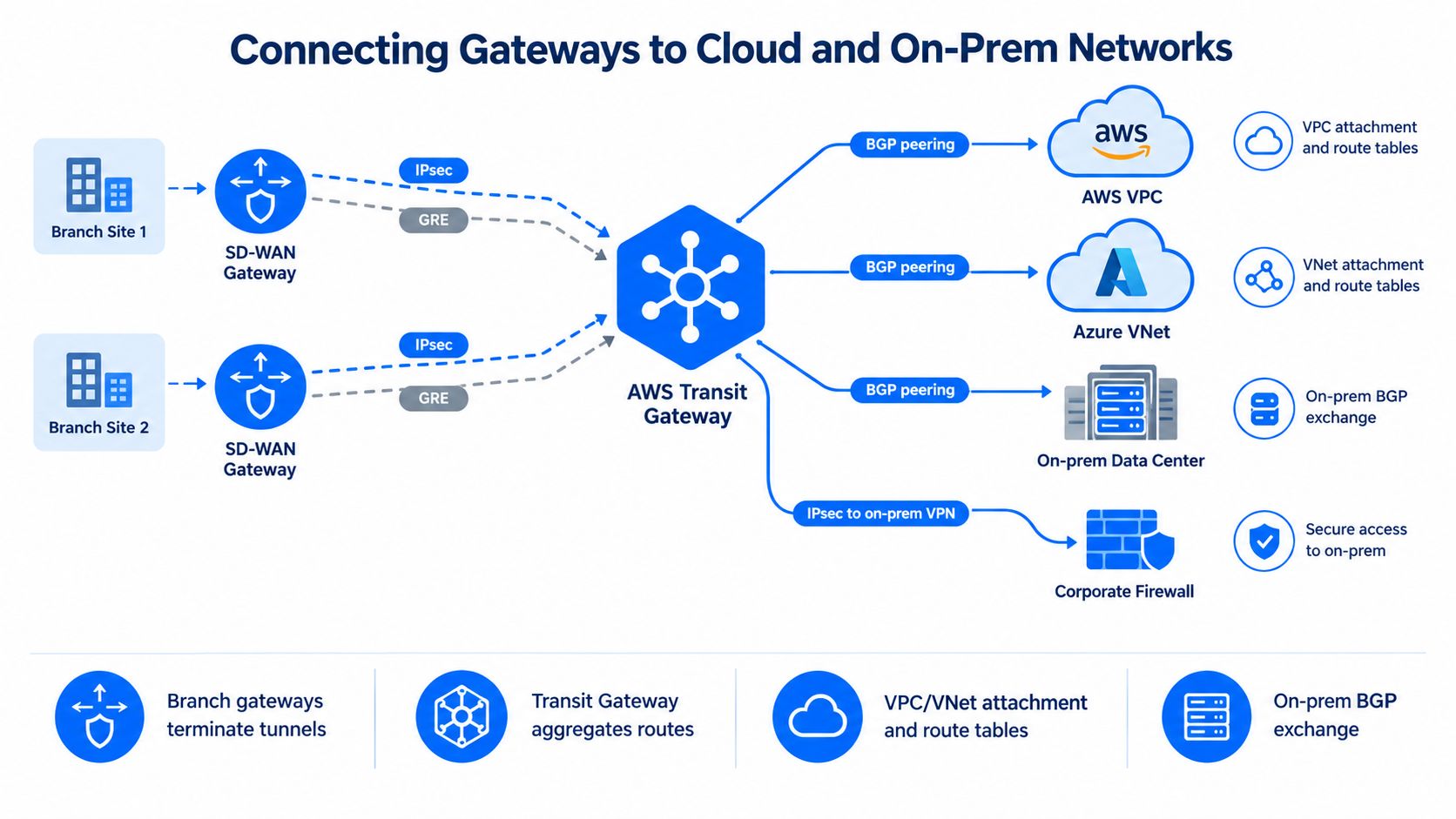
Start with a multicloud reference design.
AWS
Terminate IPsec or GRE tunnels from the SD-WAN gateway into an AWS Transit Gateway. Attach the relevant VPCs, connect inspection VPCs where required, and use Direct Connect when the organization needs a private path into AWS. Keep route propagation intentional. A branch should reach only the VPCs and services its policy permits, not every attached network by default.
The Cisco multicloud design referenced earlier shows why tunnel duplication matters. Separate tunnel paths and availability-zone placement reduce dependence on a single gateway-to-cloud connection, but they don't eliminate bad route advertisements or a shared policy failure. Test both tunnel loss and route-control failure.
Azure
Connect the gateway to an Azure Virtual WAN hub when ExpressRoute, Microsoft peering, and branch connectivity need a shared routing domain. Keep SaaS and private application paths distinct, and use private endpoints where the application and security model require traffic to remain inside the cloud environment.
The important question is who owns the effective route. Azure connectivity can be available while the SD-WAN policy still sends traffic through an unwanted inspection or egress path. Record the intended route, security control, and rollback method for each critical application class.
GCP
Use Network Connectivity Center to anchor the gateway and attach Partner Interconnect or other approved connectivity options. Organize VPC spokes by region or workload boundary so a route change in one area doesn't automatically widen the blast radius elsewhere.
On-premises
Peer the gateway with the data-center edge using BGP. Summarize branch prefixes where practical, preserve a labeled MPLS fallback when it still serves a continuity purpose, and avoid making failover depend on a complete tunnel rebuild. The gateway should exchange reachability with the existing security and routing stack while keeping SD-WAN policy authoritative for application steering.
For physical controls around the data-center side of this design, organizations may also need reliable data centre security solutions. Network resilience doesn't compensate for an access-control, power, or facility-security weakness that takes the gateway host offline.
A broader multi-cloud strategy should document not only connectivity, but also inspection ownership, route propagation, data location, and exit procedures. If those decisions remain implicit, the gateway will inherit them during the first outage.
A Realistic Scenario for a Regulated Multi-Site Network
Take a representative healthcare organization with 22 clinics, two hospitals, a hosted electronic health record, and an analytics workload expanding in Azure. The network team wants a smoother clinician experience, the security team wants clear handling of protected health information, and the board wants no surprise outage caused by an opaque provider decision.
A provider PoP gateway offers a straightforward operating model. Clinics establish overlays into provider locations, and traffic to the hosted EHR follows a managed path. The operational benefit is real, but the compliance discussion becomes more demanding because protected health information may traverse or terminate on a shared provider platform. The procurement team must examine the business associate agreement, tenant isolation, support access, logging, and geographic processing boundaries.
A cloud gateway in the EHR's Azure region changes the control model. Traffic can terminate closer to the application and remain within the customer's selected cloud tenancy, subject to the actual service design and route policy. That may improve the clinician path, but it doesn't solve access to the hospitals' on-premises PACS archive. The architecture still needs a controlled connection to the data center, inspection points, and a plan for cloud-region impairment.
The regional option
A regional hub at a colocation facility near the hospitals gives the organization a local anchor for clinic-to-hospital traffic. The clinics don't need to hairpin through the main data center for every exchange, and the hub can connect independently to Azure and the hosted EHR.
This option transfers more responsibility to the healthcare organization or its managed operator. Someone must patch the gateway, validate certificates, monitor tunnel health, test failover, and prove that logs support an audit. The colocation provider's power and carrier diversity also become part of the risk assessment.
| Choice | What IT controls | What IT must verify |
|---|---|---|
| Provider PoP | Policy configuration and contractual requirements | Shared-platform isolation, data location, maintenance behavior |
| Azure gateway | Cloud tenancy, region selection, and route policy | Cloud attachment failure, region dependency, PACS access |
| Regional colocation hub | Gateway lifecycle and local connectivity design | Facility resilience, carrier diversity, audit evidence |
The recommendation is to choose based on the clinical traffic map and compliance boundary, not on the shortest diagram. For each option, require a packet path for EHR traffic, PACS traffic, analytics traffic, and internet access. Then document who can change that path and how the change is recorded.
Governance Trade-offs Buyers Need to Evaluate
Technical scoring should come after governance questions, not before. A gateway that performs well in a demonstration can still create unacceptable exposure if the vendor can move it, patch it, or rebalance it without giving your team meaningful control.
The first question is lifecycle ownership. Ask: Who patches gateway software, certificates, cryptographic components, and underlying hosts, and how is the maintenance window coordinated with regulated-data operations? An acceptable answer includes documented release practices, advance notice, rollback procedures, vulnerability escalation, and evidence that emergency patches will not change traffic location without notice.
Rebalance behavior deserves equal attention. Ask the vendor to demonstrate what happens when an underlay degrades without fully failing. Watch for route churn, session resets, asymmetric paths, and movement between jurisdictions. The answer must describe thresholds, hysteresis, session preservation, and operator override. “The platform automatically optimizes” isn't an operational design.
SASE convergence creates another governance issue. Gartner-related coverage cited in the brief projects that 60% of new SD-WAN purchases will be part of a single-vendor SASE offering by 2026, up from 15% in 2022, as reported in Palo Alto Networks' SD-WAN gateway overview. Treat that as a market projection, not a reason to accept bundled security without examining where identity, secure web gateway, CASB, and ZTNA decisions execute.
AI operations also require proof. Gartner-based coverage cited in the brief projects that generative AI will support 20% of initial network configuration by 2026, up from near zero in 2023, according to the same research context. Ask whether the automation improves detection and repair, exposes its reasoning, supports approval gates, and preserves a complete change record.
| Governance Lever | Question to Ask the Vendor | Acceptable Answer | Risk If Unanswered |
|---|---|---|---|
| Patch lifecycle | Who patches, certifies, and rolls back the gateway? | Named owner, notice process, rollback, emergency path | Unplanned outage or audit failure |
| Rebalance behavior | What happens during brownout and partial path loss? | Tested thresholds, session behavior, jurisdiction controls | Session loss, route churn, sovereignty drift |
| SASE convergence | Which functions share policy and data-plane context? | Clear execution points, tenancy model, licensing boundaries | Control gaps and license sprawl |
| AI operations | Can operators inspect and approve automated actions? | Explainable changes, guardrails, audit logs | Black-box changes and delayed diagnosis |
Attach this scorecard to the RFP before vendors receive technical weighting. It forces the conversation toward ownership and failure behavior, where the largest risks usually sit.
Practical Next Steps for IT Leaders
Run a focused pilot this quarter. Use two sites, include a real cloud egress dependency, and test applications that matter to the business rather than synthetic traffic alone. Measure brownouts, route changes, session survival, and rebalance behavior before comparing throughput.
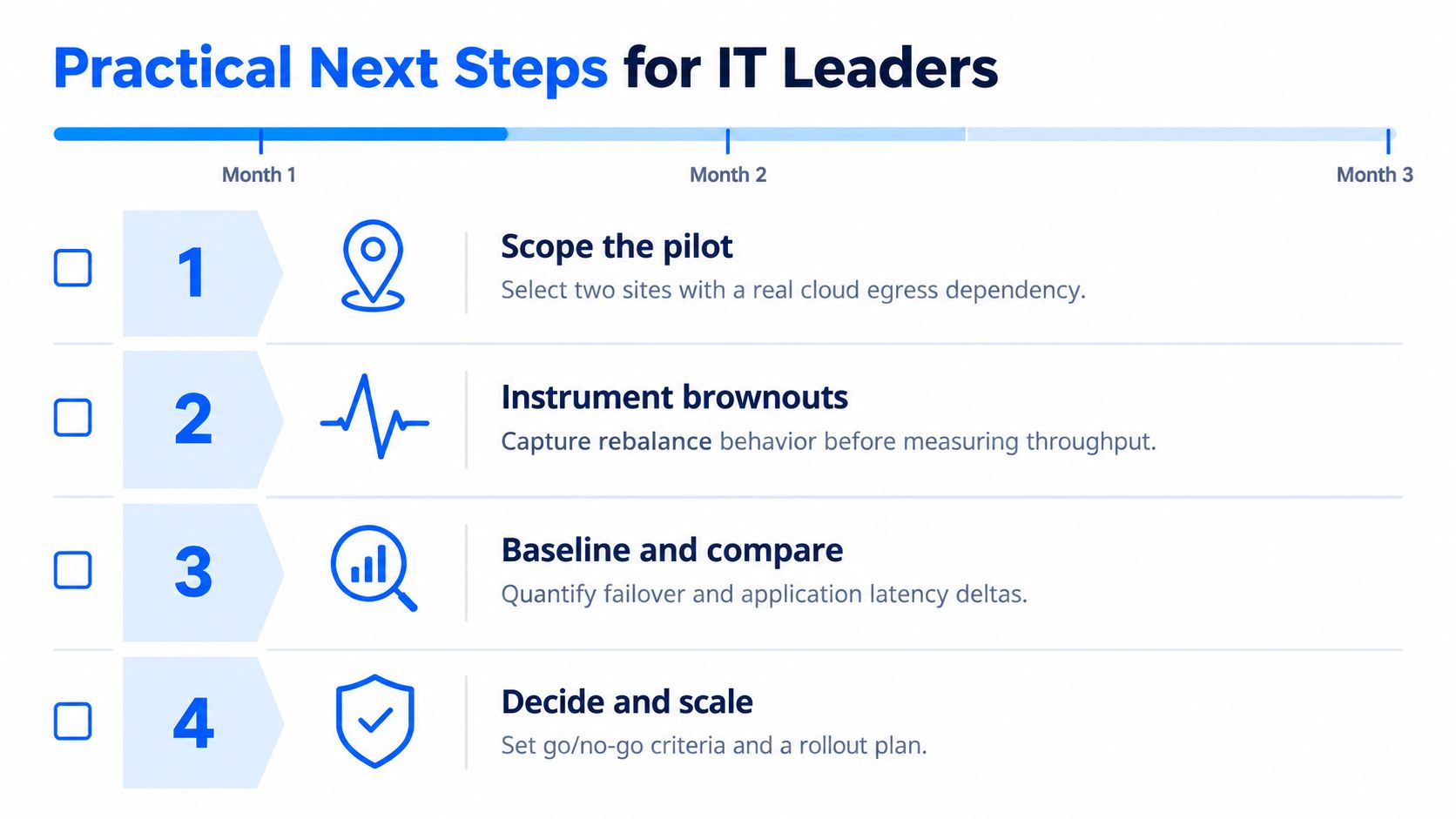
Use four gates for the evaluation:
- Scope the pilot: Select sites with different underlays and a genuine cloud dependency.
- Instrument brownouts: Capture path degradation, rebalance timing, route changes, and application impact.
- Baseline and compare: Evaluate failover behavior, cloud access, inspection paths, and operational effort.
- Decide and scale: Set go/no-go criteria before the pilot begins and record the rollout boundaries.
Score every vendor against patch lifecycle, rebalance behavior, SASE execution, and AI operations. Demand a documented failure domain for every placement option, including shared hosts, provider PoPs, cloud regions, carriers, and management systems.
End a vendor conversation immediately if the supplier makes marketing-led SASE convergence claims without shared data-plane tenancy or clear policy execution, or if gateway pricing is tied to bundled bandwidth that prevents you from changing underlays. Both signals suggest the commercial model matters more than your operating flexibility.
Produce one artifact: a one-page architecture decision record. It should name the gateway placement, failover boundaries, data sovereignty assumptions, patch owner, rebalance behavior, and exit cost.
MR2 Solutions helps organizations evaluate, procure, implement, and govern SD-WAN across branch, data-center, and cloud environments through a vendor-neutral technology brokerage approach. Visit MR2 Solutions to discuss gateway placement, failover testing, and a procurement process aligned with your operational and compliance requirements.