
Sd Wan vs Sase
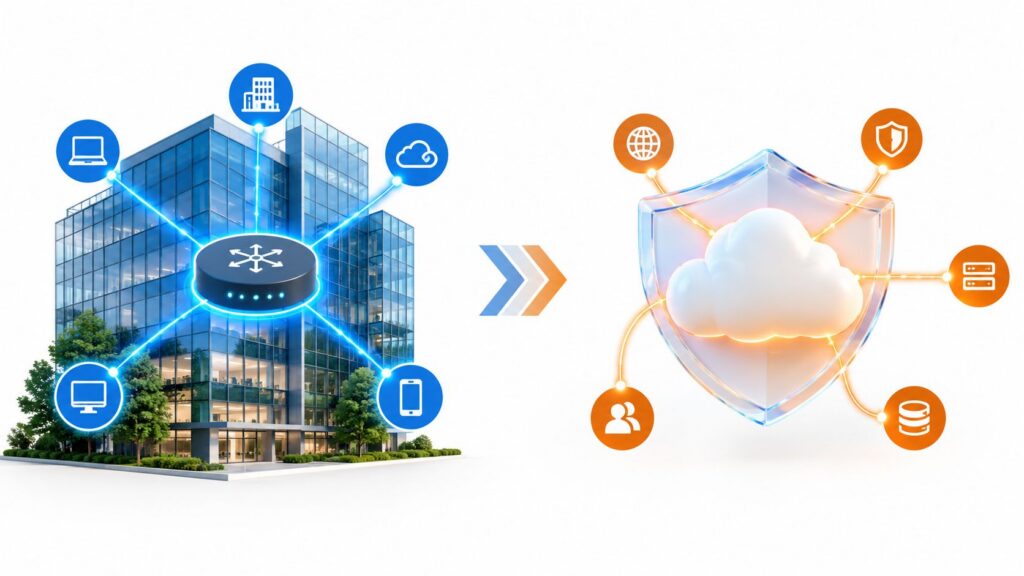
The popular advice on SD-WAN vs SASE is to pick a winner and replace the old architecture. That advice is usually too simplistic for an enterprise environment. SD-WAN and SASE solve overlapping problems, but they operate at different architectural layers, and many organizations already have network investments, operating procedures, and service-level commitments that can't be discarded without consequence.
The more useful question is: how should SD-WAN and cloud-delivered security work together over time? A practical answer starts with transport performance, security policy, ownership, and migration risk. It also recognizes that SASE adoption doesn't automatically make an existing SD-WAN deployment irrelevant.
Rethinking the Network Modernization Debate
A binary decision can create the wrong project. If a company asks whether SASE should replace SD-WAN, it may approve a platform purchase before defining which routing capabilities remain necessary, which security controls should move to the cloud, and which team will own the resulting policies.
Recent survey data supports a coexistence mindset. 42% of organizations had implemented or were deploying their first SD-WAN project, compared with 26.6% for SASE, while 38.8% identified SD-WAN as the most critical component in SASE deployments (Frost & Sullivan's 2025 SD-WAN infrastructure report). These figures do not prove that every organization should deploy both. They do show why a rip-and-replace narrative misses the market's actual starting point.
Practical rule: Treat SASE as a destination architecture, not automatically as a reason to discard the network you already operate.
The sequencing cost of a false choice
A standalone SD-WAN deployment can remain valuable when the immediate business problem is unreliable branch connectivity, poor application routing, or excessive dependence on a single circuit. SASE becomes more compelling when the organization needs consistent security enforcement for branches, remote users, and SaaS access through a cloud service.
The transition can still create duplicate spend. An enterprise may pay for an SD-WAN appliance, a separate secure web gateway, a remote-access platform, and overlapping firewall services while it tests a SASE provider. This is usually a sequencing failure rather than a technology failure.
A workable migration plan answers four operational questions:
- What remains in the branch? Identify routing, local breakout, segmentation, and resilience functions that still provide value.
- What moves first? Prioritize security controls that address the clearest access or policy gap.
- Who owns the policy? Assign responsibility for changes, exceptions, investigations, and approvals before deployment.
- How will success be measured? Combine network experience metrics with security and operational outcomes.
Digitally mature organizations are favoring phased transitions rather than broad infrastructure replacement, according to Frost & Sullivan's research. The practical roadmap is usually coexistence first, controlled consolidation later, and replacement only where an existing component no longer earns its place. This approach preserves useful investments while exposing governance gaps before they become migration blockers.
Architectural Differences and Security Models
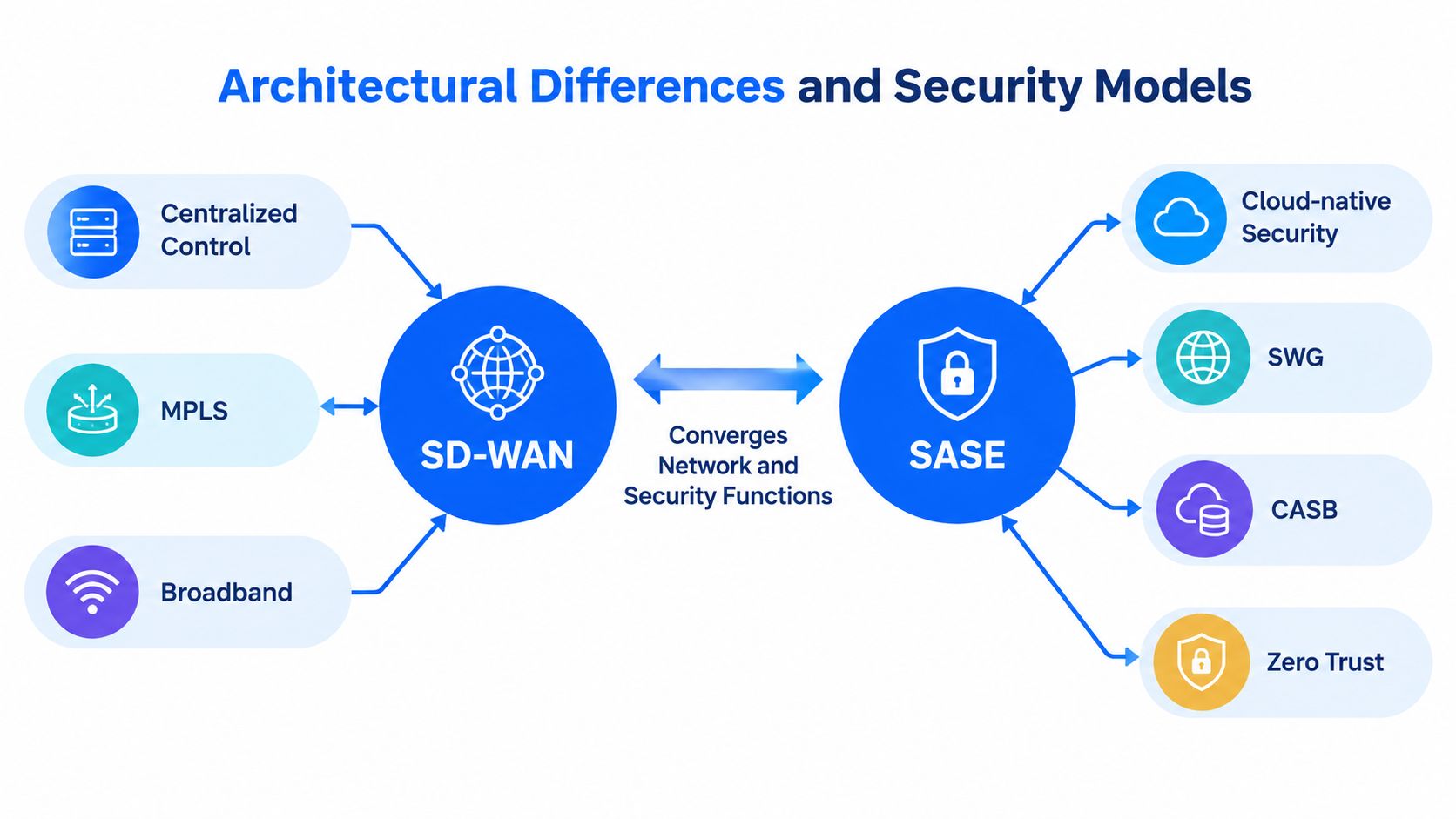
SD-WAN is primarily a WAN performance layer. It routes traffic across available links and uses path-quality signals such as latency, jitter, loss, and MOS to help determine how traffic should travel. The central concern is transport: can the branch, application, and user communicate reliably across the available network paths?
SASE extends that model. It combines SD-WAN with cloud-delivered security services, moving the architectural emphasis from transport optimization toward secure-access policy enforcement at the edge. The difference isn't that SASE has more features. SASE changes where and how the organization applies access, inspection, and security policy.
A useful mental model
Think of SD-WAN as an intelligent traffic controller. It understands the available roads, observes their condition, and chooses a path for each type of traffic. A branch may use broadband, private connectivity, or another available link, with the system selecting routes according to application and path conditions.
SASE adds the security checkpoint to that model. The organization can apply cloud-delivered services such as:
- Secure Web Gateway, or SWG, for inspecting and controlling web access.
- Cloud Access Security Broker, or CASB, for applying policy around cloud application use.
- Zero Trust Network Access, or ZTNA, for controlling access to private applications based on identity and context.
- Firewall as a Service, or FWaaS, for cloud-based firewall enforcement.
This convergence can simplify access for a distributed workforce, but it also introduces a dependency on the provider's points of presence and inspection path. A security policy that looks clean on a diagram can still produce a poor user experience if traffic takes an inefficient route.
For branch resilience, teams should also examine how secondary links are selected and monitored. A practical reference on SnapDial's backup routing can help architects think through failover behavior without confusing backup connectivity with a complete security architecture.
The security implications deserve separate treatment from routing design. Teams evaluating SD-WAN security considerations should document which controls remain on premises, which are delivered through the cloud, and how policies are synchronized across users, branches, devices, and applications.
Why the distinction matters
SD-WAN can improve path selection without providing a complete secure-access model. SASE can provide that broader model, but it doesn't remove the need to understand path quality, application dependencies, local survivability, and provider-edge behavior.
That distinction affects procurement and testing. A network team may validate application steering and circuit failover, while a security team validates identity policy, inspection, and access decisions. A successful SASE design must pass both tests without leaving either team responsible for the other team's blind spots.
Evaluating Capabilities and Deployment Patterns
The right comparison depends on the bottleneck. A company with stable branch connectivity but inconsistent remote access has a different starting point from a company whose main problem is application performance across multiple WAN links.
SASE is often the better fit when an organization wants one cloud service for remote users, branches, and SaaS access. Its value comes from combining SD-WAN with SWG, CASB, ZTNA, and FWaaS. Standalone SD-WAN generally needs separate security integrations, which can increase the number of consoles, policies, contracts, and operational handoffs.
| Evaluation Criteria | SD-WAN Focus | SASE Focus |
|---|---|---|
| Primary objective | Optimize WAN connectivity and application routing | Combine connectivity with cloud-delivered security enforcement |
| Branch connectivity | Selects among available links according to path quality and application needs | Adds security inspection and policy enforcement to the connectivity model |
| Remote users | Often requires separate remote-access and security services | Provides a unified service model for users, branches, and SaaS access |
| SaaS traffic | Improves path selection and local connectivity patterns | Applies cloud security controls while supporting SaaS access |
| Security stack | Usually integrates with separate firewalls, SWG, CASB, or ZTNA tools | Bundles SD-WAN with SWG, CASB, ZTNA, and FWaaS |
| Operational model | Primarily network-led, with security integrations | Shared network and security ownership, or managed-service ownership |
| Main risk | Fragmented security controls and duplicated administration | Provider-edge dependency, policy complexity, and unclear accountability |
| Best starting point | A branch or WAN performance problem | A distributed access and security policy problem |
Measure the SASE path, not just the branch
A common deployment mistake is to measure the local network and assume the SASE service is transparent. It isn't. Security inspection and detours through the provider edge can affect end-to-end path quality, so teams should measure availability, latency, and loss to the SASE point of presence, as recommended in Palo Alto Networks' comparison of SD-WAN, SASE, and SSE.
Those measurements should be tied to real user journeys. Test access to private applications, SaaS platforms, voice, video, and business-critical branch systems. A service can show healthy branch connectivity while users still experience delays between the inspection point and the destination application.
Deployment patterns that work
A practical pattern is to retain SD-WAN for branch routing while introducing SASE security services for remote users and selected internet-bound traffic. That allows the organization to test identity policy, inspection, provider reachability, and incident workflows before changing every branch.
Another pattern starts with a clean SASE rollout for a new location or workforce segment. This can work when the organization has limited legacy dependency and wants one operating model from the beginning. It works less well when teams haven't defined policy ownership or when the provider's service boundaries are unclear.
For organizations starting with a network-led program, SD-WAN services from MR2 Solutions offer one route for evaluating, designing, and implementing SD-WAN around business and operational requirements. The key is to assess the service as part of a broader roadmap, not as an isolated connectivity purchase.
Operational Ownership and Governance Shifts
The harder SD-WAN versus SASE decision starts after deployment. The organization must decide who owns the environment when the implementation team leaves, especially during a phased migration where legacy routing and cloud-delivered security operate together.
SD-WAN usually sits with network operations. SASE extends responsibility into identity, security policy, endpoint access, cloud applications, firewall administration, and incident response. A change to routing, inspection, or ZTNA policy can affect both security exposure and user authorization, so the operating model must reflect those dependencies.
Different teams measure different outcomes
Network teams track availability, path quality, failover, and application performance. Security teams track least privilege, inspection, policy consistency, incident containment, and auditability. A shared platform does not create shared accountability automatically. Assign decision rights before consolidating tools or handing control to a provider.
The operating model should specify:
- Policy administration: Who creates and approves access rules, web controls, segmentation, and exceptions?
- Incident response: Who investigates a blocked application, suspicious session, or provider-edge failure?
- Change control: Which changes require security review, and which can network operations make independently?
- Service accountability: Who owns the outcome when the branch, SASE point of presence, internet provider, and destination application each appear healthy?
- Reporting: Which dashboard is the authoritative record for availability, access, and security events?
A managed security service provider or managed service provider may fit better than a traditional network service provider when one team must coordinate security and network operations. Survey commentary in Frost & Sullivan's SD-WAN and SASE research describes this provider preference for SASE deployments.
Governance must precede consolidation
Convergence relocates work into shared workflows. It does not remove the work.
For regulated organizations, contracts should state who can change security policy, how emergency changes are recorded, how evidence is retained, and which party supplies incident data. SLAs should distinguish provider availability from end-user experience. A provider can meet its availability commitment to a point of presence while an unsuitable inspection path slows a critical application.
During a coexistence period, assign ownership for each traffic class and document escalation between the branch team, security team, provider, and application owner. Review those assignments before moving additional sites or users.
The SASE market is expanding quickly. According to Frost & Sullivan's Q2 2025 SASE market update, revenue grew 17% year over year to $2.6 billion in the first quarter of 2025, and 22% year over year to $2.7 billion in the second quarter of 2025. That growth increases the need for clear ownership, escalation paths, and evidence requirements before a bundled platform replaces established operating discipline.
Real-World Scenarios and Situational Recommendations
A manufacturing firm with plants, legacy equipment, and sensors may lead with SD-WAN. Its immediate requirement could be reliable site-to-site connectivity, predictable application routing, and resilient access to operational systems. The security roadmap still matters, but the first deployment should protect production continuity and preserve local behavior during link failures.
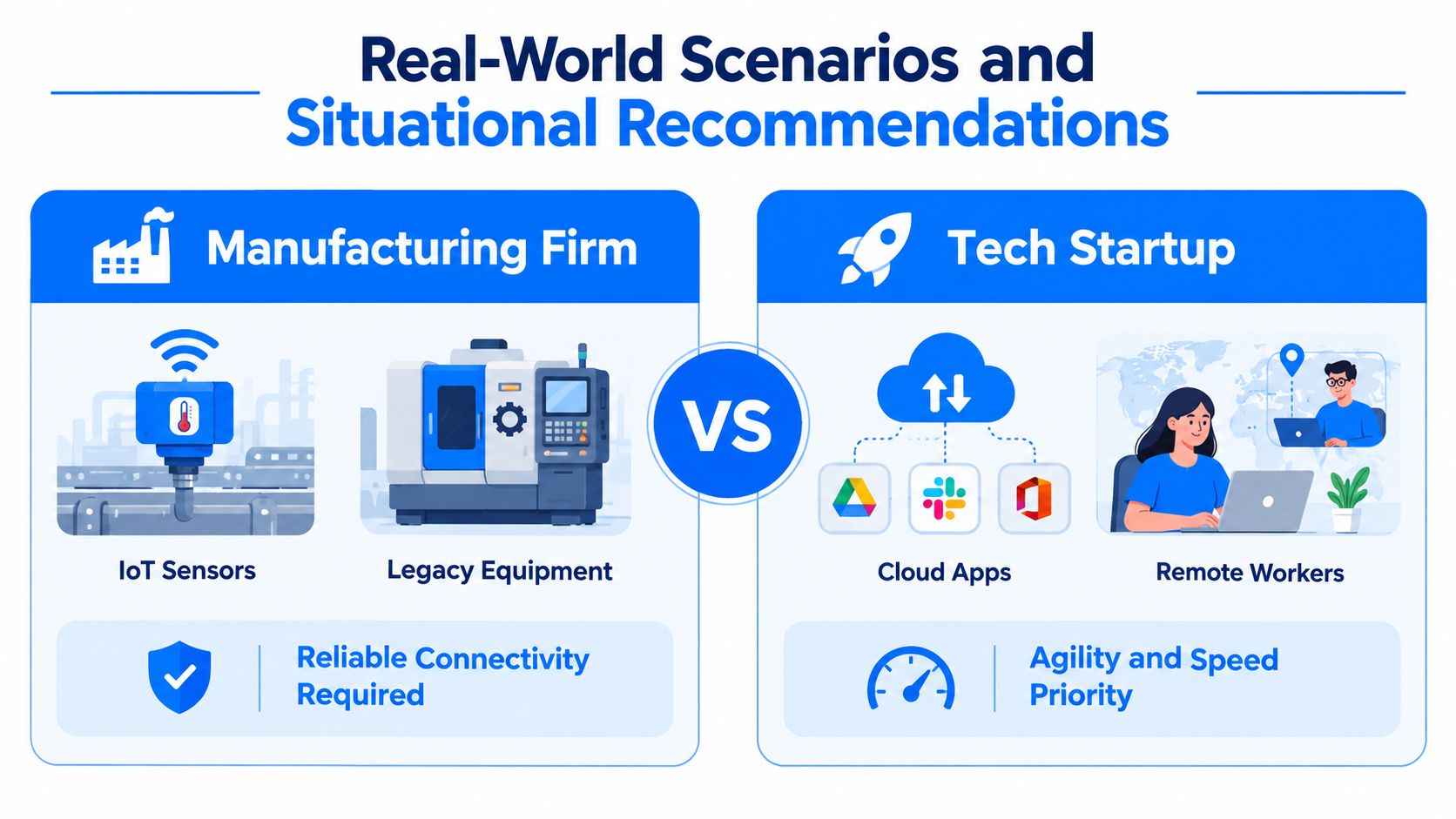
The manufacturing team shouldn't assume that adding a SASE service will automatically solve plant security. It needs to map industrial traffic, determine which systems can use cloud inspection, and identify workloads that require local enforcement or local survivability. In this situation, SD-WAN can remain the network foundation while security controls are introduced selectively.
Financial services with a remote-access priority
A financial services organization may begin with SASE when its dominant concern is controlled access to private applications for remote users and contractors. ZTNA, identity-based policy, cloud inspection, and centralized administration may matter more immediately than branch route optimization.
That organization still needs to test the path to the SASE point of presence and the destination application. Security policy is only useful if employees can complete business tasks reliably, and an access architecture that adds avoidable detours may create pressure for exceptions.
A growing software company
A cloud-oriented company with distributed employees and limited legacy infrastructure may adopt SASE directly. A single service model can reduce the number of separate products required for web access, private application access, branch connectivity, and cloud security.
Direct adoption isn't automatically simpler. The company must define policy ownership, establish an identity source, document application dependencies, and decide how it will handle provider outages. A small security team can gain operational simplicity from consolidation, but it can also become overly dependent on one provider's administration model.
The hybrid enterprise
Many established enterprises should run both. They can retain SD-WAN at branches where routing, local breakout, or resilience requirements are mature, then introduce SASE for remote users, new sites, or selected traffic classes.
The decision should follow business pressure rather than product packaging:
- Lead with SD-WAN when the primary issue is WAN performance, link diversity, or branch routing.
- Lead with SASE when secure access policy for users, branches, and SaaS is the urgent requirement.
- Use coexistence when existing SD-WAN works well but security controls are fragmented.
- Delay broad consolidation when ownership, application dependencies, or provider SLAs remain undefined.
Planning a Phased Network Transition
A phased transition protects uptime and gives teams evidence before they make irreversible changes. The sequence below is intentionally conservative because the largest risks usually come from hidden dependencies, unclear policy ownership, and overlapping contracts.
1. Audit the current estate
Document circuits, SD-WAN policies, firewalls, remote-access tools, web gateways, identity systems, SaaS routes, private applications, and operational owners. Record which traffic requires local handling and which traffic can safely reach a cloud security point of presence.
The audit should produce a dependency map, not just an inventory. For every major application, identify the user population, access path, security policy, performance expectation, and fallback behavior.
2. Select a contained pilot
Choose a branch, user group, or application class that represents real complexity without putting the entire enterprise at risk. Include remote access, internet traffic, private applications, and at least one failure scenario if the pilot can support them safely.
Define success in operational terms. Measure availability, latency, and loss to the SASE point of presence, then compare application behavior before and after the change. Include policy outcomes, help-desk impact, incident response, and administrative effort.
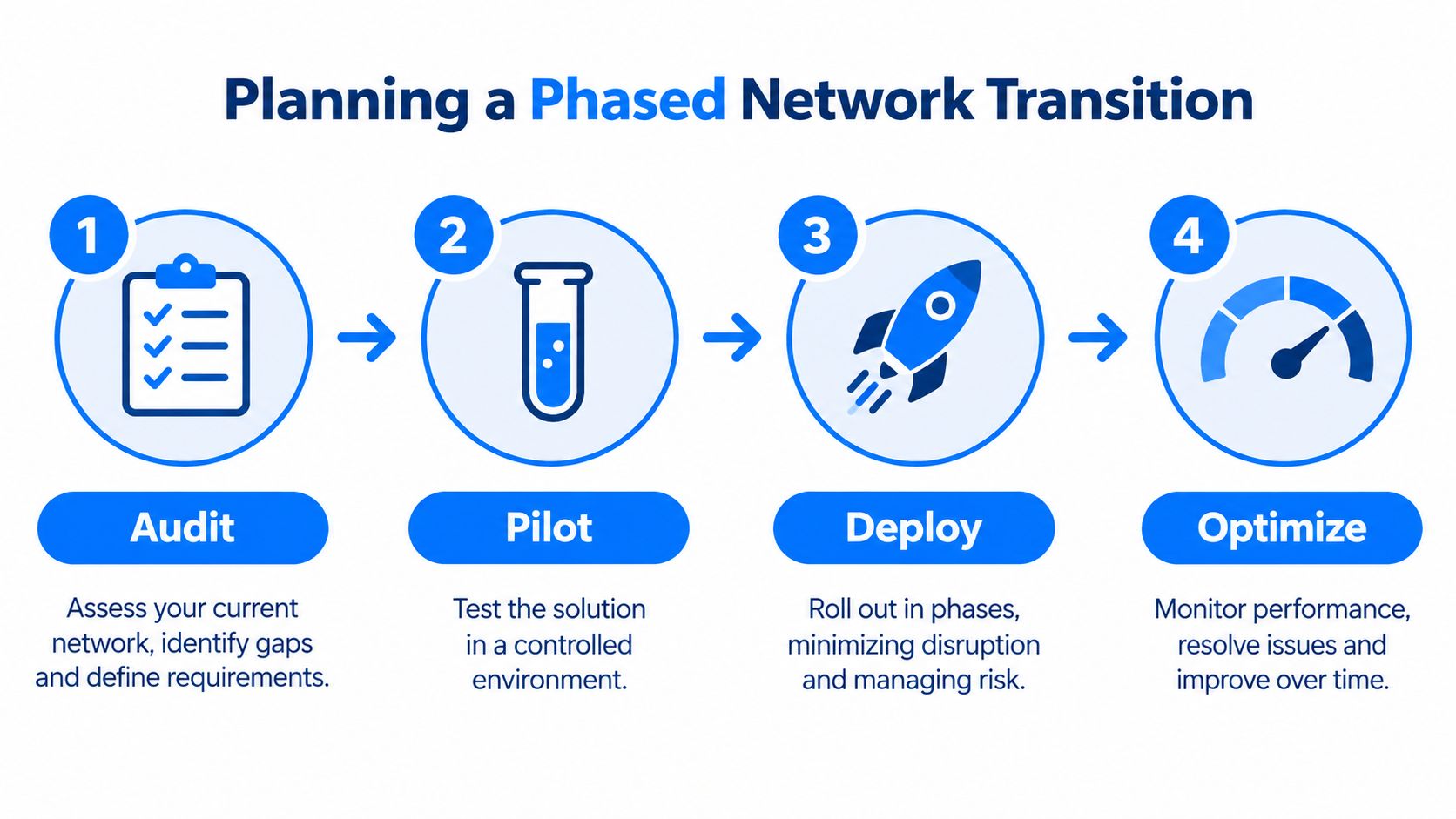
3. Deploy by dependency, not geography alone
A branch-by-branch rollout can be useful, but geography doesn't reveal every technical dependency. Group sites and users by application profile, security policy, circuit design, and support model.
Keep the existing SD-WAN path available where the architecture permits it. Introduce SASE for a defined traffic class or user population, validate the result, and expand only after the operating team can manage failures and policy changes.
4. Optimize the combined model
After deployment, remove duplicate controls only when the replacement has proven reliable. Retiring a firewall, remote-access service, or gateway too early can turn a migration issue into an outage.
Review policy overlap, provider performance, exception volume, and support tickets. Establish a new baseline for the combined architecture, then revisit contracts and licensing as components become fully redundant. The objective isn't to maximize the number of bundled features. It's to create a simpler, accountable service without sacrificing the network behaviors the business still needs.
Navigating the Provider Ecosystem
Provider selection becomes difficult when products use similar language but place responsibility in different parts of the architecture. One proposal may emphasize branch appliances, another may emphasize cloud security points of presence, and a third may sell managed operations around both. Comparing feature checklists won't reveal who owns the outcome when routing and security interact.
A vendor-neutral brokerage approach is useful because it starts with discovery instead of a preferred product. The evaluator should map business requirements to architecture, identify constraints, test deployment patterns, and compare commercial models against the operating capabilities available internally.
Evaluate the service behind the platform
Ask each provider to explain the complete path for a branch user, a remote user, a SaaS application, and a private application. Require clear answers about inspection location, routing decisions, failover, logging, policy changes, and escalation.
The proposal should also distinguish between:
- Technology scope: SD-WAN, SWG, CASB, ZTNA, FWaaS, identity integration, and monitoring.
- Managed-service scope: configuration, policy administration, incident response, reporting, and lifecycle management.
- Accountability scope: uptime, path quality, provider-edge performance, application reachability, and third-party dependencies.
- Exit scope: data portability, policy export, coexistence support, and transition assistance.
A curated ecosystem can improve the process when the organization needs several providers to deliver one operating outcome. MR2 Solutions' SD-WAN vendor guidance is one example of a resource for comparing providers rather than accepting the first platform positioned as a complete answer.
Use business outcomes as the filter
The right provider is the one that can explain how the architecture will improve the specific problem, whether that problem is branch reliability, secure remote access, SaaS performance, policy consistency, or operational capacity. It should also explain what the platform won't solve and what remains the customer's responsibility.
A disciplined evaluation should leave the CIO with more than a shortlist. It should produce a target operating model, migration sequence, measurement plan, commercial assumptions, and governance structure. That is how an organization avoids buying a polished bundle that still leaves network and security teams arguing over ownership.
MR2 Solutions helps organizations evaluate, design, procure, implement, and govern SD-WAN and SASE services through a vendor-neutral technology brokerage approach. If you're planning coexistence, a phased migration, or a new secure-access architecture, visit MR2 Solutions to discuss your requirements and build a practical provider and operating model.