
SD WAN Software Explained: A Practical Buyer’s Guide
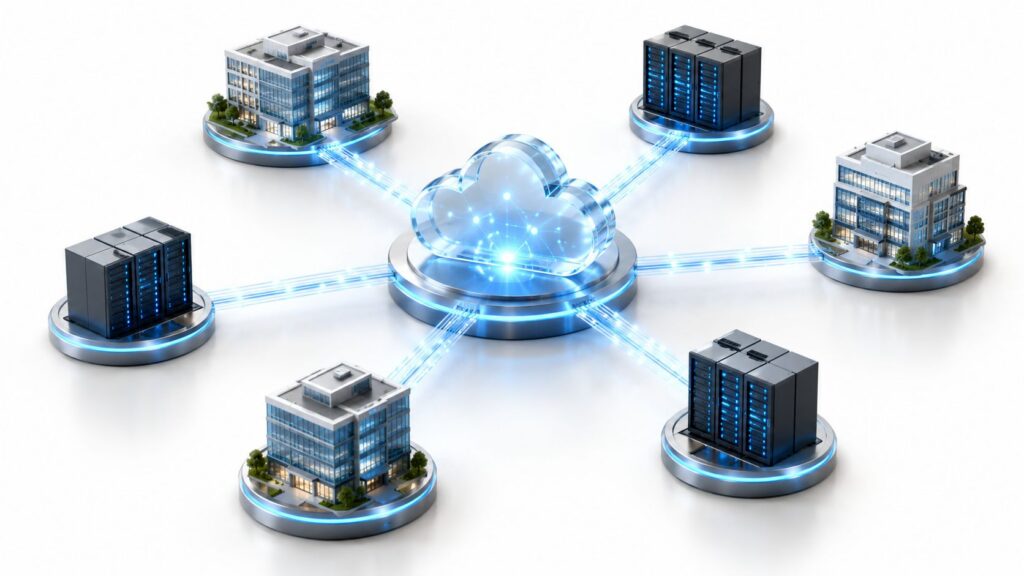
A regional sales team is waiting for an MPLS circuit to be repaired. The broadband link at the same office is available, but it sits unused because the router's configuration still treats it as a backup. Meanwhile, traffic for a cloud application travels back through headquarters, adding delay to a service that employees need every day.
This is the problem SD-WAN software is designed to address. It adds a software control layer that measures network conditions, applies business policies, and directs traffic across available connections. The technology doesn't make an unreliable circuit reliable by itself. It gives the network a way to recognize the problem and use a better path.
For a CIO, the important decision isn't just which feature list looks longest. It's who operates the control plane, what the platform can observe, how it integrates with security and cloud services, and what happens when you leave the provider.
Why SD WAN Software Matters for Distributed Networks
Traditional WAN design often places decision-making inside individual routers. Each site has its own configuration, routing rules, maintenance process, and failure modes. That model can work for a small number of locations, but operational friction grows as the business adds branches, cloud applications, remote users, and different access circuits.
SD-WAN software treats those locations as one logical network. The physical connections, called the underlay, might include MPLS, broadband, or cellular access. The software creates an overlay across those transports and uses policy and telemetry to decide how applications should move through it. A voice call can receive different treatment from a software update, even when both use the same local internet connection.
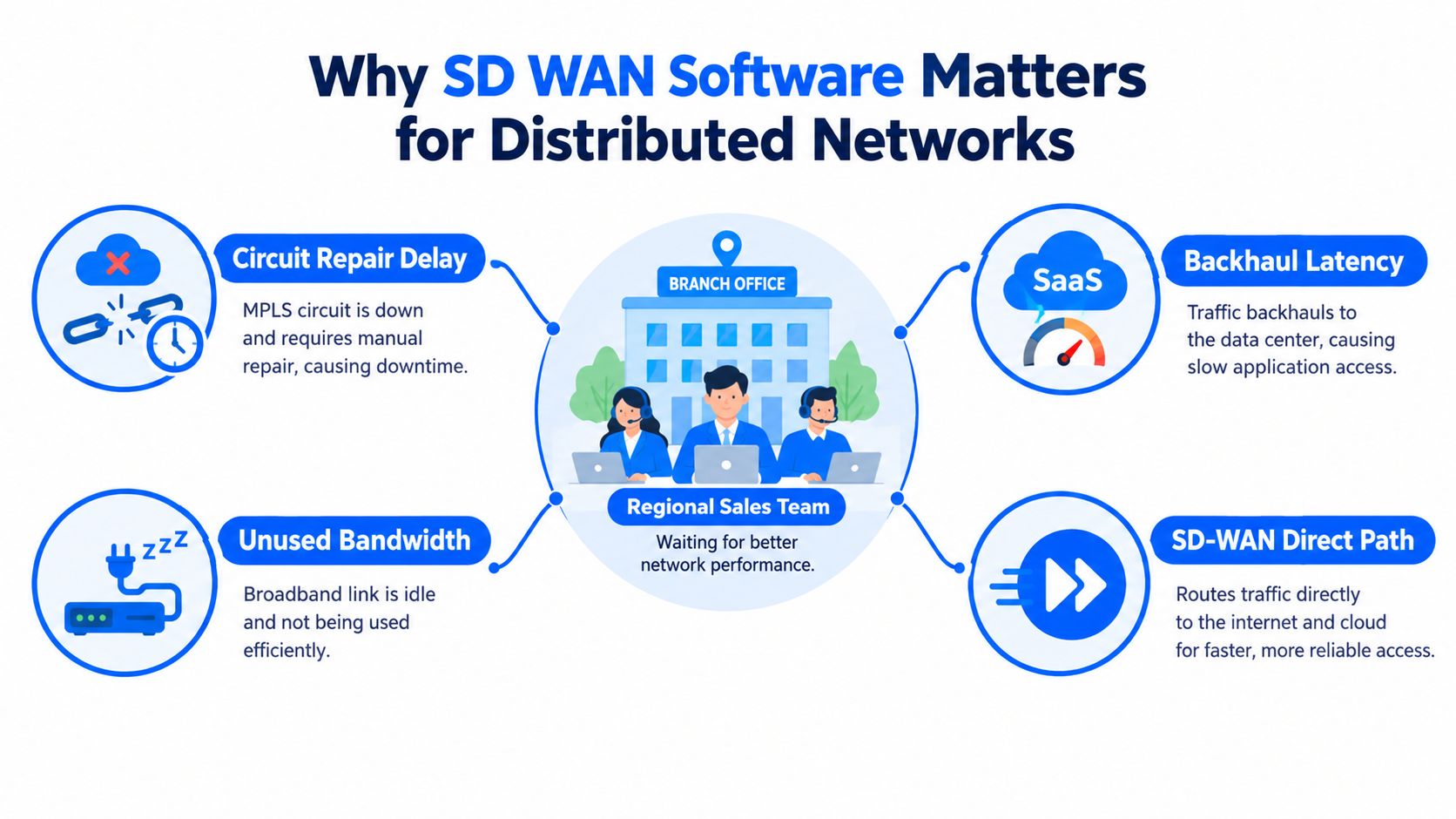
The practical value is centralized intent. Instead of asking an engineer to configure every router for every possible failure, the organization defines what matters: prioritize business-critical applications, use the healthiest available path, isolate sensitive traffic, and send suitable internet-bound traffic directly to the cloud.
That doesn't mean SD-WAN removes the need for architecture. Teams still need to choose transports, size edge hardware, design segmentation, define security controls, and test application behavior. A useful introduction to the physical and logical layers involved is this guide to modern cloud & on-prem networking, which helps place SD-WAN in the wider network architecture.
The category has moved well beyond an experimental approach. One industry account describes SD-WAN as having “no name in 2010,” gaining traction around 2014, and becoming part of major vendor portfolios after acquisitions between 2017 and 2022. TeleGeography reported that 18% of respondents had installed SD-WAN in 2018, rising to 43% in 2020, a 25-point increase over two years, as documented in this account of SD-WAN's evolution.
Buyer question: Who owns the control plane, what telemetry does it collect, and who is accountable when a policy sends traffic down the wrong path?
That question frames the rest of the purchase. The components explain what the product is. The operating model determines whether your team can run it successfully.
Core Components Inside SD WAN Software
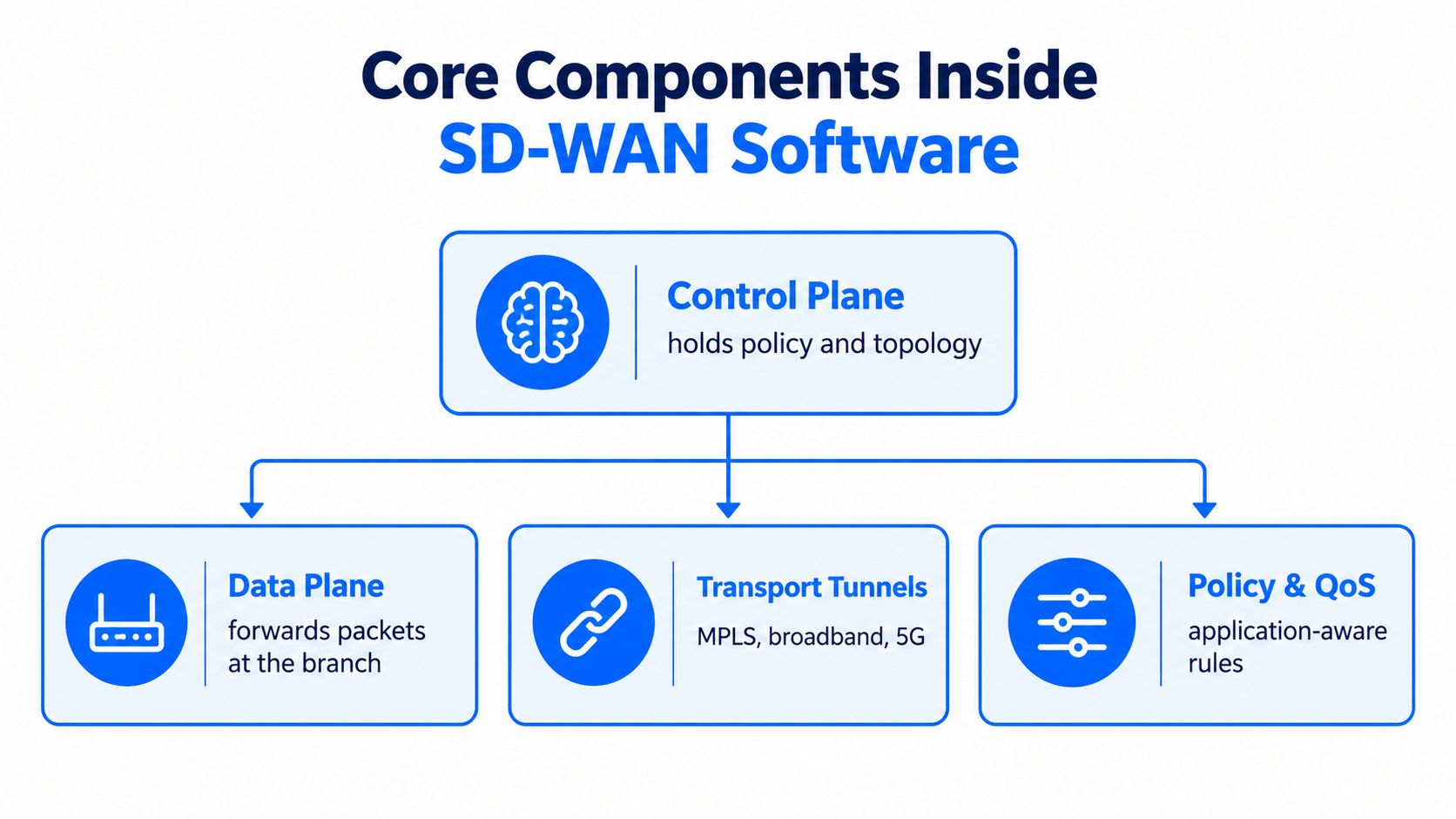
Think of SD-WAN as a traffic management system with a brain, hands, roads, and rules. The control plane decides what should happen. The data plane forwards packets. The underlay supplies physical connectivity, while the overlay creates logical paths across it.
The orchestrator and controller
The orchestrator provides the management experience for administrators. It stores site inventory, topology, templates, certificates, segmentation settings, and application policies. The controller distributes the relevant decisions to edge devices and may participate in route exchange or tunnel establishment.
Vendors use different names for these functions. Cisco uses components such as Catalyst SD-WAN Manager and controllers within its architecture. Other products may call the same general roles a management console, orchestrator, director, or controller cluster. Procurement should compare responsibilities, not labels.
The edge
The edge is the device or software instance at a branch, data center, cloud location, or virtual point of presence. It forwards user traffic, terminates tunnels, measures links, enforces security policies, and may run routing protocols such as BGP or OSPF.
An edge could be a physical appliance, a virtual CPE, or software installed on suitable infrastructure. Its processor matters because encryption, packet inspection, and traffic handling compete for resources. A useful reference for understanding the branch-side role is this overview of the SD-WAN edge.
The overlay and underlay
The underlay is the connectivity you buy from carriers or internet providers. The overlay is the logical network built across those connections, usually with encrypted tunnels such as IPsec. Some platforms also support GRE for particular integration or routing designs.
The overlay doesn't replace the underlay. It abstracts it. If broadband fails a defined quality threshold, the software can steer selected traffic to MPLS or cellular access, provided those paths exist and the policy allows the change.
Policy and application intent
Policy translates business priorities into network behavior. A rule might identify a collaboration application, assign it a preferred path, reserve treatment for voice, or place a financial system in a restricted segment. Identification can rely on application signatures, ports, destination information, user identity, or traffic characteristics, depending on the platform.
Ask vendors to show the complete path from policy creation to packet forwarding. Marketing terms change, but these four building blocks remain the architecture you must operate.
How the Controller and Orchestrator Work
The controller and orchestrator are not just dashboards. In production, they coordinate the repetitive work that otherwise creates configuration drift across sites.
A new edge may use zero-touch provisioning. An installer connects power and transport, the device authenticates to the service, receives its identity and certificates, downloads its configuration, builds tunnels, and begins forwarding traffic. The exact workflow varies, so the demonstration should include a failed enrollment, certificate renewal, and replacement of a damaged appliance.
The platform then collects telemetry from the edges and transports. Useful signals can include latency, packet loss, jitter, utilization, tunnel state, application performance, and hardware health. The software compares those measurements with policy thresholds and can select another path or trigger failover when conditions change.
Centralized policy is valuable only if changes are controlled. Look for role-based access, approval workflows, audit trails, version history, staged deployment, rollback, and a way to preview impact before pushing a change. Analytics should help answer why an application took a path, not merely display that a tunnel is up.
Choosing the control hierarchy
A single-tier design keeps management relatively direct. A multi-tier design introduces regional or tenant-level layers, often separating local administration from global governance.
| Dimension | Single-Tier Orchestrator | Multi-Tier Orchestrator |
|---|---|---|
| Administration | One central authority manages all sites | Global and regional teams can share responsibility |
| Policy model | Consistent central templates are straightforward | Local exceptions require stronger governance |
| Scale | Simpler for a contained environment | Better suited to regions, tenants, or delegated operations |
| Failure planning | Central dependency deserves close resilience testing | More layers create additional coordination points |
| Auditability | Easier to trace one administrative path | Requires clear ownership across tiers |
For organizations comparing automation platforms, a broader enterprise ROI orchestration guide can provide useful context on governance, approvals, and lifecycle ownership beyond networking alone. For the networking mechanics, review how SD-WAN works and ask vendors to map each step to their product.
During a demo, ask two concrete questions: How long does a new site take to move from powered-on hardware to forwarding approved traffic? Can an administrator simulate a policy change before deployment? If the vendor can't answer clearly, the operational risk is already visible.
Key Features Worth Evaluating
A feature matters only when it changes an outcome your users or operators care about. Ask vendors to demonstrate the outcome under a controlled failure, not just display a checkbox on a slide.
Dynamic path selection
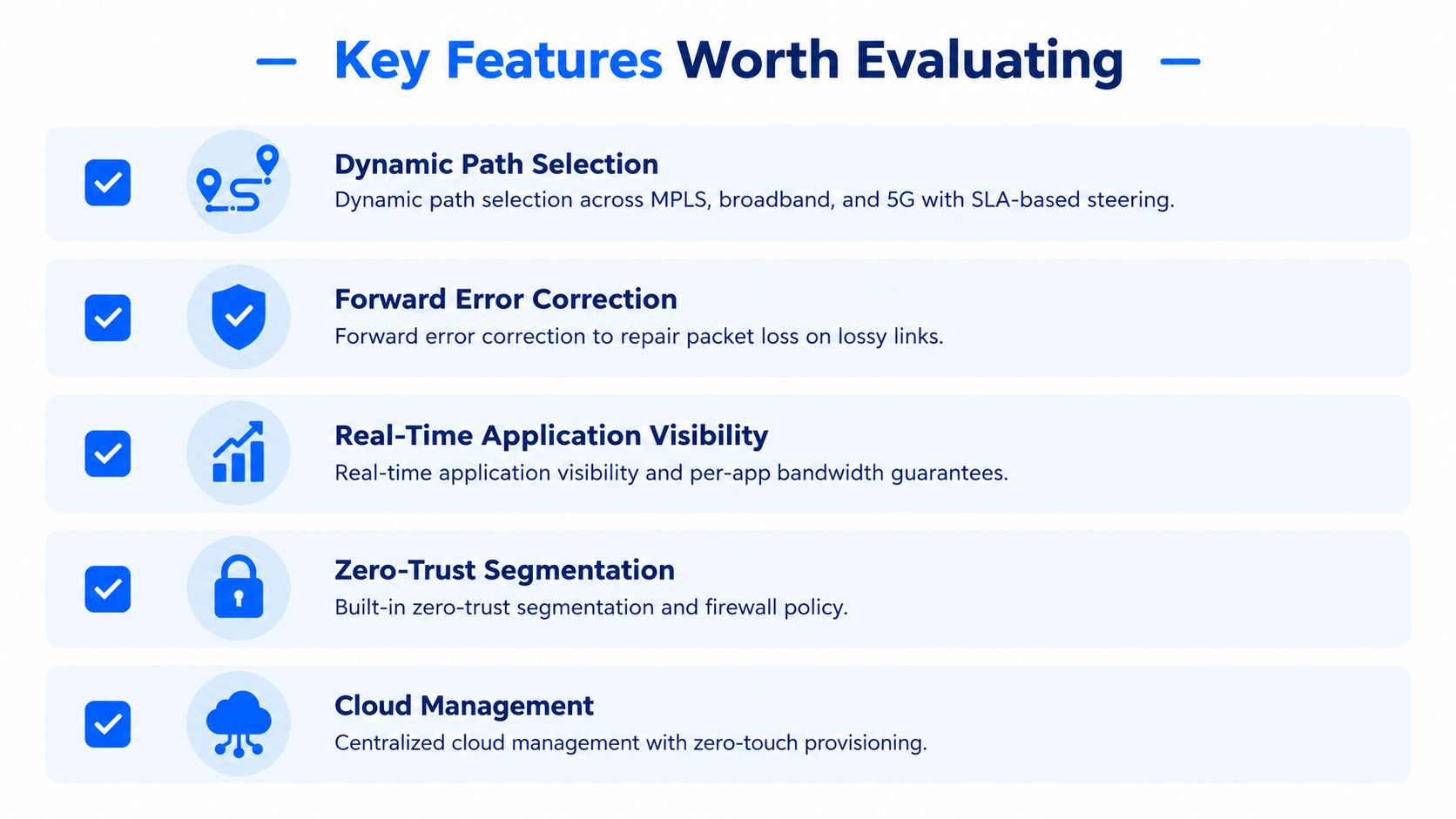
The platform should measure each available transport and apply service-level rules to traffic. Ask the vendor to degrade one link, then show whether the selected application moves, stays active, or is rebalanced across paths.
Some products use forward error correction, packet duplication, or other techniques to reduce the effect of loss. These mechanisms consume bandwidth or processing capacity, so ask what happens to other applications when correction activates.
Application-aware routing
Application steering is more useful than generic load balancing. The edge needs to recognize the traffic that matters and apply a policy to it.
Ask the vendor to show:
- Classification: How does the platform identify SaaS, voice, video, and custom applications?
- Brownout behavior: What happens when a link remains available but performs poorly?
- Quality rules: Can the platform apply different thresholds to different applications?
- Local breakout: Can approved cloud traffic avoid unnecessary backhaul?
- Troubleshooting: Can an operator see the selected path and the reason for that decision?
Independent testing shows why this deserves a lab exercise. A peer-reviewed evaluation reported that, under its tested conditions, SD-WAN increased throughput by 35%, reduced latency by 40%, and cut packet loss by 50% compared with traditional WANs, as reported in the peer-reviewed SD-WAN evaluation. Those are test-specific results, not a universal promise. Overlay design and link conditions determine the outcome.
Security and cloud access
Check whether the edge includes a stateful firewall, IPS, URL filtering, segmentation, and identity-aware controls. Then ask whether SSE or SASE functions are native, integrated through APIs, or delivered by a partner cloud.
For AWS, Azure, and Google Cloud, request a live demonstration of the onramp, routing exchange, redundancy, and policy consistency. Ask whether the platform supports direct IPsec, hosted virtual appliances, BGP peering, and cloud-region selection. Show me the failover and the logs, not just the reference architecture.
Licensing Models and Total Cost
The license that looks simple on a quote can become difficult to manage after deployment. Finance needs a predictable cost model, while network operations needs enough capacity and functionality to handle growth, seasonal demand, and security requirements.
| Model | How You Pay | Best Fit | Watch Out For |
|---|---|---|---|
| Per-device subscription | A recurring fee for each edge, often with feature or capacity tiers | A stable branch estate with predictable appliance types | Growth can trigger a new tier, and inactive or test devices may still require licenses |
| Per-bandwidth tier | Charges align with the selected or consumed bandwidth class | Environments where site capacity varies materially | Seasonal spikes and upgrades can make forecasting harder |
| Bundled SSE or SASE | WAN and security functions appear in one commercial package | Teams seeking one contract and a unified operating model | A bundled security stack may offer less flexibility than a specialist product |
Start with a normalized bill of materials. Separate hardware, software, support, implementation, circuits, cloud connectivity, security services, observability, training, and exit assistance. Request pricing for production, disaster recovery, laboratory, and temporary replacement devices so non-production licensing doesn't disappear from the comparison.
Hardware economics also deserve scrutiny. A hardware appliance purchase, a hardware-and-license bundle, and bring your own license on a virtual platform shift capital and operating costs in different ways. A low subscription price may not include the appliance, installation, cloud compute, bandwidth, or managed change service required to make the design work.
Cloud breakout can introduce charges outside the SD-WAN vendor's invoice. Ask who pays for cloud gateways, data processing, egress, hosted virtual appliances, public addresses, and redundant regions. If a managed service is involved, require a clear split between the provider's recurring fee and pass-through carrier or cloud charges.
Procurement rule: Compare the cost of operating the service, not just the price of the edge license.
Give every bidder the same site profiles, application priorities, security requirements, support window, growth assumptions, and termination scenario. Otherwise, the cheapest response may just exclude the work your team will later have to perform.
Integration Points With Cloud and Security
SD-WAN becomes part of the enterprise architecture at its integration boundaries. A branch policy can be elegant, but users still depend on cloud routing, identity controls, security inspection, logging, and operational workflows.
Cloud onramps
A cloud-connected design may use native IPsec into an AWS Transit Gateway, hub connectivity through Azure Virtual WAN, or private peering options such as GCP Partner Interconnect. The architectural choice affects routing, resilience, inspection, latency, operational ownership, and cloud charges.
Ask whether the SD-WAN platform can:
- Exchange routes: Support BGP or the required cloud routing method without manual duplication.
- Separate environments: Maintain distinct production, development, and regulated segments.
- Handle failure: Move traffic when a tunnel, virtual appliance, hub, or region becomes unavailable.
- Apply consistent policy: Preserve branch security and segmentation intent in cloud locations.
- Expose ownership: Show which team controls the SD-WAN configuration and which team controls the cloud network.
Security and observability
Security integration can include inline next-generation firewalls, SSE providers, ZTNA, secure web gateways, and identity systems. Operational integration may require syslog and IPFIX export to a SIEM, plus REST or streaming telemetry for platforms such as Splunk, Datadog, or ServiceNow CMDB.
The operating model changes the burden. A managed service can hide much of the stitching behind an MSP contract. A cloud-delivered platform may centralize integration through vendor APIs. A self-hosted deployment leaves your NetOps team responsible for certificates, connectors, upgrades, alert mapping, and troubleshooting across every boundary.
The API test
Don't accept “API available” as a sufficient answer. Test rate limits, authentication, pagination, retries, idempotent configuration, event delivery, schema stability, and version pinning. Ask whether your team can export policy and telemetry in usable formats without opening a support ticket.
For a security-focused view of the architecture, review this explanation of SD-WAN security. Your evaluation should include a real incident workflow: a site loses a transport, the security path changes, the SIEM receives events, and an operator can reconstruct what happened.
Choosing a Deployment Model Without Lock-In
The deployment model determines who carries the operational risk. Self-hosted, cloud-delivered, and managed service options can all work, but they fit different staffing levels, governance needs, and tolerance for provider dependency.
Choose a managed service when your organization has limited network staff, needs a rapid branch rollout, or requires a defined uptime and remediation commitment that justifies recurring spend. The provider may handle onboarding, monitoring, carrier coordination, configuration changes, and lifecycle work. You still own the business policy, risk acceptance, application priorities, and vendor governance.
Choose cloud-delivered SD-WAN when your team wants a provider-operated control plane but retains responsibility for architecture, security integration, and day-to-day network decisions. This can simplify access to the platform, but it makes tenant availability, data residency, API behavior, and provider exit terms important contract topics.
Choose self-hosted software when you need direct control over data, upgrades, integrations, and operational tooling, and you have the skills to maintain the complete service. That control has a cost. Your team must manage redundancy, certificates, hardware or compute, observability, change procedures, and support escalation.
| Lock-In Vector | Self-Hosted | Cloud-Delivered | Managed Service |
|---|---|---|---|
| Hardware CPE | You may own or lease proprietary appliances | The provider may require approved edge hardware | The provider often supplies or controls the appliance |
| Cloud tenant | You control the hosting environment | Policy and telemetry may depend on the vendor tenant | The service provider may own the tenant relationship |
| Licensing | Capacity and feature licenses remain your responsibility | Subscription tiers can restrict portability | Contract terms may bundle licenses with service tenure |
| Configuration data | You can control storage and export methods | Export depends on vendor tools and formats | The provider may hold operational records and templates |
| Exit work | Your team performs migration | You coordinate migration from the platform | Negotiate transition assistance and ownership explicitly |
Negotiate the SLA beyond uptime. Include remediation timelines, configuration change windows, incident communication, performance credits, maintenance notice, and exit assistance. Define what happens to circuits, appliances, certificates, logs, policies, and cloud subscriptions at termination.
Put these questions in every RFP:
- Can we export the full configuration as code or a documented, reusable format?
- What is the true cost and provider effort required to migrate 100 sites?
- Which components, data, licenses, and hardware remain ours if we terminate the contract?
MR2 Solutions offers vendor-neutral evaluation, design, procurement, implementation, and governance for SD-WAN and enterprise networking decisions. If you need help comparing operating models, integration requirements, and total ownership risk, contact MR2 Solutions to structure the evaluation around your business and operational requirements.