
Fractional Chief Information Officer Guide

Your board sees the same pattern every quarter. Technology spending keeps growing, vendors each defend their own roadmap, internal IT handles emergencies, and nobody can explain which initiatives directly support revenue, compliance, or operational resilience. You need executive-level technology judgment, but a permanent CIO may be more commitment than the organization needs right now.
That's where a fractional chief information officer can help, provided you treat the role as a governance decision rather than a staffing shortcut. The right executive doesn't just attend occasional meetings or review an IT budget. They establish decision rights, coordinate suppliers, set priorities, and make sure technology work produces business value even when the executive isn't on site.
Redefining the Fractional Chief Information Officer
Many buyers approach a fractional CIO as a part-time replacement for a full-time hire. They call one during a leadership vacancy, a failed implementation, or a cybersecurity scare, then expect a few recommendations and a rapid exit. That approach misses the true value of the role.
A fractional CIO is better understood as an operating-model control layer. The executive governs how your organization makes technology decisions, assigns accountability, manages suppliers, and moves initiatives from concept to execution. In a multi-vendor environment, that control layer matters more than the title. Without it, your cloud provider optimizes cloud usage, your managed service provider manages tickets, your security firm reports vulnerabilities, and your software vendors promote product adoption. Nobody necessarily owns the integrated business outcome.
The market now reflects that broader role. One industry report places the global fractional executive market above $5.7 billion in 2024 to 2025, with growth of about 14% CAGR, while demand for fractional CIO and CTO roles rose 68% year over year between 2023 and 2024 according to Alchemy Consulting's fractional CIO FAQ. The same source reports that the professional base expanded from roughly 60,000 people in 2022 to 120,000 in 2024, and LinkedIn profiles using fractional titles increased from about 2,000 in 2022 to more than 110,000 by early 2024.
Those figures matter because they show the model has moved beyond emergency cover. Mid-market and enterprise organizations increasingly buy senior technology leadership on demand when they need strategic judgment without the permanence of a full-time executive seat.
The role is broader than IT support
A managed service provider can monitor endpoints, respond to incidents, administer Microsoft 365, and maintain infrastructure. A fractional CIO decides whether those services fit the company's operating model, risk tolerance, and business priorities.
The role typically covers:
- Decision rights: Who approves architecture changes, security exceptions, vendor renewals, and major investments?
- Vendor coordination: Which supplier owns each outcome, and how are competing priorities resolved?
- Architecture discipline: Which platforms should remain, which should integrate, and which should be retired?
- Business alignment: Which technology initiatives support growth, efficiency, customer experience, or compliance?
- Leadership continuity: How does the organization preserve context between executive working sessions?
A peer-reviewed study describes fractional CIOs as experienced executives who act as CIOs part-time for multiple organizations. Its sample included 40 individuals across 10 countries, reinforcing that the model is a cross-market governance pattern rather than a local workaround. The study also emphasizes that the fractional CIO may retain the authority and responsibility associated with a full-time CIO, including direct or indirect management of IT staff and suppliers. Read the peer-reviewed analysis of fractional CIO governance before you define the role as simple advisory support.
Board-level rule: Buy a fractional CIO for decision quality and accountability, not merely for access to another pair of technical hands.
Core Responsibilities and Strategic Outcomes
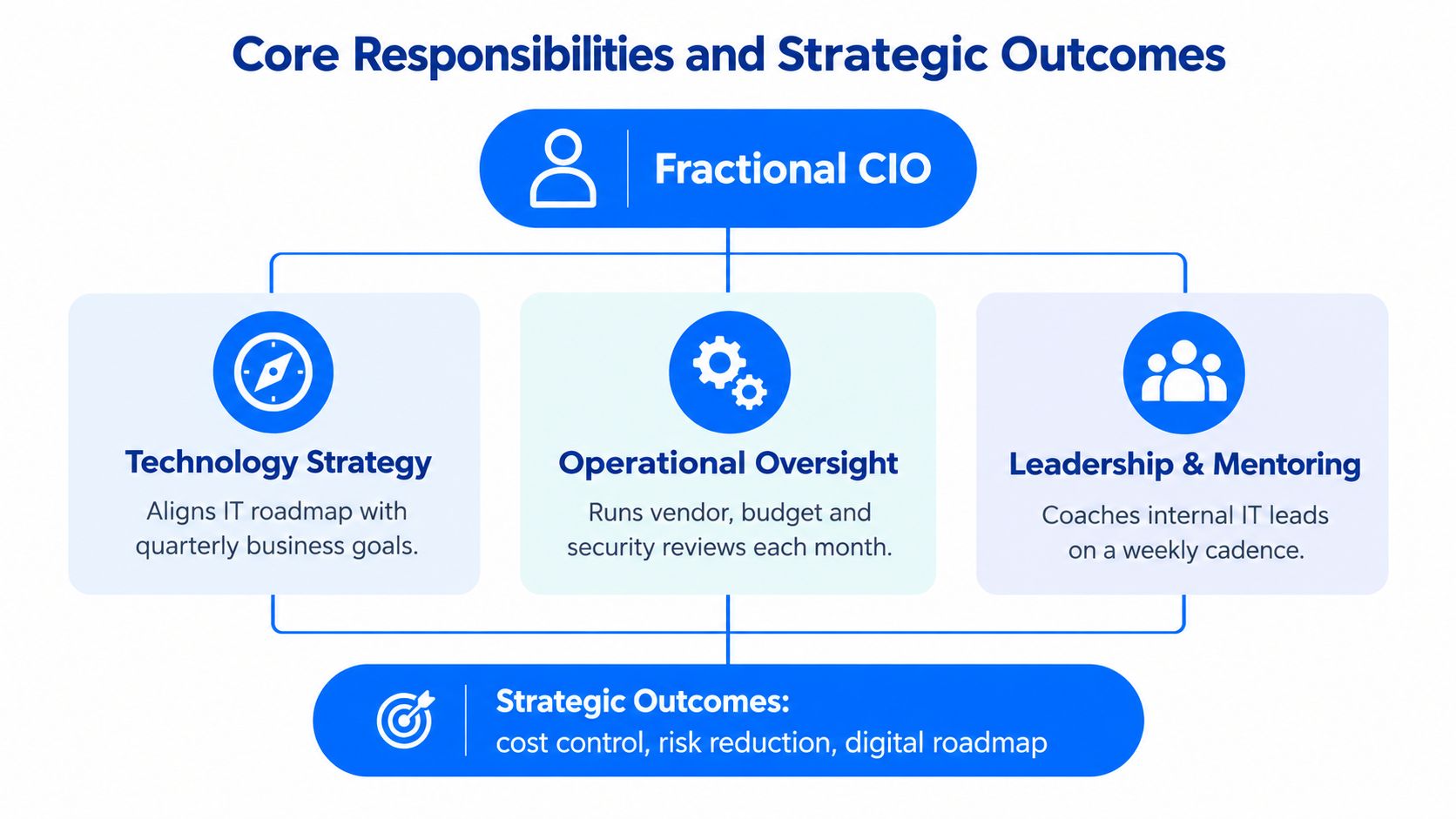
A mature fractional CIO engagement produces visible management outputs. The executive should leave your team with clearer priorities, stronger accountability, and an architecture that can be explained to the board. The work fits into three connected pillars, People, Process, and Portfolio.
People
The fractional CIO gives internal IT leaders the direction they often lack when they're strong operators but don't have executive capacity. That can include coaching an IT director, clarifying the responsibilities of an applications manager, preparing a succession plan, or helping a security lead communicate risk in business terms.
The executive also manages the relationship with external suppliers. They should review service levels, challenge recurring charges, resolve ownership disputes, and make vendors explain how their work supports agreed outcomes. In a fragmented environment, this coordination prevents five suppliers from producing five disconnected definitions of success.
People leadership doesn't mean taking over every technical decision. The fractional CIO should set the operating boundaries, then let qualified specialists execute within them.
Process
Process is where strategy becomes repeatable. The fractional CIO establishes architecture review practices, cybersecurity governance, change control, incident escalation, and reporting standards. They may introduce a technology steering committee, a decision register, a risk register, and a roadmap review that links each initiative to a business objective.
A weekly cadence might focus on blocked decisions, active risks, staffing constraints, and supplier performance. A monthly review should examine budget movement, security posture, major incidents, project status, and decisions requiring executive intervention. The exact cadence can vary, but it must be fixed. A part-time executive who only reacts to urgent emails isn't providing governance.
Portfolio
The portfolio view answers the question boards care about most: What are we buying, why are we buying it, and what happens if we delay it?
A fractional CIO should maintain a prioritized technology portfolio covering core systems, cloud, cybersecurity, data, automation, connectivity, and transformation initiatives. Each item needs an accountable owner, a business rationale, dependencies, risks, and a funding view. The executive should also identify duplicate tools, underused licenses, stalled projects, and vendor commitments that no longer fit the business.
Use this CIO job description resource to distinguish executive accountability from tactical service delivery. The job description should make clear whether the fractional CIO owns decisions, influences them, or only advises the person who does.
A useful deliverable set includes:
- A current-state technology and risk assessment
- A prioritized roadmap tied to business outcomes
- A vendor and contract accountability map
- A technology decision register
- A monthly executive dashboard
- A documented security and continuity improvement plan
Managed services keep systems running. Fractional CIO leadership decides which systems deserve investment and how they should serve the business. Don't pay one provider to perform both roles unless the contract preserves independent governance.
Evaluating Costs and Engagement Models
Cost is a valid reason to consider fractional leadership, but it is a poor reason to buy it without a defined operating model. Compare the total cost of the leadership outcome, not just the invoice line.
Market benchmarks commonly place fractional technology leadership retainers between $6,000 and $15,000 per month, with hourly rates typically between $150 and $350, depending on scope and complexity. These benchmarks are reported in coverage of the fractional executive market. Treat them as market reference points, not as a substitute for a scoped proposal.
| Cost Factor | Full-Time CIO | Fractional CIO |
|---|---|---|
| Compensation | Permanent salary, bonus, benefits, and possible equity | Retainer or hourly fee tied to agreed scope |
| Availability | Dedicated executive capacity | Scheduled capacity with defined escalation access |
| Recruitment | Executive search, assessment, onboarding, and transition risk | Vetted sourcing and faster access to specialized leadership |
| Continuity | Strong day-to-day context if the role is well supported | Requires documentation, cadence, and internal ownership |
| Scope | Broad organizational mandate | Deliberately limited mandate with explicit priorities |
| Financial flexibility | Ongoing fixed leadership commitment | Capacity can expand or contract as priorities change |
| Governance | Usually embedded in the executive structure | Must be designed through contract, reporting, and decision rights |
Select the right engagement model
A fixed-scope project engagement fits a defined challenge, such as ERP selection, cloud migration governance, or preparation for a security audit. It should end with specific deliverables, decisions, and handoff documentation.
An ongoing strategic retainer fits organizations with recurring governance needs. Choose this model when the business has multiple suppliers, an active transformation portfolio, or internal IT leaders who need regular executive direction.
An interim arrangement is appropriate when a full-time CIO is expected but recruitment or transition will take time. Don't let an interim arrangement drift into an undefined permanent substitute. Set a transition plan, ownership expectations, and a decision point.
Contract test: If the agreement lists hours but doesn't define decisions, deliverables, escalation rights, and reporting, you're buying availability rather than leadership.
Measure value beyond fee reduction
Build the business case around avoided waste and improved control. Review whether the engagement:
- Prevents an unsuitable platform purchase
- Identifies overlapping licenses and vendor services
- Improves the sequence of transformation projects
- Reduces unresolved ownership disputes
- Gives the board a reliable view of technology risk
- Accelerates decisions that were blocking operational work
A technology expense review should connect contracts, consumption, service quality, and business need. The technology expense management approach from MR2 Solutions is one example of how boards can examine spend as a portfolio rather than as isolated invoices.
When to Hire Fractional IT Leadership
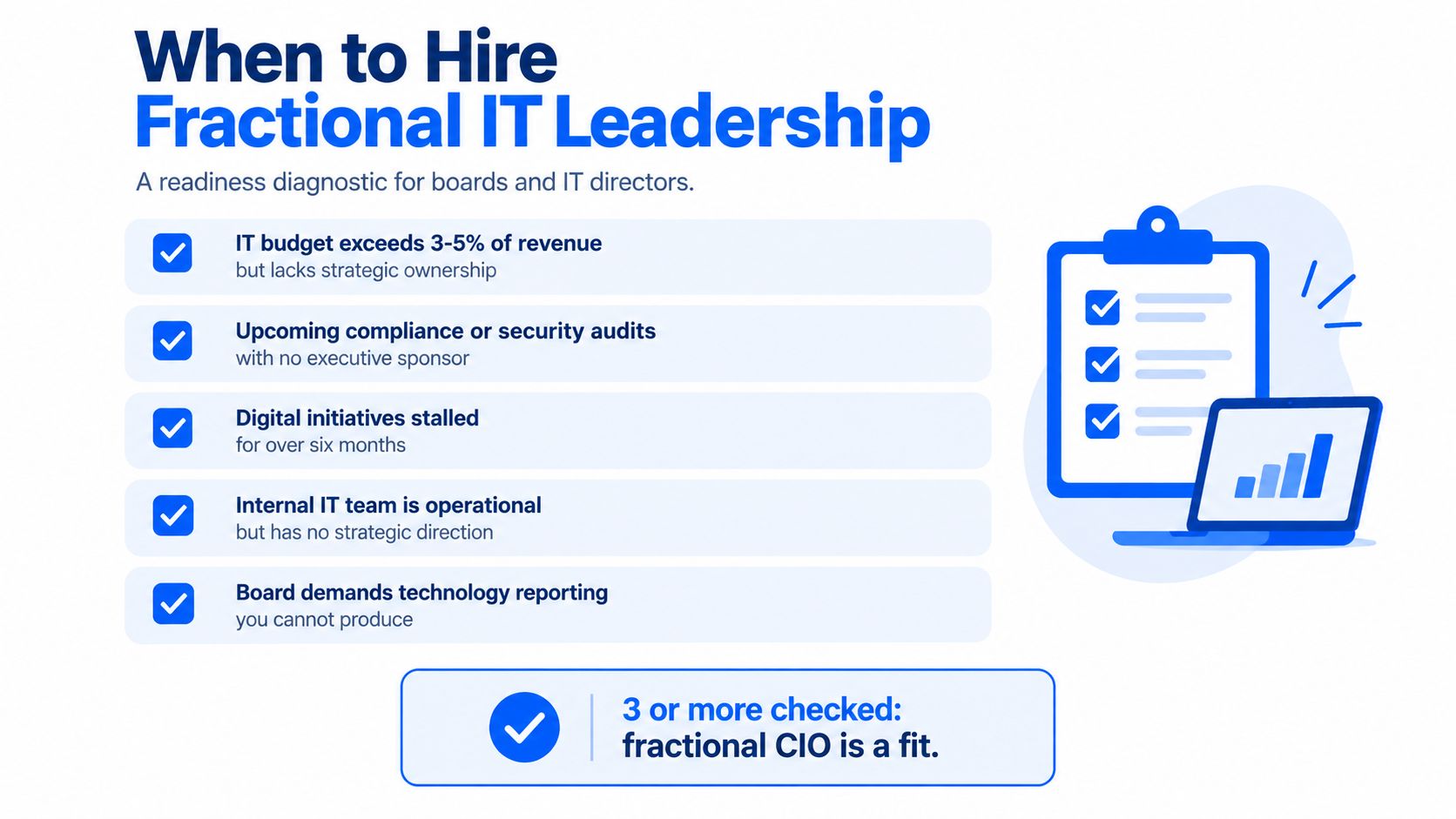
A fractional CIO is appropriate when your organization has enough technology complexity to require executive judgment, but not enough need for permanent executive capacity. The trigger isn't company size alone. It's the combination of business dependence, decision friction, and leadership gaps.
Use this diagnostic sequence before signing a retainer.
Start with the business trigger
Hire fractional leadership when a business event has raised the cost of weak technology governance. Common triggers include a complex cloud migration, a cybersecurity or compliance initiative, rapid organizational change, a merger, a fragmented supplier base, or a strategic project that keeps losing momentum.
The important question is whether the trigger requires cross-functional authority. If a specialist can complete the work within a clear technical scope, hire the specialist. If the work requires competing departments and vendors to agree on priorities, you need executive governance.
Test internal readiness
The fractional model works best when an internal team can execute decisions after the executive makes them. Check whether you have:
- An operational owner: Someone inside the company can manage daily IT work and follow through on assigned actions.
- A business sponsor: The CEO, COO, CFO, or another executive will resolve conflicts and reinforce the CIO's mandate.
- A vendor inventory: You know which providers support which systems, what each contract covers, and where accountability is unclear.
- A decision path: Leaders can approve priorities, risk exceptions, budget changes, and architecture standards without endless meetings.
- A documentation habit: Systems, dependencies, risks, and decisions can live in a shared repository rather than in personal memory.
Research on SME fractional CIO engagements identifies four interacting success components, the fractional CIO, the client, their relationship, and the engagement setup. The related research examined engagement types and success factors across 62 fractional CIOs from 10 countries, showing that the title alone doesn't determine the outcome. Review the research on fractional CIO engagement success factors when assessing organizational readiness.
Know when not to hire one
Don't hire a fractional CIO if nobody can execute the roadmap, if the board won't grant decision authority, or if the company expects the executive to function as an always-available helpdesk. In those conditions, a managed service provider, an IT operations manager, or a full-time CIO may be the better choice.
Designing the Governance and Continuity Setup
The biggest continuity risk isn't that a fractional CIO works part-time. It's that the organization fails to capture decisions, context, and accountability between working sessions.
Independent analysis identifies recurring weaknesses in fractional CIO engagements, including limited depth, difficulty maintaining continuous business context, and a reactive operating stance. That finding should change how you write the contract. The continuity problem is a governance design problem, not proof that fractional leadership cannot work. See the analysis of the rise of fractional CIOs for context on the model's increasing specialization around cyber, cloud, and data strategy.
Put decision rights in writing
Your statement of work should identify who can decide, who must be consulted, and who executes. Use a simple decision-rights matrix for areas such as:
- Architecture standards and exceptions
- Security risk acceptance
- Vendor selection and renewal
- Project prioritization
- Budget reallocation
- Incident escalation
- Data access and retention
- Business continuity testing
Also define escalation paths. A supplier issue that threatens a critical service shouldn't wait for the next scheduled meeting. Specify the trigger, the responsible internal executive, the communication channel, and the expected response pattern.
Make continuity operational
The fractional CIO should maintain a shared governance hub containing the roadmap, decision register, risk register, vendor map, project status, meeting records, and architecture principles. Your internal IT lead should update operational information, while the CIO records strategic decisions and unresolved dependencies.
Use asynchronous communication deliberately. A short weekly written update can capture decisions made, risks emerging, actions due, and items requiring executive attention. The board shouldn't need to reconstruct technology context from scattered emails.
Establish a fixed rhythm
A practical setup includes:
- A weekly operating meeting with internal IT and key suppliers
- A recurring leadership review focused on business priorities and risk
- A monthly budget, vendor, security, and portfolio review
- A regular board report using stable metrics and plain language
- A documented checkpoint to confirm whether the engagement still fits
Continuity principle: The executive can be part-time. The governance system cannot be occasional.
Define the handoff from the start. When the fractional CIO is unavailable, the internal IT owner should know which decisions they can make, which supplier to contact, and which issues require escalation. When the engagement ends, the organization should retain its roadmap, records, standards, and operating cadence. If the value disappears the moment the executive leaves, the company bought personal dependency instead of durable capability.
Sourcing Talent Through Technology Brokerage
The hardest part of a fractional CIO search isn't finding someone who has held the title. It's finding someone whose judgment matches your industry, supplier ecosystem, regulatory exposure, and internal culture.
Generalist staffing agencies often optimize for candidate availability. Personal networks optimize for familiarity. Neither method necessarily tests whether the executive can govern a complicated environment without favoring a preferred vendor. Boards should look for a sourcing mechanism that evaluates both leadership depth and independence.
Why neutrality changes the decision
A vendor-neutral technology brokerage can assess the business problem before recommending a person, platform, or service provider. That sequence matters. If the same firm earns revenue from reselling a specific security platform, cloud service, or managed service, its roadmap may be shaped by commercial incentives rather than by your requirements.
A brokerage-led search should examine:
- The candidate's experience with comparable operating complexity
- Their record of vendor negotiation and supplier governance
- Their ability to translate technical risk for a board
- Their approach to architecture standards and exceptions
- Their ability to coach internal staff rather than displace them
- Their willingness to document decisions and transfer context
This is the practical value of Technology Brokerage-as-a-Service, or TBaaS. The broker can coordinate discovery, evaluate options, procure services, and govern implementation through a curated provider ecosystem. Fractional human capital becomes part of the operating model rather than a disconnected staffing purchase.
Organizations comparing flexible executive capacity with broader workforce options may also find this resource on flexible staffing for busy professionals useful. The key distinction is that fractional CIO sourcing requires governance judgment, not just scheduling flexibility.
Demand proof of independence
Ask candidates to describe a situation where they rejected a popular tool, challenged a supplier's recommendation, or stopped a project that lacked business readiness. Strong executives explain the decision criteria, the stakeholders involved, and how they managed the consequences.
Ask the brokerage how it handles conflicts, how it compares providers, and who owns the final recommendation. The engagement should give your organization one accountable advisory point while preserving your right to choose the architecture and suppliers.
Use a structured cloud services brokerage market overview when your fractional CIO will govern cloud providers or a hybrid environment. That research should support a broader conversation about sourcing discipline, not push the organization toward a predetermined platform.
MR2 Solutions offers vendor-neutral technology brokerage alongside fractional IT and security leadership, managed services, cybersecurity, cloud, networking, and technology expense management. Present that kind of provider as one option within a clearly governed selection process, not as a replacement for independent board oversight.
Executing the First 90 Days of Engagement
The first 90 days should create control, not produce a decorative strategy document. The fractional CIO needs to learn the business quickly, establish credibility with the internal team, and give leadership a defensible view of risk and priorities.
Days 1 to 30 focus on discovery
The executive starts with stakeholder interviews across finance, operations, sales, compliance, and IT. They review the current roadmap, supplier contracts, security posture, major incidents, core systems, budget commitments, and projects that have stalled.
The first output should be a plain-language baseline. It should identify immediate risks, unclear ownership, duplicated spend, architectural constraints, and quick wins. The CIO should also explain what they won't prioritize yet. Restraint builds more confidence than a long list of ambitious initiatives.
Days 31 to 60 create the roadmap
The next phase converts findings into decisions. The CIO ranks initiatives by business value, risk, dependency, readiness, and available execution capacity. They establish the steering committee, document decision rights, set the reporting cadence, and negotiate changes with suppliers where contracts or service expectations don't match the roadmap.
Internal IT staff should participate in this work. They know where systems fail in practice, and they'll be responsible for execution after the executive moves on. Treating them as a handoff destination rather than as design partners creates avoidable resistance.
Days 61 to 90 demonstrate execution
By the final phase, at least some governance improvements should be operating. The board should receive a concise dashboard covering active priorities, key risks, supplier accountability, budget direction, and decisions required. The organization should also see progress on selected quick wins, such as consolidating ownership, closing a documented security gap, or removing a blocked project dependency.
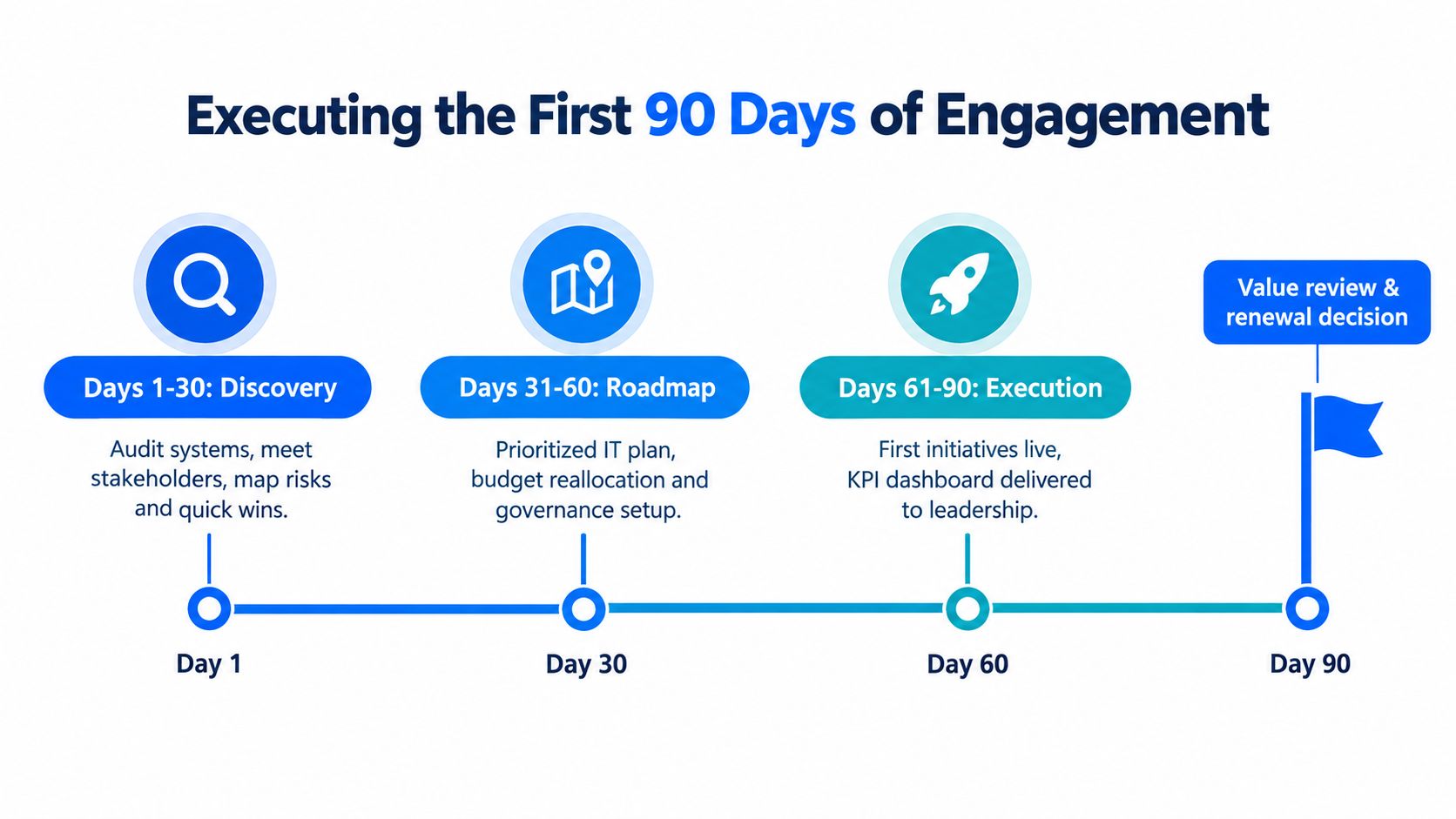
At the day 90 review, assess whether the executive has improved decision velocity, clarified accountability, strengthened supplier control, and produced a roadmap the business can execute. Renew the engagement only when the next phase has defined outcomes and the governance system is working.
MR2 Solutions helps mid-market and enterprise organizations design fractional CIO engagements, coordinate multi-vendor technology decisions, and connect IT investment to business outcomes. Visit MR2 Solutions to discuss your current supplier base, leadership gap, and the governance structure your organization needs.