
Chief Technology Officer as a Service Explained

A chief technology officer as a service engagement is a contracted technology executive who owns architecture, vendor, and security decisions within a defined scope and cadence. The market has been estimated at US$280 million in 2024, with a projection of US$557 million by 2031, while another estimate places it at US$3.97 billion in 2025 and projects US$12.5 billion by 2035, reflecting different market definitions rather than a settled category.
You're likely considering the model because the technology queue has outgrown the leadership capacity around it. A permanent CTO has left, an AI initiative is competing with infrastructure work, vendors are renewing on different schedules, and the CIO is now expected to resolve architecture, security, and delivery disputes personally.
That situation doesn't call for another adviser who produces recommendations and waits for someone else to act. It calls for a defined technology owner who can approve trade-offs, maintain an evidence trail, and connect technical decisions to business measures. CTO-as-a-Service works when it operates as a governance layer, not when it functions as a few hours of executive coaching.
What CTO as a Service Really Means in Practice
A mid-market company loses its permanent CTO just as its roadmap becomes harder to manage. Three ERP platforms need to exchange data, a new AI pilot is consuming engineering attention, and several vendors are asking for renewal decisions. The CIO inherits the queue, but every decision is disputed because nobody knows who has authority to choose the architecture, reject a supplier, or accept a security exception.
An adviser can review the situation and recommend a path. A properly structured chief technology officer as a service engagement does more. It names an accountable executive, gives that person explicit authority, and establishes a rhythm for making and recording decisions.
The distinction becomes visible in the first month:
- Named ownership: The contracted CTO owns defined architecture, vendor, and security decisions rather than merely attending steering meetings.
- Operating cadence: A weekly architecture review resolves open RFCs, while vendor decisions receive written approvals and rationale.
- Security baseline: The engagement establishes a documented security baseline and an exception process, rather than treating security as a later workstream.
- Executive visibility: The CIO and board receive a concise report showing decisions made, risks accepted, and delivery constraints.
Those outputs matter because technology leadership is mostly a discipline of resolving ambiguity. In a multi-vendor environment, teams stall when they can't tell whether a platform choice belongs to engineering, procurement, security, or the executive team. The fractional CTO should reduce that uncertainty by defining decision rights before the first major dispute occurs.
Practical rule: If the engagement doesn't produce approved RFCs, vendor scorecards, incident postmortems, and a quarterly board memo, it's probably advisory capacity rather than operating leadership.
The role should also include a capacity model. A part-time executive can become a bottleneck if every issue is treated as urgent, so the contract needs a prioritization method based on business criticality and explicit escalation paths. The result is not a temporary title. It's a controlled mechanism for making technology decisions, measuring their consequences, and handing ownership to an internal or permanent successor when the engagement ends.
Core Responsibilities and Deliverables
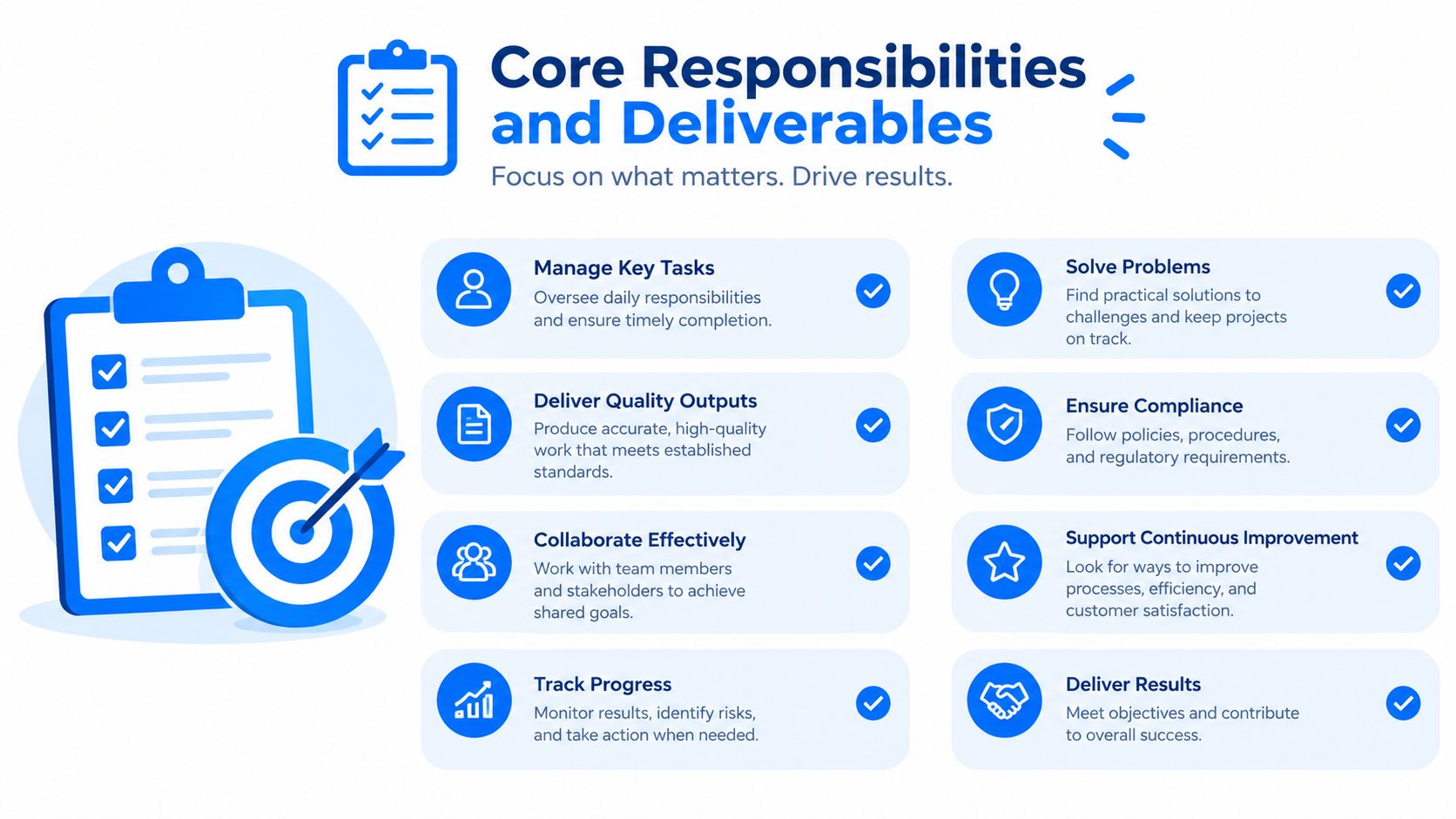
A fractional CTO should leave behind operational evidence every week. The buyer shouldn't have to infer progress from meeting attendance or polished presentations. Each workstream needs a decision, an owner, a due date, and a metric that shows whether the decision changed the business.
Architecture and platform consolidation
The first responsibility is to turn a fragmented technical estate into an intentional target state. The CTO should maintain a target architecture diagram, a dependency map, and a prioritized list of architectural risks.
That work might include deciding whether two overlapping integration platforms should be consolidated, approving a standard pattern for API authentication, or defining the boundary between an ERP and a customer-facing application. Weekly architecture office hours give engineering leads a place to raise RFCs before inconsistent choices spread across teams.
The deliverables should include:
- A target architecture and transition roadmap.
- An RFC register with status, owner, and approval authority.
- A technical debt inventory ranked by delivery, reliability, or security impact.
- A platform standard that identifies approved patterns and prohibited exceptions.
Vendor and contract governance
Vendor sprawl creates both cost and accountability problems. The CTO should work with procurement to maintain vendor scorecards covering service quality, security posture, integration fit, renewal timing, and exit risk.
A Monday vendor queue review is useful because it forces renewal and selection decisions into a regular operating rhythm. The CTO shouldn't sign every contract, but the engagement should define which suppliers can be approved within delegated authority and which require executive or board approval.
A scorecard should also include renewal triggers. A supplier with repeated incidents, weak evidence, or poor integration performance shouldn't reach renewal by default only because nobody opened the contract early enough.
Security and compliance baseline
Security ownership can't remain implied. The CTO should establish a security exception register, identify accountable owners, and maintain an incident playbook that explains who decides, who communicates, and who approves recovery actions.
The baseline should cover identity, privileged access, backup and recovery, third-party risk, vulnerability handling, and evidence needed for audits or customer reviews. A monthly executive scorecard can show unresolved exceptions, incident themes, and remediation status without burying the leadership team in technical detail.
The CTO may work closely with a vCISO or internal security lead, but the architecture and risk trade-offs still need a named owner. That distinction becomes critical when a product team wants to introduce an AI service that changes data flows or vendor exposure.
AI and product direction
An AI use-case portfolio prevents experimentation from becoming an uncontrolled collection of pilots. Each proposed use case should identify the business problem, data required, model or platform options, human oversight, security implications, and a clear kill criterion.
The CTO should approve the build-versus-buy decision, define a path from prototype to production, and connect each initiative to product or operational metrics. A use case that can't meet its data, risk, or adoption conditions should stop before it absorbs more engineering capacity.
Advice is not a deliverable. A deliverable names the decision, owner, due date, and measure that will move.
The strongest engagements make these artefacts visible to engineering, procurement, security, and finance. That shared record turns the fractional CTO into an operating participant rather than an executive commentator.
Fractional CTO vs Full-Time CTO vs Other Fractional Executives
The choice isn't primarily about whether a company can afford a permanent salary. It's about whether technology requires a permanent executive presence, and which decisions the role must own.
A full-time CTO is the right choice when technology is a primary revenue driver, product and engineering decisions shape the company's competitive position, and the board treats technology as a standing executive function. The role needs continuous cultural influence, recruiting ownership, and daily participation in product and operating decisions.
A fractional CTO fits when the company needs senior authority but doesn't yet need a permanent seat. This is common when the roadmap is complex, the internal engineering team needs governance, or the business is navigating a transition. The engagement should still carry decision rights, not just scheduled advice.
A vCIO is better when the constraint is IT service delivery, budget control, user support, infrastructure operations, or portfolio prioritization. CIO responsibilities often center on reliable business services and investment governance rather than product architecture. Organizations comparing this role with CTO leadership can review fractional chief information officer services to clarify where the mandate belongs.
A vCISO should own security strategy, control design, incident readiness, and compliance evidence when regulatory exposure is the dominant risk. Don't substitute a fractional CTO for a vCISO on an AI initiative. The CTO can decide how a system should be architected, but security leadership must independently test data handling, access, monitoring, and response obligations.
Use these triggers:
- Choose full-time CTO leadership when technology drives revenue and requires daily executive integration.
- Choose a fractional CTO when the business needs architecture and product direction without a permanent executive calendar.
- Choose a vCIO when service management, IT economics, and operational reliability are the main constraints.
- Choose a vCISO when compliance, cyber risk, or incident preparedness requires specialist ownership.
Headcount matters, but it shouldn't decide alone. A smaller company with a high-risk product may need stronger governance than a larger company with a straightforward technology estate. Roadmap complexity and regulatory exposure are better signals than size by itself.
Engagement Models and Pricing Structures
Commercial structure determines how much authority the CTO can exercise and how much risk remains with the client. Buyers should negotiate the operating model before debating the fee.
A monthly retainer creates the closest equivalent to a standing executive seat. It can include scheduled leadership participation, ongoing architecture ownership, vendor governance, and recurring reporting. This model works when technology is central to the business and decisions continue beyond one project.
A sprint or project-based engagement focuses on a defined result, such as a cloud migration, platform assessment, or technology operating model. It creates useful urgency, but authority often returns to the client when the deliverable is complete. The contract should specify who owns decisions during the project and what documentation must be handed back.
An equity-plus-advisory model is more appropriate for founders who need experienced challenge and board-level guidance but have limited cash. It usually provides narrower operating authority. It shouldn't be presented as a substitute for embedded execution unless the agreement explicitly says otherwise.
| Dimension | Monthly Retainer | Sprint / Project-Based | Equity + Advisory |
|---|---|---|---|
| Primary purpose | Ongoing technology leadership | Defined transformation outcome | Strategic coaching and challenge |
| Decision rights | Can include standing approval authority | Usually limited to project scope | Typically advisory or board-level |
| Risk allocation | Shared through continuous governance | Concentrated around delivery scope | Client retains most operating risk |
| IP ownership | Must cover ongoing documentation and code | Must define project deliverables | Usually narrower and tied to advisory work |
| Best fit | Technology is core to business operations | A specific platform or architecture problem | Early-stage companies seeking strategic guidance |
Every model needs clear treatment of signing authority, architecture and code ownership, confidentiality, non-solicit terms, conflict checks, and termination notice. A vendor-neutral technology expense management process can help connect the CTO's recommendations to contract renewals, total cost, and supplier performance rather than leaving commercial decisions outside the technology plan. Technology expense management should support the governance model, not operate as an unrelated finance exercise.
The right question is not which model costs less. Ask how permanent the leadership gap is, how much technology affects revenue, and whether the company needs someone to decide or merely someone to advise.
Why Demand for CTO as a Service Is Growing
Market estimates disagree sharply because providers define the category differently. One report estimated the CTO-as-a-Service market at US$280 million in 2024 and projected US$557 million by 2031, implying a 9.8% CAGR over that forecast period, as described in this analysis of changing fractional CTO demand. Another report estimated US$3.97 billion in 2025 and projected US$12.5 billion by 2035, implying a 12.1% CAGR. Both estimates point to growing interest in flexible technology leadership, but the gap is a warning to buyers: this is still a fragmented category.
The demand is not driven by one problem.
AI execution creates a leadership gap between ambition and operating control. Organizations may have promising use cases but lack an executive who can decide which data is usable, which platform fits, how models move into production, and when a pilot should stop. AI-led engagements need architecture authority and production accountability, not a monthly strategy presentation.
Governance exposure creates a second driver. Boards, customers, insurers, and regulators expect named ownership for security, data, and third-party risk. A contracted CTO can provide that ownership on a defined scope, provided the engagement includes reporting, decision logs, and clear escalation rules.
Interim coverage is the third driver. A leadership departure can leave a roadmap without an accountable technical decision-maker. Fractional coverage gives the CIO time to run a disciplined search, preserve delivery momentum, and define a handoff rather than rushing into a poor permanent appointment.
Treating these situations as one generic service is a buying mistake. Before selecting a provider, score the organization's operating readiness with a readiness scoring model, then write a brief that states whether the primary need is AI execution, governance, or transition coverage.
How to Evaluate and Select a CTO as a Service Provider
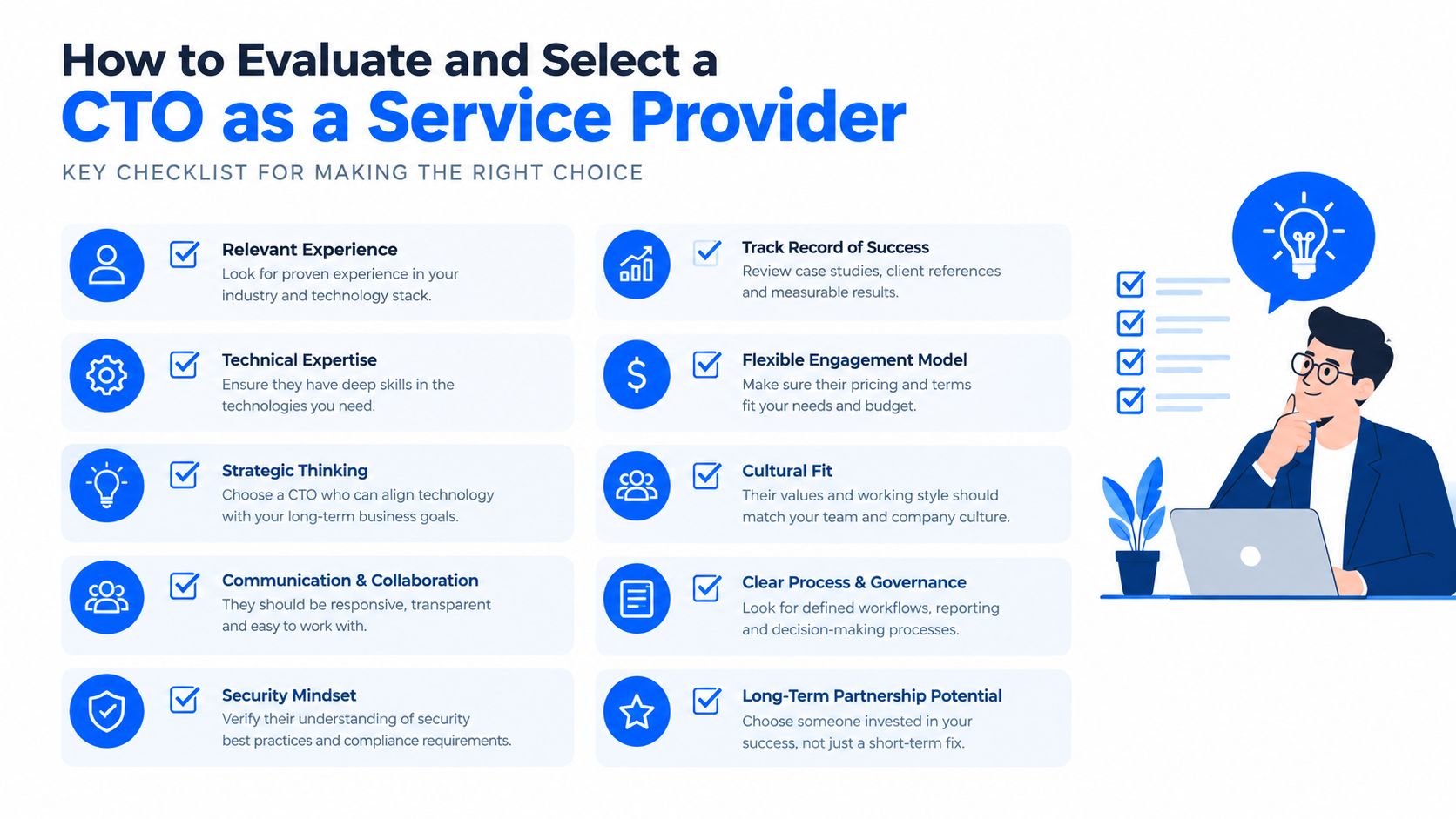
Don't begin with résumés. Begin with authority.
The contract should state which decisions the CTO can approve independently, such as architecture patterns, vendor selection within a delegated threshold, and incident response actions. It should also state which decisions require CEO, CIO, or board approval. Anything left ambiguous will be contested when the first expensive trade-off arrives.
Test the operating rhythm
Require evidence of a repeatable cadence before signing:
- Weekly status: Written progress, unresolved decisions, risks, and ownership.
- Monthly steering: Executive review of delivery, spend, security, and vendor issues.
- Quarterly architecture review: Reassessment of technical debt, platform direction, and roadmap fit.
- Decision log: A maintained record of approvals, rejected options, assumptions, and reversals.
This structure distinguishes an operator from an adviser. A provider who only offers workshops and recommendations may be capable, but the engagement won't close a governance gap unless someone has authority to act.
Choose a small KPI set
Use a limited group of measures that match the mandate. Useful examples include deployment frequency, incident mean time to resolution, uptime, vendor consolidation progress, infrastructure-spend efficiency, bug-resolution time, and security issue resolution time. The relevant KPI depends on the constraint. A platform rebuild should not be judged by the same measure as an interim leadership mandate.
Compensation doesn't need to depend entirely on outcomes, especially where the CTO lacks control over staffing or budget. It should, however, include explicit success measures and review points rather than rewarding hours alone. Expert guidance on technical KPIs for CTO-as-a-Service reinforces this focus on delivery, reliability, spend, and security outcomes.
Examine security and exit hygiene
Ask for relevant security qualifications, insurance coverage, conflict checks, and a clear IP assignment covering code, diagrams, decisions, and documentation. Require an exit clause with notice, transition obligations, current architecture records, and named handoff participants.
Use the same discipline in procurement. A structured IT procurement process should preserve vendor neutrality, document evaluation criteria, and separate technical approval from commercial pressure.
Real-World Use Cases and Outcomes
The title stays the same, but the mandate changes with the company's operating reality.
A seed-stage SaaS company may need architecture discipline before it needs executive scale. The fractional CTO reviews the product's core design, approves a limited vendor set, defines security expectations, and creates a hiring plan for the first in-house engineering leader. Success is measured through clearer release ownership, fewer architecture reversals, and a documented path from outsourced or founder-led delivery to internal leadership.
A multi-site services company faces a different problem. Regional teams have selected overlapping tools, contracts renew independently, and security controls vary by location. The CTO owns a consolidation roadmap, helps negotiate master service agreements, and defines a shared baseline for identity, connectivity, data protection, and incident handling.
The scorecard should focus on operational consistency. Relevant measures include vendor cost per seat, unresolved integration decisions, incident patterns, and progress against the consolidation roadmap. The CTO doesn't need to centralize every local choice, but the role must establish which standards are mandatory and where local exceptions are acceptable.
The company stage changes the success metric. A young product team needs architectural confidence, while a distributed operator needs consistency and control.
An organization running an AI transformation needs another shape of engagement. The CTO governs model selection, data ownership, access controls, platform choices, and the build-versus-buy decision. The portfolio should show which use cases have passed data and risk checks, which are in production, and which have been stopped.
Time-to-first-AI-feature can be useful for a product-led company, while incident rates and security issue resolution may matter more for a regulated operator. The point isn't to attach the same KPI set to every engagement. It's to connect the role's authority to the constraint that limits progress.
A fractional CTO succeeds when the organization can see the mechanism behind the outcome. The record should show which decision changed the roadmap, which control reduced exposure, and which technical constraint the team removed.
Avoiding the Advice-Only Failure Mode
The most common failure is easy to recognize. The CTO produces a strategy deck, attends leadership meetings, and sends recommendations, while engineering continues to make unrecorded architecture choices and procurement renews suppliers by default. The company has purchased executive language without gaining executive control.
Three contract mechanisms prevent that outcome.
Establish a decision-rights matrix
Create a matrix that divides decisions into three categories:
- CTO-owned: The CTO can approve defined architecture patterns, vendor selections within an agreed threshold, and operational responses within scope.
- Jointly approved: The CTO recommends and the CEO, CIO, or board approves decisions involving major investment, risk acceptance, or strategic product direction.
- Team-owned: Engineering and product leaders retain decisions that fall within approved standards and do not create material risk or architectural divergence.
The matrix should identify escalation routes as well. A disputed decision can't sit indefinitely in a queue because two executives interpret the contract differently.
Tie performance to business measures
The engagement should track the measures that reflect its mandate. Depending on the work, that may include delivery cycle time, deployment frequency, uptime, incident resolution, roadmap milestones, vendor efficiency, or security remediation. The CTO shouldn't be rewarded for generating more meetings or documents.
Use monthly reviews to test whether the role is changing outcomes. If the KPI is flat, the leadership team should ask whether the CTO lacks authority, the internal team lacks capacity, or the chosen priority is wrong.
Make overrides accountable
The CEO or CIO must be able to reverse a CTO decision. That safeguard protects the business when commercial, legal, or strategic conditions change. But the override should require written justification within five business days, as recommended in the engagement design described in the fractional CTO governance guidance.
This rule protects both sides. The CTO can make decisions without fearing informal reversal, and the executive sponsor must explain why an approved trade-off is being changed. It also keeps the decision log useful for future leaders.
CTO-as-a-Service is not a cheaper way to buy slide decks. It's a way to add experienced decision capacity where the organization needs control but isn't ready, or doesn't need, a permanent executive seat. If the contract doesn't define authority, KPIs, escalation, and handoff, don't call it technology leadership. Call it consulting.
MR2 Solutions can help you structure a governance-led technology leadership engagement, evaluate vendors, and coordinate architecture, security, procurement, and implementation decisions across a multi-vendor environment. Visit MR2 Solutions to discuss whether a fractional CTO, vCIO, vCISO, or broader technology brokerage model fits your current operating gap.