
What Is IT Staff Augmentation and How It Works

IT staff augmentation is a workforce model in which external specialists join your existing team under your management, while the provider handles sourcing, employment, payroll, and replacement. The global staff augmentation services market was estimated at USD 122.54 billion in 2025 and is projected to reach USD 201.53 billion by 2032, while another estimate places the IT staff augmentation market at USD 105.45 billion in 2025 and USD 178.97 billion by 2032.
An IT director can understand the appeal without needing a presentation. The roadmap is approved, the delivery date is already visible on the calendar, and two important technical roles have remained open long enough to threaten the plan. The internal team knows what to build, but it doesn't have enough people to build it at the required pace.
That situation creates a difficult choice. Permanent hiring may take too long or add headcount the business doesn't want to carry indefinitely. Outsourcing may introduce a layer of separation that makes it harder to control architecture, security, and daily priorities. Staff augmentation sits between those options, but only if the organization understands exactly where control, accountability, and risk remain.
This guide explains what IT staff augmentation is, how it works, where it fits, and when another delivery model makes more sense. It also covers the governance conditions that determine whether added specialists improve throughput or just add coordination work.
Why IT Leaders Keep Asking What Is IT Staff Augmentation
The question usually appears in the middle of a delivery problem, not during a vocabulary exercise. A mid-market technology leader may have an active cloud migration, a security program, or a network rollout already approved. The business expects progress, but the internal team is balancing operational tickets, executive requests, and vacancies that haven't been filled.
That leader doesn't necessarily need an entirely new department. They may need a cloud security engineer for a defined initiative, a network specialist during a rollout, or several developers to clear a backlog while the permanent organization remains stable.
Staff augmentation is the answer when external specialists join the existing team and work under the client's direction, while the provider takes care of sourcing, employment, payroll, and replacement. The client still owns the roadmap, priorities, technical decisions, and delivery result. The provider supplies the employment and talent infrastructure around the specialist.
The problem is usually capacity or capability
A capacity gap means the organization has the right skills but not enough hands. For example, an internal platform team may understand its deployment process but lack the people required to support a major release and normal operations at the same time.
A capability gap is different. The team may have enough people, but nobody has the specialist knowledge needed for cloud security, infrastructure engineering, or another narrow discipline. Augmentation allows the buyer to specify the required role, seniority, or domain expertise instead of commissioning an entire project from an outside company.
That distinction matters during procurement. A request for “help with our cloud program” is too broad to govern well. A request for an engineer who can work within the existing cloud architecture, review security controls, and support a defined migration backlog gives the provider and client a much clearer basis for selection.
Control changes the decision
The central question isn't just whether an external person is involved. It is who directs the work and who owns the outcome.
With staff augmentation, the external specialist normally participates in the client's meetings, uses the client's tools, follows its engineering standards, and receives daily direction from its managers or technical leads. That structure can preserve consistency in environments where process drift, security controls, and architecture standards matter.
The model isn't a shortcut around leadership. It works best when the organization already has a defined roadmap and internal product ownership. Without those foundations, an additional specialist may spend more time asking what to do than completing the work.
Practical rule: Buy additional execution capacity when your organization knows what must be delivered and can assign someone internally to direct it.
The Core Concept Explained Simply
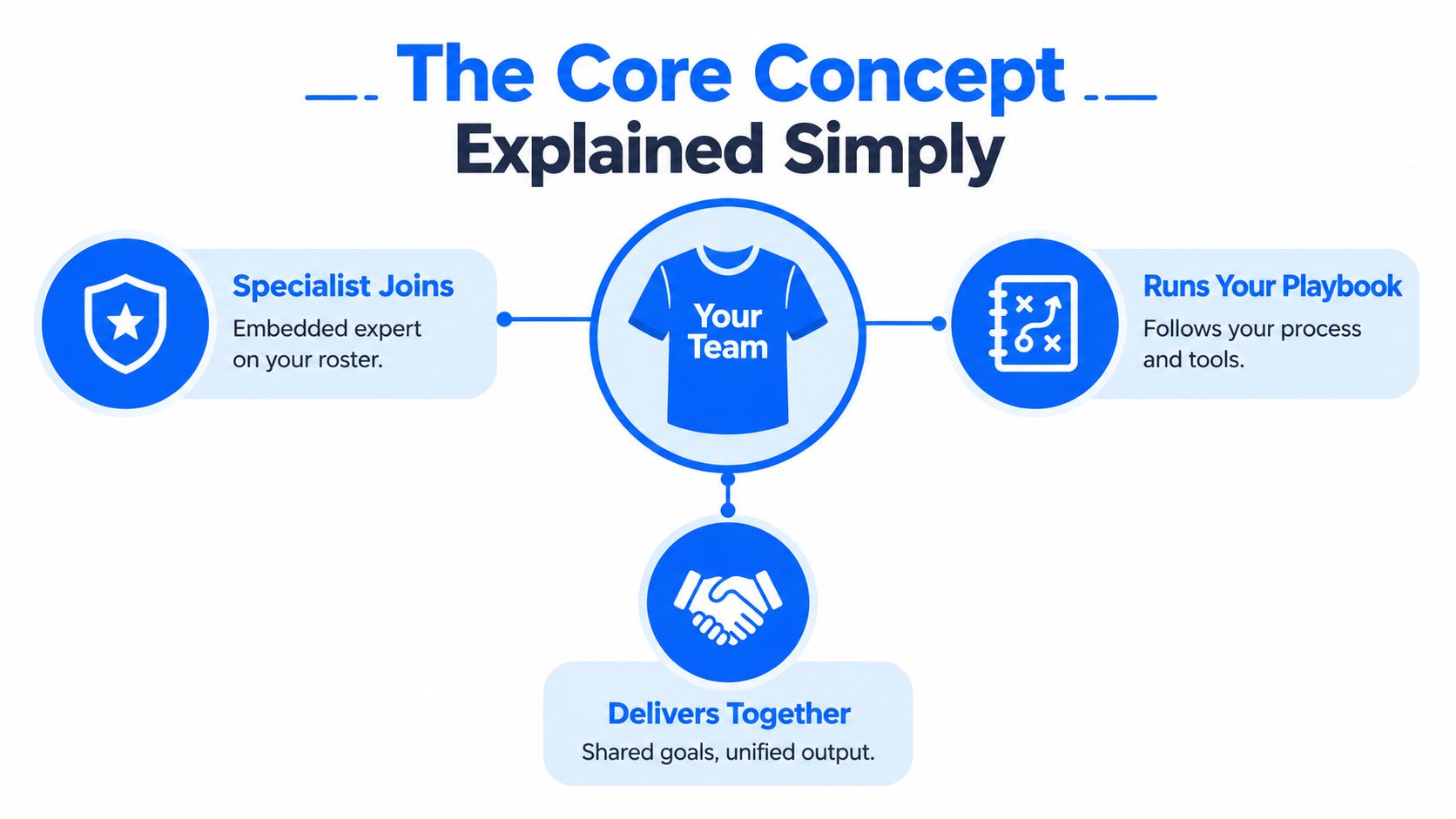
Think of a sports team preparing for an important season. Staff augmentation is like adding a specialist player to the roster. The player wears your jersey, learns your signals, follows your playbook, and works toward your team's result. You haven't handed the entire game to another club.
Outsourcing is closer to asking another club to run the match. The outside organization may provide its own coach, tactics, players, and operating method. You may define the desired result, but you give up more control over how the work is performed.
The distinction becomes clear when responsibilities are separated.
What the client controls
The client typically retains:
- Daily management: Assigning work, setting priorities, reviewing progress, and deciding what gets attention first.
- Technical direction: Choosing architecture, tools, coding conventions, security practices, and implementation standards.
- Delivery accountability: Accepting the work, managing dependencies, communicating with business stakeholders, and owning the final result.
- Team integration: Bringing the specialist into relevant ceremonies, documentation practices, access procedures, and review routines.
The provider typically manages:
- Talent sourcing: Finding candidates who match the requested role and level of experience.
- Employment administration: Handling the employment relationship, payroll, and related operational responsibilities.
- Replacement support: Helping replace a specialist when the arrangement ends or the person is no longer suitable.
- Engagement logistics: Supporting the commercial and administrative framework around the external resource.
Choosing the size of the addition
Augmentation doesn't require the buyer to request a complete delivery team. The target can be a particular role, seniority, or specialty.
A business might add one experienced infrastructure engineer, a small group of application developers, or a security specialist who supports an existing compliance initiative. The engagement can address a capacity gap, a capability gap, or both.
That flexibility is useful because organizations rarely experience shortages evenly. A team may have enough project managers and analysts but lack hands-on cloud engineering. It may have strong developers but need a specialist who understands a particular infrastructure environment. Augmentation lets procurement describe the missing capability rather than buying a broad service package that includes roles the organization already has.
The condition that makes the model work
The client must already know who owns the product or program. A roadmap doesn't need to be perfect, but it must be concrete enough for an incoming specialist to understand priorities, dependencies, and acceptance criteria.
If nobody can decompose the work, review decisions, or resolve blockers, the provider has supplied a person without supplying direction. The organization then pays an onboarding and coordination cost before it receives useful output.
How the Model Evolved and Where the Market Stands
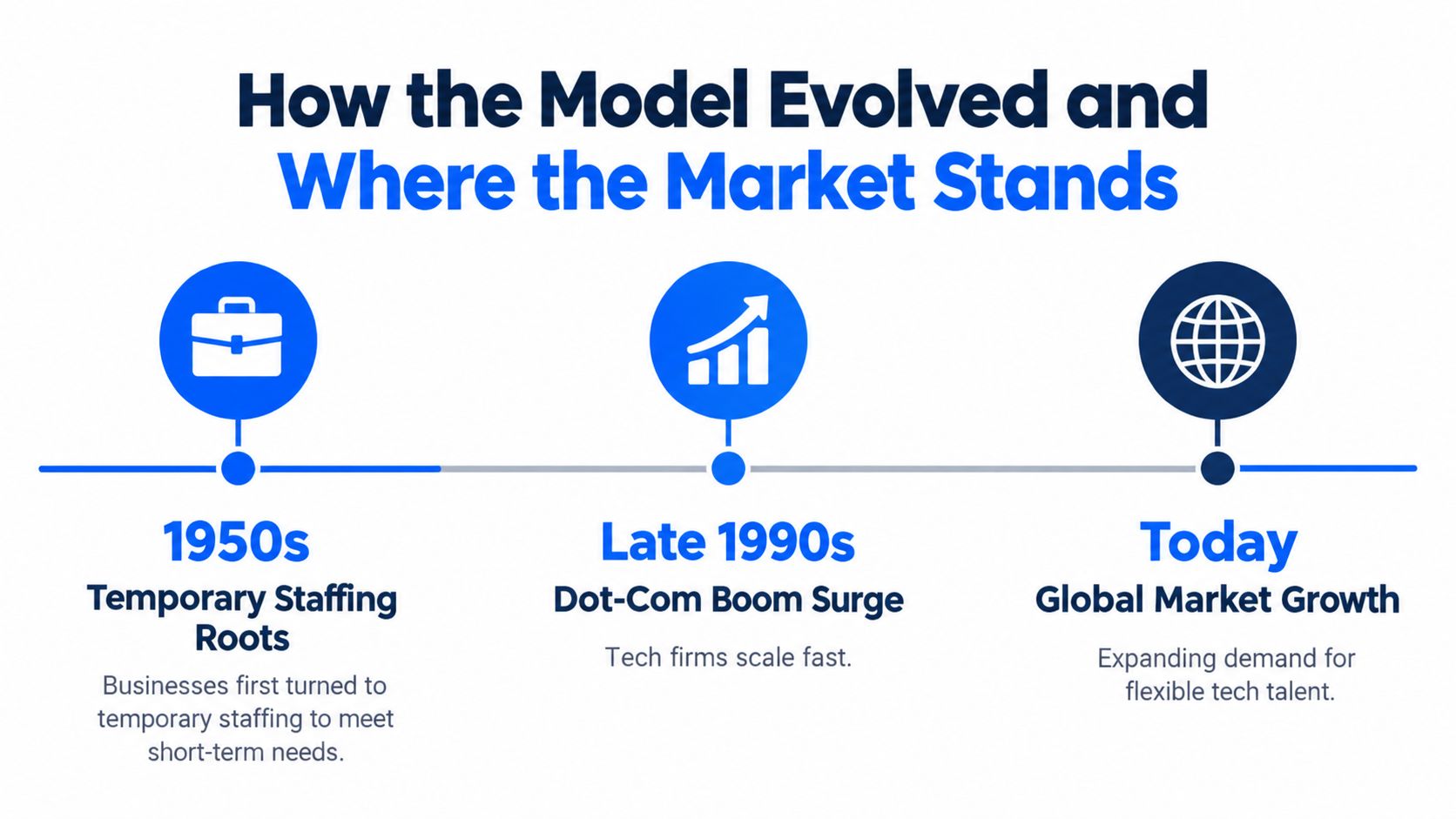
Staff augmentation has roots in mid-20th-century temporary staffing, when organizations used external workers to address changing labor needs. The model took on a more recognizable technology form during the late-1990s dot-com boom, when technology firms needed specialized developers and IT professionals faster than traditional hiring could provide them. Recurring skills shortages and project spikes made flexible access to specialists attractive.
The model later expanded beyond short-term technical staffing. Internet-based collaboration made distributed work more practical, allowing external specialists to contribute to teams without sitting in the same office. Over time, organizations began using the approach across functions such as engineering, finance, and legal services, treating external talent as part of a broader workforce strategy rather than only as an emergency staffing fix. This evolution is described in the history and definition of staff augmentation.
What the market signals
Current estimates show that staff augmentation is no longer a niche workaround. One 2026 industry estimate values the global staff augmentation services market at USD 122.54 billion in 2025 and projects USD 201.53 billion by 2032, implying a 7.36% CAGR. Another estimate places the worldwide IT staff augmentation services market at USD 105.45 billion in 2025, with a projection of USD 178.97 billion by 2032 at a 7.9% CAGR. These estimates appear in staff augmentation services market coverage.
The difference between the estimates reflects differences in market definitions and methodology. It shouldn't be treated as a precise single-market measurement. The more important strategic signal is that companies now use external specialists as a repeatable way to manage skills shortages, transformation work, and fluctuating delivery demand.
For CIOs, that means the question is no longer whether the model exists. The question is whether the organization can govern it well enough to use it selectively.
Real-World Use Cases for Augmented IT Teams
Consider a healthcare organization preparing a cloud security initiative. Its internal security and infrastructure leaders understand the environment and retain responsibility for the program, but they lack a specialist with the required cloud security experience. Hiring permanently may not fit the long-term workforce plan, while outsourcing the entire initiative could make internal ownership less clear. The organization can augment its team with a specialist who works within its security process, documents decisions, and supports the existing leadership structure.

Surge demand during a rollout
A networking group might be responsible for a multi-site SD-WAN rollout while continuing to operate the current network. The team already owns the architecture, vendor relationship, and rollout sequence. Its problem is execution volume.
An augmented network engineer can help prepare site configurations, support testing, document changes, and resolve implementation tasks under the internal network lead's direction. The buyer isn't purchasing a complete networking function. It is adding hands during a period of concentrated demand.
A narrow technical capability
A development team may need a specialist for a short technical push. The missing capability could involve a difficult integration, a complex infrastructure component, or a security-sensitive part of the application. The rest of the team can own the product and roadmap while the specialist contributes knowledge that would be expensive or unnecessary to maintain permanently.
The important procurement question is, “Which capability is missing?” It isn't, “Which entire project should we transfer?” That difference keeps the client's product ownership and decision rights intact.
A longer embedded need
Some organizations need external talent for longer than a single surge but still don't want to create permanent positions. In that case, long-term augmentation can provide continuity while the client retains management and technical direction. The arrangement still needs a clear review process, because a temporary resource can become operationally critical if documentation and succession planning are neglected.
A CIO may also need leadership capacity alongside delivery capacity. A fractional technology leader can establish priorities, clarify decision rights, and coordinate specialists when the internal management layer is stretched. Organizations evaluating that combination may find it useful to review fractional chief information officer services alongside a talent plan. Teams looking for geographically distributed development capacity can also explore how to hire developers in Brazil as one possible sourcing route.
Across these examples, the pattern stays consistent. The organization has a roadmap and an internal owner. It needs more execution capacity or a specific capability, but it doesn't want to transfer the entire outcome to an outside operator or add permanent headcount for a temporary need.
Augmentation Versus Hiring, Outsourcing, and Managed Services
The right model depends on the boundary the organization wants to preserve. Direct hiring, staff augmentation, outsourcing, and managed services can all add capability, but they distribute control and accountability differently.
| Delivery Model | Control Over Daily Work | Speed to Capacity | Best Fit |
|---|---|---|---|
| Staff augmentation | High. The client directs the specialist's daily work, tools, priorities, and technical practices. | Usually faster than a permanent hiring cycle when suitable talent is available. | A defined roadmap, internal ownership, and a temporary capacity or capability gap. |
| Direct hiring | High. The employee becomes part of the permanent organization and its management structure. | Often slower because the organization must complete its own recruiting and hiring process. | A durable core capability that the business expects to maintain internally. |
| Outsourcing | Lower. The provider generally controls more of the delivery method, staffing, and execution process. | Can be efficient when the provider already has a complete delivery team. | A defined project or whole-scope outcome that the client wants an external organization to deliver. |
| Managed services | Lower for day-to-day operations. The provider manages an ongoing function against agreed service expectations. | Appropriate for standing operational needs with an established service model. | Recurring functions such as support, monitoring, or infrastructure operations. |
Control and speed
Staff augmentation is often the strongest fit when the client must make daily technical decisions. The external specialist can work inside the organization's systems and routines, while the internal lead retains authority over priorities and standards.
Direct hiring offers similar control, but it makes more sense when the capability will remain central after the current initiative ends. If the requirement is temporary or uncertain, permanent headcount may create a different problem once demand falls.
Ownership and governance
Outsourcing can be the better choice when the client wants a provider to own an entire outcome. For example, an organization without the internal capacity to manage a complete application workstream may prefer a provider with its own delivery leadership, planning, and quality process.
Managed services fit a related but distinct pattern. The provider operates a function over time, usually with defined service expectations and escalation paths. A business comparing that option should also examine the practical considerations in this guide to managed IT services cost, including what ongoing responsibility it wants to retain.
Decision test: If your team can direct the work but can't complete it with current capacity, consider augmentation. If it can't direct the work and wants an outside party to own the outcome, consider outsourcing or managed services.
These boundaries become more important in regulated and technically complex environments. Healthcare, public sector, financial, and infrastructure teams may need external help while preserving internal control over access, architecture, security review, data handling, and change approval. Augmented staff can follow those controls, but the client still has to define them and enforce them.
Hybrid operating models are often practical. A company may augment engineering during a transformation, use managed services for routine operations, and outsource a clearly bounded workstream. The value comes from assigning each responsibility to the model that matches its required level of control.
Risks and Governance Most Buyers Underestimate
Adding a person doesn't automatically add throughput. Staff augmentation increases execution bandwidth only when internal ownership, task decomposition, and governance are mature enough to use that capacity.
The common failure begins before the specialist writes a line of code or changes a system. The client requests “an experienced engineer,” provides limited context, leaves access unresolved, and assumes the person will discover priorities through observation. The specialist spends time learning who makes decisions, where documentation lives, which standards apply, and what success means. That lost productivity is the onboarding tax.
Build the operating system before the person arrives
A practical engagement should begin with a documented gap analysis. Define what is missing, why the gap matters, which work the specialist will perform, and which internal leader will make decisions.
Useful controls include:
- Documented gap analysis: Describe the capacity or capability problem in operational terms, not just as a job title.
- 30/60/90-day success criteria: Set staged expectations for early contribution, expanding ownership, and measurable delivery responsibility.
- Weekly blocker reporting: Give the specialist and internal lead a predictable way to surface access issues, dependencies, and unresolved decisions.
- Knowledge-transfer checkpoints: Require documentation, walkthroughs, and handoff activities before the engagement ends.
- Explicit accountability: Name the person who approves work, resolves conflicts, and owns the business result.
These practices help the organization benefit from the specialist's expertise without creating a knowledge silo. They also give procurement clearer criteria for reviewing whether the engagement is producing useful output.
AI changes the vetting question
AI is also changing what “qualified” means. Buyers increasingly need to assess not only whether a developer can write code, but whether that person can review AI-generated code, identify subtle mistakes, challenge unsafe assumptions, and apply the organization's security and quality standards. Coverage of staff augmentation trends and AI-era vetting describes this shift from code production toward code oversight and judgment.
That change affects governance as well as recruitment. A contract should make quality expectations clear when specialists use AI-assisted tools. The client should know which tools are approved, what data may be entered, how generated output is reviewed, and who remains accountable for the result.
Quality still has an owner: Machine-assisted productivity doesn't transfer accountability away from the internal product or technology leader.
The model fails when the buyer treats external talent as self-directing labor. It succeeds when the client provides a playbook, gives the specialist authority appropriate to the role, reviews work consistently, and measures progress against outcomes rather than activity alone.
When to Engage MR2 for Fractional IT Leadership and Augmentation
Some organizations need additional specialists, but their deeper problem is unclear ownership. A fractional technology or security leader can establish the roadmap, clarify priorities, set governance expectations, and create the conditions in which augmented staff can contribute effectively.
MR2 Solutions positions its Technology Brokerage-as-a-Service framework around People, Process, and Portfolio. In practical terms, that can connect IT staff augmentation for skills and capacity gaps with fractional leadership such as a vCIO, vCISO, or CAIO. Its fractional CTO services are one example of how leadership support can sit alongside hands-on technical capacity.
The company also describes a vendor-neutral role that helps organizations evaluate, procure, implement, and govern technology solutions through a curated provider ecosystem. That approach can be relevant when the buyer needs help defining the gap before selecting a resource or combining augmentation with managed services, security, networking, or transformation work.
Start with three questions. What capability or capacity is missing? Which internal leader will direct the work? What evidence will demonstrate success during the engagement? Clear answers will tell you whether staff augmentation is appropriate, whether fractional leadership should accompany it, or whether another delivery model better matches the ownership boundary.
MR2 Solutions helps organizations evaluate technology delivery options, add specialized IT staff, and strengthen the leadership and governance needed to use external talent effectively. Visit MR2 Solutions to discuss your capacity or capability gap, define practical success criteria, and determine whether augmentation or a different model fits your roadmap.