
10 Best Practices in IT Procurement for Better Outcomes
The cheapest quote is rarely the best decision. A low license fee can conceal implementation effort, integration work, security exposure, training, renewal conditions, data migration, and capacity nobody uses. A vendor can win the sourcing event and still create years of operational friction if the buying team hasn't tested how the solution will work inside the existing environment.
The strongest IT procurement process starts with business outcomes and continues after the contract is signed. It connects discovery, requirements, neutral evaluation, architecture, risk, negotiation, implementation, governance, and expense optimization into one operating discipline. That matters because procurement timelines can stretch sharply with complexity. A U.S. Government Accountability Office study found that federal IT contracts below $250,000 took an average of 158 days to award, while contracts valued at $25 million or more took an average of 669 days, more than four times as long (GAO analysis of federal IT acquisitions).
The following 10 best practices in IT procurement follow the decisions that experienced teams make in sequence. Define the need before reviewing products. Compare providers against consistent criteria. Model the full lifecycle cost. Plan integration and risk controls before signing. Then govern implementation, usage, renewals, and retirement as carefully as the initial purchase.
1. Use a vendor-neutral evaluation framework
Vendor selection becomes unreliable when the shortlist is shaped by reseller incentives, personal relationships, or a familiar product before the organization has defined what success means. A neutral evaluation starts with the business problem, then tests qualified providers against the same requirements and evidence.
For example, a company replacing its wide area network shouldn't begin by asking which SD-WAN brand its incumbent reseller carries. It should define application performance, site connectivity, security, support, resilience, migration, and reporting requirements first. Every provider can then respond to an identical RFI or RFP, with scores based on business priorities rather than presentation quality.
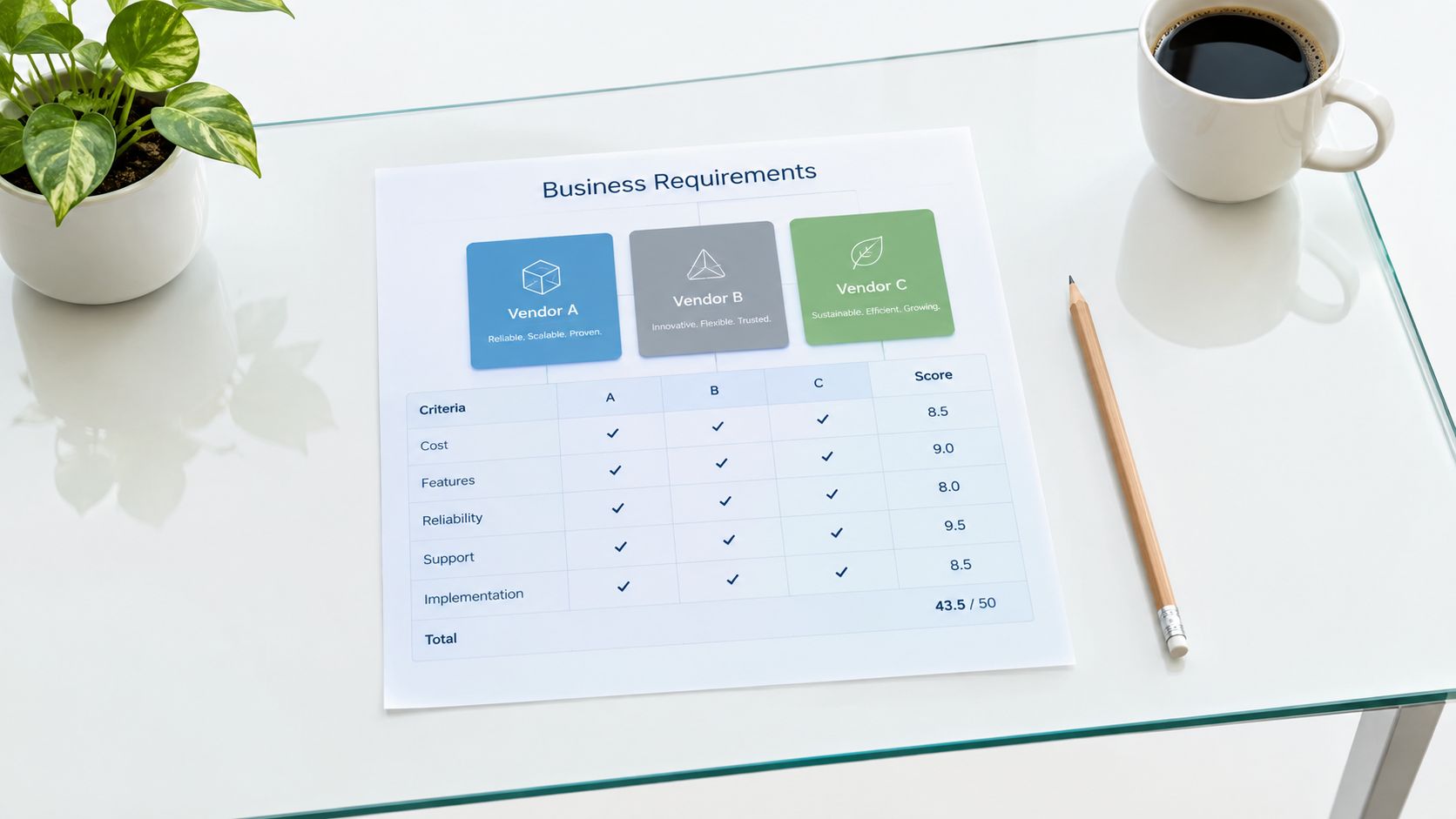
A weighted model makes trade-offs visible. Cost may matter, but so might security, implementation capacity, usability, financial stability, cultural fit, data portability, and the vendor's willingness to accept operational accountability. Record the scoring rationale, evaluator comments, conflicts of interest, and any exceptions. That documentation helps executives make a decision and gives auditors a defensible trail.
Build comparability into the process
Use a consistent evidence pack for each provider:
- Business outcomes: Define the operational result the purchase must produce, not just the features users want.
- Weighted criteria: Assign importance to cost, security, integration, service quality, adoption, and risk before reviewing responses.
- Identical questions: Require vendors to answer the same technical, commercial, and implementation questions.
- Independent challenge: Ask an internal architecture or security lead, or an independent advisor, to challenge the preferred option.
- Lifecycle economics: Compare implementation, support, renewal, migration, and exit costs alongside the initial price.
A vendor-neutral brokerage can help when the internal team lacks category expertise or when a reseller relationship creates a perceived conflict. MR2 Solutions describes its data center brokerage services as part of a broader vendor-neutral approach to evaluating infrastructure options.
2. Analyze total cost of ownership
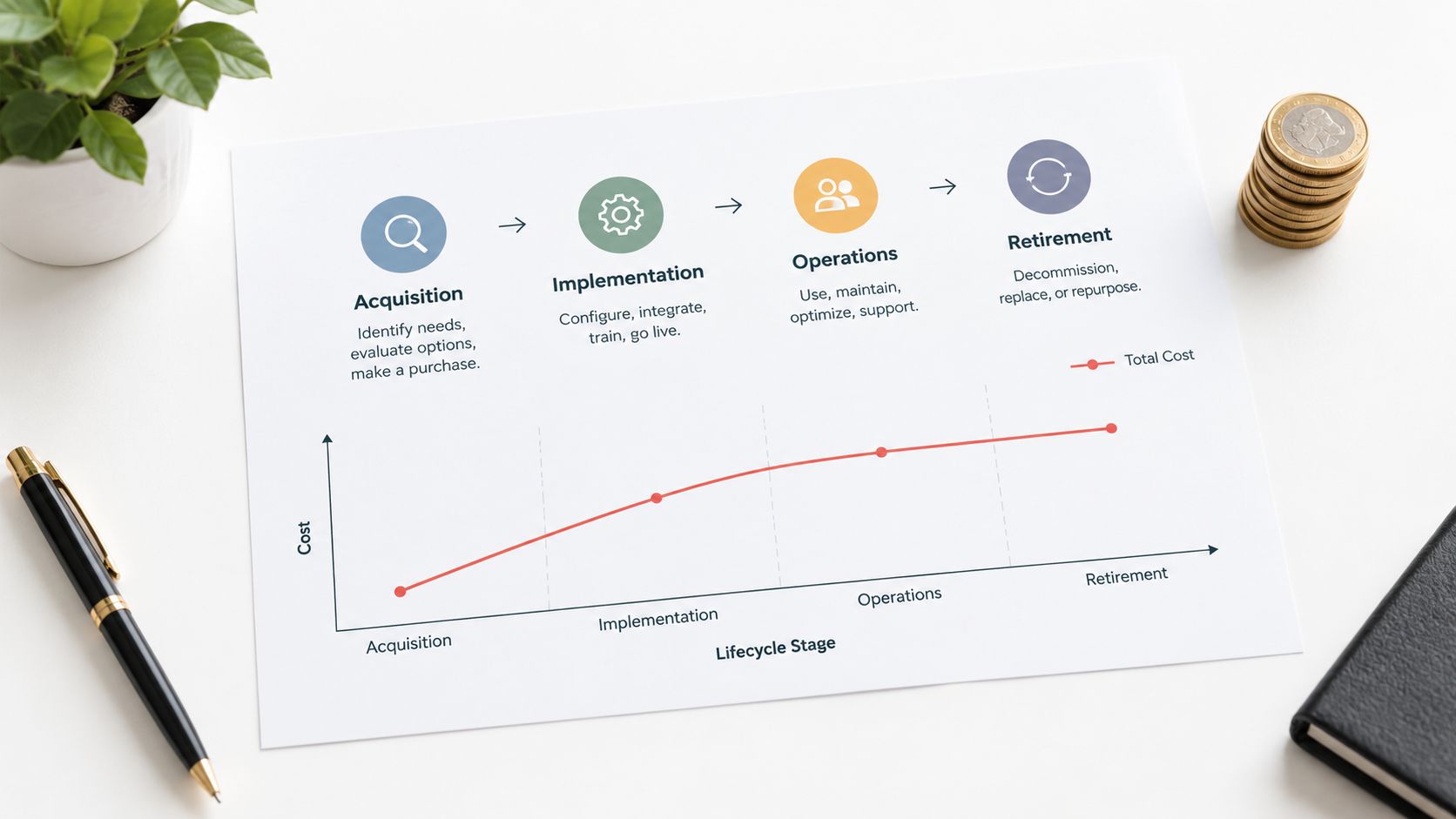
A low purchase price can conceal an expensive technology decision. Total cost of ownership, or TCO, should follow the asset from acquisition through implementation, operation, change, renewal, migration, and retirement. Show who absorbs each cost, when it appears, and which assumptions could change.
A cloud platform may look cheaper than on-premises infrastructure until the comparison includes architecture design, migration labor, integration, identity controls, monitoring, backup, support, training, data egress, consumption growth, and legacy decommissioning. The opposite outcome is also possible. A larger initial investment may reduce support work or replace several overlapping services. The right choice depends on the full operating model, not the first invoice.
Build the model jointly with finance, IT operations, security, and the business owner. Request line-item pricing, usage assumptions, renewal mechanics, professional-services rates, support tiers, and termination charges from each vendor. Test those assumptions against internal spending and delivery history. Vendor forecasts rarely reflect every operational constraint.
Make post-signature costs visible
Record direct charges such as hardware, software, subscriptions, implementation, support, storage, connectivity, and managed services. Add internal effort for project management, architecture, security review, integration, training, administration, and service transition. Account for productivity disruption, process redesign, adoption support, and temporary parallel operation during change.
Commercial exposure also belongs in the model. Include price escalators, minimum commitments, consumption growth, renewal terms, data egress, and termination assistance. Exit obligations may include data extraction, migration, decommissioning, records retention, and replacement procurement. A technology expense management capability, such as the service described by MR2 Solutions, can connect contracted capacity with actual spend and usage over time.
Run sensitivity tests for user growth, transaction volume, storage, support demand, and implementation duration. Refresh the model when usage or business requirements shift. The Server Scheduler guide to cloud TCO also examines lifecycle economics beyond the initial infrastructure bill.
3. Manage a curated provider ecosystem
A curated provider ecosystem reduces the need to start from zero every time the organization needs a security platform, cloud partner, network service, or implementation team. It isn't a static vendor directory. It's a managed pool of providers whose capabilities, financial position, delivery record, security posture, and commercial fit have been assessed for relevant categories.
The qualification standard should match the risk of the work. A provider handling sensitive identity data needs deeper security and privacy evidence than a low-risk office equipment supplier. A strategic implementation partner also needs references, delivery methodology, staffing depth, escalation practices, and evidence that it can work with the organization's architecture.
Keep the ecosystem useful
Create a qualification record for each provider that includes certifications, insurance, service coverage, financial checks, references, capabilities, geographic reach, pricing model, and known limitations. Then use scorecards after every engagement. Track delivery quality, responsiveness, incident handling, commercial discipline, documentation, and stakeholder experience.
Annual requalification is useful, but it shouldn't be the only review. Trigger an interim review after a serious service failure, ownership change, security incident, acquisition, or material change in capability. For critical categories, maintain credible alternatives rather than allowing a single provider to become unavoidable.
A curated ecosystem also needs governance. Document why a provider is approved, which categories it can serve, which risks remain open, and when the record must be refreshed. This approach can speed discovery without turning the shortlist into a closed club. New providers should have a route into consideration when they offer a materially better fit or solve a capability gap.
The practical trade-off is breadth versus management effort. A large list creates noise if nobody maintains the evidence. A smaller, actively governed ecosystem gives buyers faster access to relevant options while preserving competition and accountability.
4. Diagnose the current state before defining requirements
Start with the operating problem, not the product category. “We need a new collaboration platform” or “we need a cloud migration” describes a possible response, but it does not identify the current failure, the business result required, or the constraints that could derail delivery.
Build a documented baseline before drafting requirements. For a network refresh, review application latency, traffic patterns, site dependencies, circuit performance, outage history, security controls, and support workload. For a cloud program, map legacy dependencies, data sensitivity, licensing constraints, recovery requirements, and the skills available to run the target environment.
A short diagnostic can prevent a long negotiation for the wrong solution.
Include the people who operate, fund, secure, and depend on the service. IT, security, finance, operations, business-unit leaders, service desk staff, and affected users will see different causes and consequences. Their input keeps the RFP from reflecting only the priorities of the loudest technical stakeholder.
Turn findings into testable requirements
Separate what the solution must do from the conditions under which it must operate. Record each requirement with its owner, evidence, priority, and acceptance method.
- Functional needs: Workflows, integrations, reporting, administration, automation, and user capabilities.
- Service expectations: Availability, response times, support coverage, recovery, scalability, and maintenance windows.
- Security controls: Identity, encryption, logging, access separation, vulnerability management, incident response, and data location.
- Operating constraints: Budget, staffing, existing contracts, regulatory obligations, timeline, and architecture standards.
- Outcome measures: Adoption, service quality, risk reduction, process efficiency, or revenue protection.
Mark each item as mandatory, negotiable, or desirable. Then document the current state, target state, dependencies, and transition risks. This gives evaluators a defensible basis for comparing proposals and gives negotiators clarity about what the organization can trade.
The assessment can also stop an attractive option before procurement, implementation, and ongoing operating costs consume months of effort. That is lifecycle discipline, not administrative overhead.
5. Plan multi-vendor architecture and integration before purchase
A single-vendor suite can simplify contracting, support, and accountability. It can also force compromises if one platform performs well in one category but poorly in another. A multi-vendor architecture can deliver stronger specialist capabilities, but only when the integration, ownership, and operating model are designed before the purchase.
A cybersecurity stack illustrates the trade-off. An organization might use one platform for security information and event management, another for endpoint detection, another for data loss prevention, and a separate identity service. The products may each fit their role, but the operational value depends on reliable event flow, consistent identity context, shared response procedures, and clear escalation paths.
Put integration requirements into the RFI or RFP. Ask about APIs, webhooks, data formats, rate limits, event timing, authentication, logging, version support, testing assistance, and charges for integration support. Require vendors to identify what they can integrate natively and what requires custom development or middleware.
Assign ownership at the seams
The most difficult failures often occur between products, not inside them. Define who owns data quality, synchronization, integration monitoring, incident response, change approval, and vendor escalation. Document single points of failure and design failover where the business impact justifies it.
A low-code integration platform may reduce custom work, but it doesn't remove governance. The team still needs version control, security review, error handling, capacity monitoring, and a plan for what happens if an integration provider changes its pricing or API.
Test the critical paths before full deployment. A pilot should validate authentication, data synchronization, failure handling, reporting, and operational procedures, not just whether two systems can exchange a sample record. Integration belongs in the business case and TCO model because every connector creates a future maintenance obligation.
6. Use structured negotiation and contract management
A contract is not a procurement finish line. It sets the commercial and operating conditions that shape cost, accountability, flexibility, and exit options throughout the technology lifecycle. Negotiation should begin before a preferred vendor issues its final order form. Waiting that long signals preference, consumes internal resources, and creates schedule pressure, which weakens the buyer's position.
Prepare a should-cost model and negotiation plan while options remain open. Set the target position, acceptable alternatives, walk-away conditions, approval authority, and business rationale for each request. Test commercial terms alongside technical and operational requirements, rather than reducing negotiation to a final discount discussion.
For major programs and systems contracts, structured negotiation strategies can achieve 20% to 40% savings on overall contract value, according to the McKinsey analysis of public-sector contract negotiations, which also cites a government agency achieving 30% run-rate savings on a recurring service contract while keeping the scope similar. Confirm savings after signature by tracking them against an approved baseline.
Control the terms that shape the operating model
Review the full contract envelope, not just the initial price. Usage economics should define license metrics, minimum commitments, overage rates, true-up rights, and growth tiers. Service accountability needs measurable service-level objectives, reporting access, remedies, and service credits.
For delivery, specify Change control through fixed-price deliverables, acceptance criteria, dependencies, and approval for scope changes. Exit protection should cover data portability, transition assistance, deletion, backup access, and termination rights. Renewal discipline requires notice periods, renewal caps, price escalators, and the ability to reduce unused capacity. Risk allocation should address indemnity, liability, confidentiality, insurance, security duties, and incident notification.
A documented IT procurement process should connect sourcing decisions, negotiation positions, approvals, and the executed contract. Legal counsel reviews the final language. The service owner verifies that operational commitments are measurable, funded, and deliverable.
7. Add fractional executive leadership where governance is thin
A procurement team can run an efficient event and still lack the executive perspective needed to choose well. This is common when an organization is modernizing several areas at once, when the CIO role is vacant, or when a security purchase has implications across architecture, risk, operations, and compliance.
A fractional CIO or CISO can provide that oversight without waiting for a permanent hire. The leader should join early, during diagnostic work, rather than appearing only at the approval meeting. Early involvement helps connect individual purchases to the IT portfolio, target architecture, risk appetite, operating model, and business priorities.
For example, a cloud procurement may involve infrastructure services, identity, security tooling, networking, data platforms, and professional services. A vCIO can challenge whether the contracts fit together, whether the organization can operate the result, and whether the sequence creates avoidable dependency. A vCISO can test whether a security platform addresses a documented control gap or merely adds another console.
Give the role decision access
Fractional leadership works when the mandate is specific. Define responsibility for procurement oversight, vendor governance, executive reporting, approval participation, risk escalation, and a post-implementation review. Give the leader access to the relevant architecture, financial, security, and operational information.
Set a regular cadence. Weekly meetings are appropriate during an active sourcing or implementation phase, with focused decision logs rather than broad status conversations. Capture the rationale for the recommendation, unresolved risks, rejected alternatives, and conditions of approval.
The engagement shouldn't end at contract signature. A review after implementation can test whether the delivered service matches the business case, whether adoption is adequate, and whether governance has transferred to internal owners. Fractional leadership is most valuable when it leaves behind stronger decision rights, templates, scorecards, and portfolio visibility.
8. Govern implementation as part of procurement
The contract doesn't create business value. People, systems, processes, and operating controls do. Treating implementation as a vendor handoff is one of the fastest ways to lose the benefits that justified the purchase.
Before kickoff, agree on milestones, deliverables, dependencies, resources, acceptance criteria, risks, and escalation routes. The project plan should show the work required from the buyer as clearly as the vendor's tasks. A cloud migration can fail because the customer hasn't prepared identity, network connectivity, data classification, or application owners, even when the supplier has met its contracted deliverables.
Use a governance rhythm that matches the risk. The project team needs regular working sessions with decisions and action owners. An executive steering group should review progress, dependencies, scope, budget, and escalations. Traffic-light reporting helps executives see whether a red issue needs a decision rather than another status update.
Protect operational acceptance
Formal change control prevents a project from absorbing unpriced work through informal requests. Each change should show its effect on scope, time, cost, security, dependencies, and acceptance. Don't approve a change just because the team has already invested heavily.
Test in layers. Technical validation should confirm configuration, performance, resilience, security, monitoring, and integration. User acceptance testing should confirm that people can complete the processes the business needs. For high-risk transitions, parallel operation or a phased rollout can reduce exposure, but it also creates temporary cost and coordination work that belongs in the plan.
Within two weeks of completion, capture lessons while the details remain clear. Record what the vendor delivered, what internal assumptions failed, which controls worked, and what should change in the next procurement. The project is complete only when the service owner accepts the solution and the operating team can support it.
9. Manage technology expense continuously
IT procurement continues after signature. Technology expense management connects contracts, users, entitlements, consumption, renewal dates, service performance, and business ownership. Without that view, an organization may negotiate a favorable agreement and still pay for inactive accounts, duplicate tools, idle capacity, or services no one can explain.
Build an inventory that ties every technology expense to its vendor, contract, cost center, owner, service, and renewal event. Reconcile invoices with entitlements and actual usage. For cloud services, examine consumption by account, workload, environment, and team. For SaaS, review active users, feature utilization, access levels, and overlapping capabilities.
A quarterly review should bring together procurement, finance, IT operations, security, and the business units using each service. The decision is not only whether to cut spending. Each service should be retained, resized, consolidated, renegotiated, redesigned, or retired based on usage, value, risk, and operating needs.
Turn usage data into commercial decisions
Prepare renewal discussions with evidence:
- Capacity review: Compare purchased capacity with active users, transactions, storage, circuits, or workloads.
- Overlap analysis: Find products with similar functions or duplicate workflows.
- Service review: Compare contracted service levels with actual performance and support experience.
- Renewal calendar: Start early enough to test alternatives and avoid automatic renewal.
- Ownership check: Confirm that a business owner still accepts the service and its cost.
Deloitte's 2025 Global Chief Procurement Officer Survey reports that procurement organizations allocate approximately 20% of their budgets to procurement technology. Digitally advanced “Digital Masters” allocate about 24%, with planned investment rising to 26%. Adoption is concentrated in data analytics at 88%, invoice and payment processing at 78%, and purchasing at 75% (Deloitte's 2025 Global CPO Survey). For IT procurement, the practical lesson is to fund connected visibility and controls rather than another isolated tool.
For managed-service providers, tools such as Volgap apply the same principle at the client level. They can connect expense visibility with recurring service reviews, giving advisors a basis for discussing consumption, avoidable waste, and upcoming commercial decisions instead of treating cost analysis as a one-time audit.
10. Assess security, compliance, and vendor risk before selection
A security review that starts after vendor selection is already late. Security requirements should influence the shortlist, architecture, contract, and operating model from the beginning. A technically capable product may still be unsuitable if the provider cannot explain data handling, access control, incident response, subcontractors, resilience, or exit support.
The depth of review should match the risk. A supplier processing identity data, regulated records, or security telemetry warrants more scrutiny than one handling low-sensitivity information. Request current certification evidence, independent assurance reports, penetration-testing information where appropriate, vulnerability-management practices, breach history, insurance, financial stability, and relevant subcontractor details.
Map requirements to a recognized framework such as NIST or ISO 27001. Then test the provider's evidence against the product's actual scope, data, integrations, and operating model. A certification supports the assessment, but it does not demonstrate that every control applies to the service being purchased.
Make risk obligations enforceable
Build the assessment into the agreement through provisions covering:
- Data governance: Ownership, processing locations, retention, deletion, backup, and permitted use.
- Access control: Administrative access, privileged activity, identity federation, logging, and review.
- Incident response: Notification, cooperation, evidence preservation, communications, and remediation.
- Continuity: Recovery objectives, testing, service resilience, and dependency visibility.
- Privacy: Data processing obligations aligned with applicable privacy requirements.
- Ongoing assurance: Audit rights, updated assurance reports, vulnerability disclosure, and material-change notices.
The review continues after implementation. Use service-level reporting, scheduled control reviews, and renewal gates to confirm that the provider still meets the agreed standard. A source-code security audit guide for development teams shows why assurance should examine how technology is built and maintained, not only what a vendor states during sales.
Practical rule: If a control maps to NIST or ISO 27001 and matters to the business, put the evidence requirement, review cadence, and remedy into the contract language.
Top 10 IT Procurement Best Practices Comparison
| Approach | Implementation complexity | Resource requirements | Expected outcomes | Ideal use cases | Key advantages |
|---|---|---|---|---|---|
| Vendor-Neutral Evaluation Framework | Medium–High (structured MCDA) | Cross-functional team, neutral criteria, possible third‑party facilitation | Unbiased vendor selection, audit trail, lower long‑term TCO | Major platform procurements, public sector, compliance‑sensitive buys | Reduces vendor bias/lock‑in; aligns tech to business outcomes |
| Total Cost of Ownership (TCO) Analysis | Medium (financial modeling) | Finance + IT data, cost modeling tools, scenario analysis | Full lifecycle cost visibility, ROI and payback estimates | Cloud vs on‑premise, large capital investments, build vs buy decisions | Reveals hidden costs; improves budgeting and executive buy‑in |
| Curated Provider Ecosystem Management | High (ongoing program) | Vendor vetting process, monitoring team, governance | Faster sourcing, consistent vendor quality, negotiated pricing | Recurring procurements, enterprises needing rapid sourcing | Shortens procurement cycles; improves pricing and risk control |
| Diagnostic Assessment and Requirement Definition | Medium (4–8 week assessments) | SMEs, stakeholder workshops, assessment tools | Clear, evidence‑based requirements and KPIs; reduced rework | Pre‑RFP, migrations, complex transformations | Prevents scope drift; accelerates vendor evaluation |
| Multi‑Vendor Solution Architecture & Integration Planning | High (integration design) | Integration architects, middleware, testing resources | Best‑of‑breed functionality with integrated workflows | Organizations needing specialized tools or avoiding single‑vendor lock‑in | Flexibility to replace vendors; superior functionality per category |
| Structured Negotiation & Contract Management Process | Medium (multi‑round negotiations) | Skilled negotiators, legal review, authority matrix | Better commercial terms, clear SLAs, defined exit clauses | High‑value licenses, complex SaaS/MSA negotiations | Lowers contract costs; protects organizational interests |
| Fractional Executive Leadership (vCIO/vCISO) Oversight | Low–Medium (engagement setup) | Fractional executive fees, onboarding time, governance access | Strategic alignment, security oversight, faster decisions | Organizations lacking senior IT/security leadership | Adds executive expertise and credibility; reduces strategic risk |
| Implementation Governance & Project Delivery Management | High (detailed PM & controls) | Project managers, steering committee, QA/testing resources | On‑time/on‑budget delivery, quality assurance, lessons learned | Large rollouts, cloud migrations, multi‑vendor implementations | Reduces overruns; enforces change control and acceptance criteria |
| Technology Expense Management & Cost Optimization | Medium (continuous discipline) | TEM tools, finance+IT collaboration, quarterly reviews | Lower ongoing spend, license optimization, better forecasting | SaaS/cloud‑heavy environments, high subscription volumes | Continuous savings; usage visibility and renegotiation leverage |
| Security, Compliance & Risk Assessment in Vendor Selection | Medium (rigorous assessments) | Security team/vCISO, questionnaires, third‑party audits | Reduced compliance and breach risk, documented due diligence | Regulated sectors, sensitive data, security tooling procurement | Prevents risky vendors; ensures regulatory alignment and incident readiness |
Turn procurement into a managed advantage
The best practices in IT procurement work as a connected operating rhythm, not as isolated tactics. Start by diagnosing the current environment and the business problem. Define measurable outcomes, functional requirements, non-functional controls, constraints, and decision rights before vendors shape the conversation. That sequence prevents the organization from mistaking a familiar product category for a validated need.
Next, compare providers neutrally. Use a consistent RFI or RFP, a weighted scorecard, identical questions, documented evidence, and independent challenge where conflicts could affect the result. A strong evaluation doesn't pretend every criterion can be reduced to a single score. It makes trade-offs visible so executives can decide whether a higher implementation burden is justified by better security, lower operating risk, stronger integration, or greater adoption potential.
Model lifecycle cost before selecting a winner. TCO should include internal effort, integration, training, support, consumption, renewal, migration, exit, and the cost of running old and new services together. Then negotiate the full commercial envelope. Unit price matters, but so do usage rights, price escalators, service levels, data portability, termination assistance, security obligations, and remedies that the operations team can measure.
Governance must continue after signature. Assign an accountable executive, service owner, technical owner, security owner, and commercial owner. Give the implementation team clear acceptance criteria, change control, testing responsibilities, and escalation routes. Don't declare success when the supplier completes its tasks. Confirm that users adopt the service, operations can support it, security controls work in practice, and the expected business outcomes are being measured.
The federal experience demonstrates why portfolio visibility matters. The Government Accountability Office reported that federal agencies invest more than $100 billion annually in IT, while IT acquisition and operations have remained on the government-wide high-risk list since 2015 because of cost overruns, schedule slippage, and weak alignment with mission outcomes. In a review of the Department of Veterans Affairs, the agency couldn't provide evidence of CIO approval for 4,513 of 11,644 new IT contract actions, or 39%, awarded between March 2018 and the end of fiscal year 2021 (GAO review of federal IT acquisition governance). The lesson applies beyond government: significant purchases need approval evidence, portfolio context, accountable technology leadership, and post-award benefits tracking.
Quarterly reviews should examine spend, utilization, service levels, risk, renewals, dependencies, and retirement options. Deloitte found that 74% of CPOs viewed maintaining active alternative sources as the most effective risk-mitigation strategy (Deloitte's procurement risk findings). For critical cloud, connectivity, security, and infrastructure services, qualify alternatives before an incident or renewal deadline forces a rushed decision.
Finally, challenge the assumption that more procurement technology automatically creates more value. A 2025 survey of enterprise procurement executives found that two-thirds used more than 10 procurement tools, but only 8% believed most of those tools delivered their expected returns. The same verified summary reports that more than half required IT support to make system changes, while Deloitte identified siloed ways of working as the most frequently cited barrier to value delivery, at 57%, followed by competing priorities at 46% and insufficient organizational or technology capability at 40% (Digital Commerce 360's procurement technology coverage). Choose systems that improve visibility, adoption, integration, and governance. Retire tools that add work without producing accountable outcomes.
Assign owners, standardize discovery and scoring templates, maintain a renewal calendar, and schedule the first post-implementation review before the contract is signed. If internal capacity or cross-vendor expertise is limited, a vendor-neutral partner such as MR2 Solutions can support discovery, evaluation, procurement, implementation coordination, technology expense management, and ongoing governance through its Technology Brokerage-as-a-Service approach.
MR2 Solutions helps organizations evaluate, procure, implement, and govern IT solutions through a vendor-neutral brokerage model, including provider comparison, contract negotiation, project coordination, and technology expense management. Visit MR2 Solutions to connect your procurement decisions with lifecycle cost, operational risk, and measurable business outcomes.