
Cybersecurity Compliance Services: A 2026 Guide

You've probably seen the pattern. A partner asks for a HIPAA attestation, the acquiring bank wants PCI DSS evidence, sales needs a SOC 2 package, and your security team has already scheduled an internal NIST CSF review. Each request looks manageable in isolation. Together, they create duplicated controls, competing evidence requests, unclear ownership, and a compliance calendar nobody fully trusts.
Cybersecurity compliance services should solve that operating problem, not just prepare another audit binder. The right program creates one defensible control environment, maps obligations across frameworks, assigns accountable owners, and produces evidence as part of normal business operations. Audits then become checkpoints in a functioning security program instead of emergency projects that reset after the assessor leaves.
When One Audit Is Not Enough
The Tuesday inbox is where fragmented compliance becomes visible. The CIO sees a healthcare customer asking how protected health information is secured, a payment partner requesting PCI DSS documentation, an enterprise prospect requiring SOC 2 evidence, and an internal security review based on NIST CSF. The security team responds to each request, but nobody has confirmed whether four separate evidence packages are really proving four different things.
That approach creates waste without necessarily improving protection. One team uploads access reviews to a customer portal, another keeps screenshots in a shared drive, and a third asks system owners to repeat the same control narrative in a different template. Meanwhile, the control owner may not know which request has priority or whether an exception disclosed in one assessment affects the others.
Practical rule: If the same control is evidenced in multiple places, the organization needs one source of truth, not another consultant-built folder.
The operating answer is a cross-framework control baseline. Start by identifying the obligations that truly apply to each business unit, product, data set, contract, and supplier. Then map those obligations to shared controls, document where a requirement is more specific, and assign evidence ownership to the person who directly operates the control.
That baseline should support recurring activities, including access recertification, vulnerability remediation, policy review, incident exercises, supplier reviews, and management reporting. It also needs an exception process. A control that can't operate as designed should produce a documented risk decision, a responsible executive, a remediation path, and a validation date.
NIST's Cybersecurity Framework 2.0 publication supports this risk-based direction. NIST describes CSF 2.0 as usable by organizations of every size, sector, and maturity level, with outcomes that can be adapted to different regulatory and operating environments. It also connects cybersecurity risk with broader enterprise risk management, which is exactly where compliance belongs.
The goal isn't to eliminate audits. It's to stop treating every audit as a separate security program. A mature service turns overlapping requests into a controlled operating rhythm, with shared evidence, visible gaps, and fewer surprises for the people accountable for risk.
What Cybersecurity Compliance Services Actually Cover
Cybersecurity compliance services aren't one product category. They combine governance design, control implementation, and ongoing operation. Buyers should separate those layers before comparing providers, because a firm that writes policies may not run technical controls, and a managed security provider may not understand how an auditor will test evidence.
Policy and governance establish the rules
The first layer defines the system being governed. It includes scoping the environment, identifying relevant data and obligations, setting risk criteria, writing or rationalizing policies, mapping controls to frameworks, and maintaining the evidence library.
Think of policy as the building code. It says what the organization requires, who owns the requirement, how exceptions work, and what proof demonstrates performance. A policy that says privileged access must be reviewed is incomplete unless the program also defines the reviewer, review frequency, approval record, escalation path, and retention of evidence.
A useful starting point is MR2 Solutions' compliance in IT security resource, especially when leadership needs to connect compliance requirements with practical IT governance rather than treat them as isolated legal tasks.
Technical controls make the rules real
The second layer covers the mechanisms that enforce or demonstrate the policy. Typical work includes identity and access governance, logging standards, vulnerability handling, encryption baselines, backup controls, security configuration, endpoint protection, and incident-response procedures.
These are the building's locks, alarms, cameras, and fire doors. They reduce exposure, but they also generate the artifacts an assessor will inspect. A written access policy doesn't prove least privilege. The organization needs role definitions, approval records, periodic entitlement reviews, and logs showing that inappropriate access is removed.
Managed operation keeps evidence current
The third layer is the security guard company. Managed compliance or compliance-as-a-service may coordinate continuous control monitoring, evidence collection, exception handling, training workflows, policy reviews, supplier requests, and auditor communications.
That service can be advisory, co-sourced, or fully managed. An advisory engagement may deliver a roadmap and coach internal owners. A co-sourced arrangement may operate selected controls while the client retains accountability. A fully managed contract may include recurring evidence production and technical administration, but the contract must state exactly what systems, controls, and response obligations are included.
Ask providers to separate these deliverables in writing. “Audit support” can mean a senior advisor joins a call, or it can mean the provider owns the evidence calendar, tests artifacts, tracks remediation, and coordinates every auditor request. Those are different services, different workloads, and different risks.
The Major Frameworks Side by Side
Framework selection should follow business exposure, customer requirements, contractual commitments, and the data the organization handles. It shouldn't begin with whichever certification a provider happens to sell.
HIPAA is a regulatory regime focused on protecting protected health information. Its Privacy, Security, and Breach Notification Rules shape the safeguards, administrative practices, and response evidence expected from covered entities and business associates. HIPAA itself isn't a certification, so a provider promising “HIPAA certification” is using imprecise language.
PCI DSS applies to environments that store, process, or transmit payment card data. It focuses heavily on the cardholder data environment, access control, vulnerability management, monitoring, testing, and documented responsibility. Validation requirements are influenced by the organization's payment role and acquiring-bank expectations, so the right assessment path must be confirmed early.
NIST CSF 2.0 is voluntary and outcome-based. It offers a common language for identifying, protecting, detecting, responding to, and recovering from cybersecurity risk, while its newer governance emphasis helps connect security decisions to enterprise oversight. It doesn't provide a certification, but it can serve as the internal baseline that organizes several mandatory or customer-driven obligations.
ISO 27001 is an internationally recognized, certifiable standard for an information security management system. It requires a risk-management approach, documented governance, a statement of applicability, risk treatment, internal review, and independent certification activity. Certification is useful when customers or international operations need a formal assurance signal, but the certificate doesn't replace daily control operation.
| Framework | Mandatory or Voluntary | Primary Trigger | Core Evidence | Biggest Overlap With Others |
|---|---|---|---|---|
| HIPAA | Mandatory when the organization falls within the applicable healthcare scope | Protected health information and healthcare relationships | Risk analysis, policies, safeguards, access records, training, incident and breach documentation | Privacy, access control, incident response, risk management |
| PCI DSS | Contractually required for applicable payment environments | Storing, processing, or transmitting cardholder data | Scope documentation, configuration evidence, testing, scans, logs, access reviews | Network security, vulnerability management, encryption, monitoring |
| NIST CSF 2.0 | Voluntary, unless adopted by contract or policy | Enterprise risk management and cybersecurity governance | Profiles, risk decisions, control evidence, metrics, improvement plans | Broad control vocabulary across security and privacy programs |
| ISO 27001 | Voluntary certification, often commercially required | Customer, market, or governance demand for a certifiable ISMS | Risk treatment, statement of applicability, internal audits, management review, certification evidence | Governance, risk treatment, access control, business continuity |
The overlap is where experienced providers earn their value. A single access-governance process can support several frameworks, while payment-specific segmentation or healthcare privacy obligations may need separate evidence. The objective isn't to force every requirement into one generic control. It's to identify the minimum common control set and preserve the additional detail where a framework specifically demands it.
How Assessment and Remediation Work in Practice
An assessment should answer a defined question. A gap assessment compares current practices with selected requirements. A risk assessment ranks threats and business consequences, whether or not a framework gap exists. A controls readiness review tests whether controls are designed, implemented, and supported by credible evidence before an external assessment.
Confusing those outputs causes bad decisions. A gap report can identify missing artifacts without ranking business impact. A risk assessment can expose a serious concentration risk that no checklist labels as a simple pass or fail. Leadership needs to know which type of work it is funding.
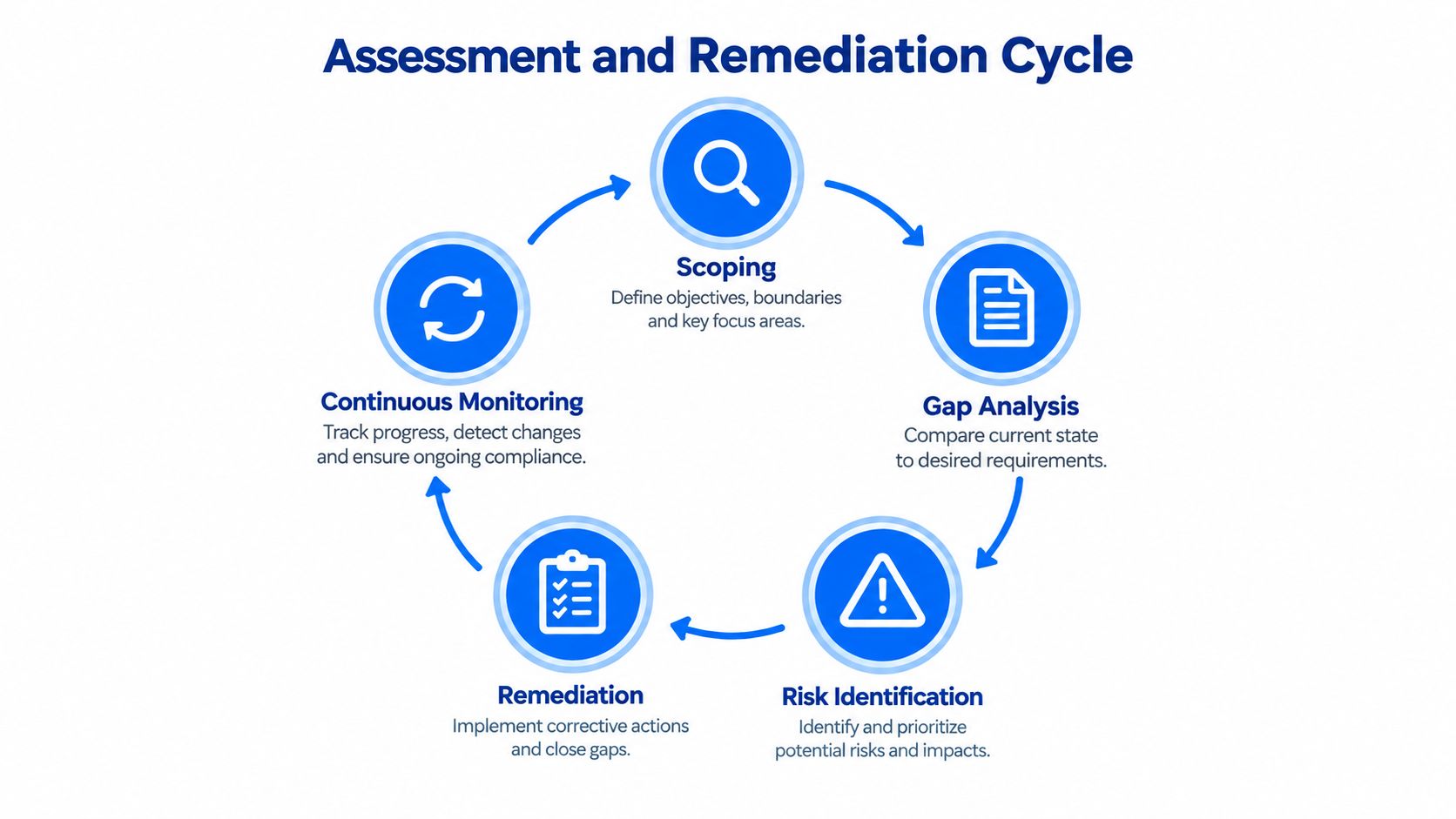
The operating loop
A reliable cycle moves through five connected activities:
- Scope the environment. Identify systems, applications, data flows, business processes, suppliers, and obligations. Scope decisions determine the credibility of every later conclusion.
- Collect and test evidence. Gather policies, tickets, configurations, logs, approvals, training records, access reviews, and supplier artifacts. Test whether the evidence demonstrates actual operation.
- Triage findings. Rank findings by risk, regulatory exposure, exploitability, business criticality, and dependency. Don't let an easy documentation fix displace a high-impact access weakness.
- Remediate with ownership. Assign a control owner, delivery owner, due date, required resources, exception path, and validation criteria. A ticket without a named owner is a report decoration.
- Validate and monitor. Retest the control, confirm the evidence, close or accept the finding, and put the recurring activity into the compliance calendar.
The handoffs deserve more attention than the assessment workshop. Remediation often fails when findings land in an IT backlog with no executive priority, when evidence requests bypass the system owners who create the artifacts, or when validation means checking a box instead of repeating the original test.
Every finding should carry a maturity view. Leadership may decide to document a temporary exception, implement a compensating control, or fund a permanent redesign. That decision becomes defensible only when the organization can show current state, target state, risk, owner, and progress.
Managed and Compliance-as-a-Service Models
Managed compliance is often sold as continuous assurance, but buyers need to inspect what happens between the sales presentation and the next audit. The service usually combines three distinct layers, and each creates a different dependency on the provider.
| Service Model | What Is Included | Ideal Buyer |
|---|---|---|
| Advisory and program design | Scope, framework mapping, policies, risk methodology, roadmap, and readiness guidance | Teams with capable operators that need structure and specialist judgment |
| Co-sourced compliance operations | Evidence coordination, control testing, exception handling, technical control support, and governance reporting | Mature programs that need additional capacity without outsourcing accountability |
| Fully managed compliance service | Recurring monitoring, evidence production, policy lifecycle management, audit coordination, and selected control operation | Lean teams or regulated organizations with persistent resource gaps |
Pricing can be organized around a framework subscription, per-control units, or an outcome-based retainer. Each model carries an incentive problem. A per-framework subscription may encourage the provider to treat every framework as a new workstream, even when controls overlap. Per-control pricing can reward a larger control inventory rather than a simpler one. Hourly advisory work can make the provider responsive while leaving the client uncertain about the cost of reaching an operating state.
An outcome-based retainer is better aligned when the outcome is defined precisely. “Audit readiness” is too vague. A stronger agreement specifies evidence coverage, control-owner participation, remediation tracking, executive reporting, supplier review scope, validation responsibilities, and the conditions that constitute readiness.
Common upsells need the same scrutiny. Continuous control monitoring is core when the client expects ongoing assurance, not merely a readiness project. Policy lifecycle management is valuable when policies need ownership, review triggers, approval history, and communication workflows. Auditor liaison can save internal time, but it shouldn't become a substitute for accountable control owners.
Insurance buyers also need to connect compliance scope with risk-transfer decisions. Organizations evaluating coverage can review cyber security insurance in Australia as one resource while defining the safeguards, incident obligations, and third-party exposures that their insurance process may examine.
Governance, Reporting, and Third-Party Risk
An audit artifact answers, “Did the organization have evidence of this control during the assessment?” A governance metric answers, “Is the control working across the business, and is risk improving?” Boards need the second answer.
A useful executive view should show control coverage by critical asset, residual risk trend, third-party concentration risk, and mean time to remediate. These metrics are meaningful only when their definitions stay stable. If “coverage” means a policy exists in one report and a tested technical safeguard in another, leadership can't compare periods or make sound investment choices.
Audit evidence proves a point in time. Governance reporting explains the direction of travel.
Third-party risk belongs in the same loop. Begin with inherent risk scoring based on data access, service criticality, connectivity, geographic exposure, and concentration. Then apply proportionate due diligence, such as security questionnaires, independent reports, contract requirements, access reviews, incident-notification terms, and remediation tracking.
Critical suppliers need more than an onboarding questionnaire. Their risk profile changes when they introduce a new subprocessor, expand privileged access, suffer an incident, or become operationally irreplaceable. Continuous monitoring doesn't mean collecting every available signal. It means defining which changes trigger reassessment and who decides whether the relationship remains acceptable.
Data quality affects all of this. Inaccurate asset inventories, incomplete supplier records, duplicated identities, and stale control ownership can distort prioritization and executive reporting. Leaders working on this problem can consult the business impact of data accuracy issues when connecting information quality with operational and financial decisions.
The system design matters. Policy requirements should connect to controls. Controls should connect to evidence sources and owners. Evidence should feed exceptions, remediation, and reports. A technology due diligence process should support the same chain, and a practical technology due diligence checklist can help buyers assess whether providers, platforms, and integration choices support that operating model.
Choosing a Vendor-Neutral Provider
Vendor neutrality isn't a friendly promise. It's a design constraint that should be visible in the provider's methods, tools, contract, and recommendations.
A provider that starts with its preferred platform may define the problem around that platform. A vendor-neutral provider starts with obligations, business processes, risk, existing systems, and desired outcomes. That distinction matters when the organization must support several frameworks without buying a separate workflow for each one.
Five tests for a serious shortlist
| Criterion | Evidence to Request | Red Flag |
|---|---|---|
| Multi-framework scoping | A sample scope showing shared controls and framework-specific requirements | The provider recommends one framework before reviewing business obligations |
| Open control mapping | Exportable crosswalks with control owners, evidence sources, and traceability | A proprietary taxonomy that can't be transferred or independently reviewed |
| Tool integration | A documented evidence workflow using the client's existing ticketing, identity, logging, and GRC tools | A requirement to replace functioning systems before the provider can work |
| Commercial alignment | Clear separation of fixed deliverables, recurring operations, hours, and outcome measures | The provider sells “continuous compliance” but prices every activity as open-ended labor |
| Third-party coverage | Supplier tiers, due diligence methods, reassessment triggers, and escalation rules | Vendor review stops at a questionnaire with no validation or remediation path |
Ask how the provider handles an obligation that falls outside its preferred framework. Ask whether the client owns the control map and evidence history at the end of the engagement. Ask who performs substantive retesting, who approves exceptions, and what happens when a critical supplier refuses requested evidence.
The commercial model should also expose boundary changes. Some managed services narrow the audit scope to reduce their own liability, even when the excluded systems support important business processes. The provider should explain exclusions in operational terms, including the risk created by leaving them outside the program.
CIOs and CISOs can use weighted scoring, but they shouldn't give brand recognition the highest weight. Prioritize multi-framework reasoning, evidence integration, ownership clarity, remediation execution, and third-party governance. For organizations that need interim security leadership while building that program, fractional CISO services can provide governance capacity without pretending that a software subscription replaces executive accountability.
Building Your First 90 Days of Compliance Operations
The first 90 days should install a repeatable operating rhythm. They shouldn't be judged by whether the organization can produce a polished gap report or announce an imminent certification.
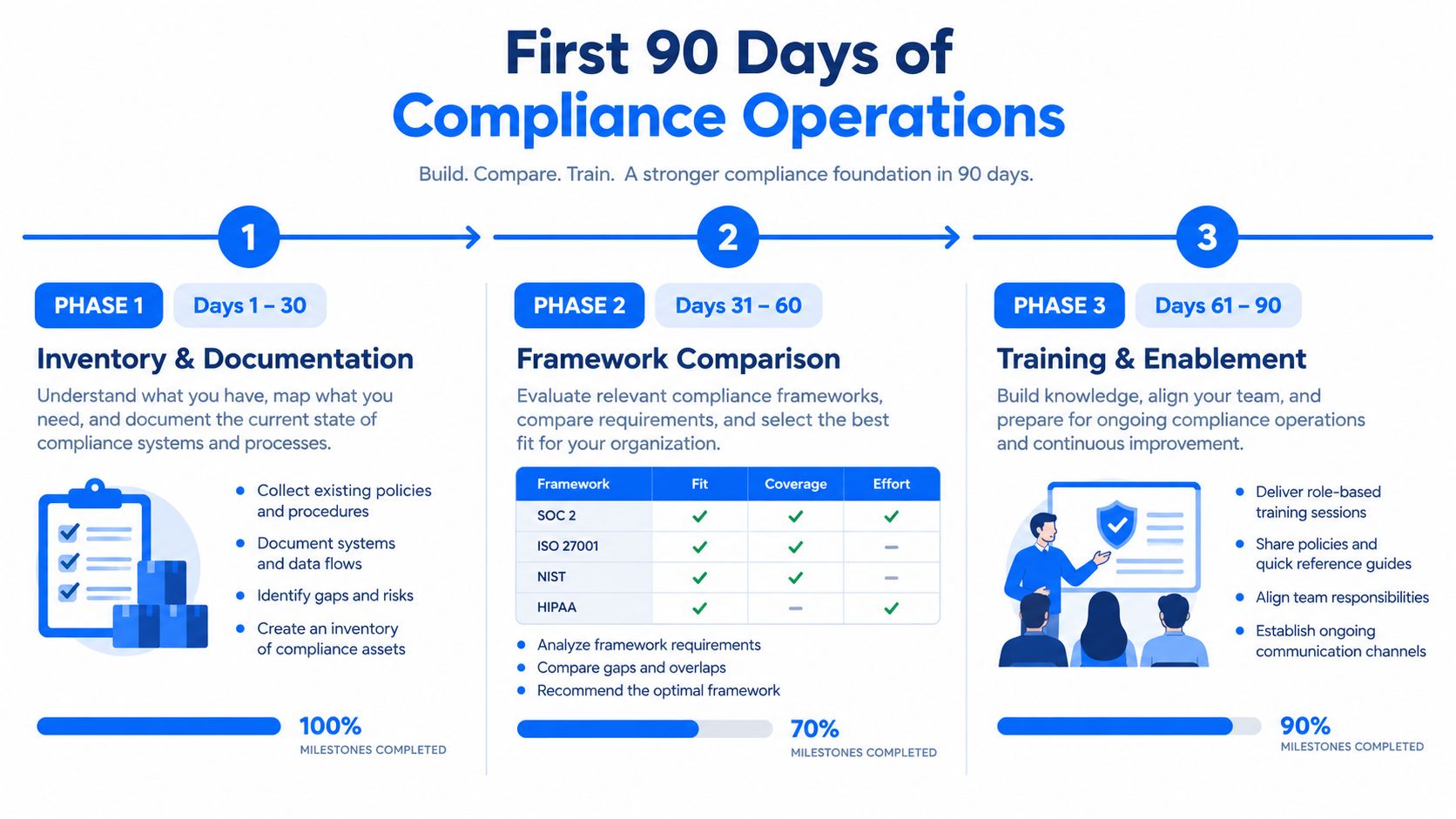
Days 1 to 30 establish scope
Inventory the systems, applications, data, business processes, suppliers, contracts, and customer commitments that create compliance obligations. Identify where regulated or sensitive data enters, moves, is processed, and leaves the environment.
Choose one primary framework that reflects the strongest business driver, then select one adjacent framework for control rationalization. Don't launch several independent assessments before the organization knows which requirements overlap and which require specialized treatment. Name an executive sponsor, a program owner, and control owners for critical domains.
Days 31 to 60 build the evidence pipeline
Evaluate providers against the criteria above, then onboard the selected team into existing workflows. Define a RACI for every control category. Connect evidence requests to the systems where artifacts already exist, such as identity platforms, ticketing tools, endpoint systems, vulnerability scanners, learning platforms, and supplier records.
Run a baseline assessment, but require more than a list of gaps. Each finding should include risk, affected assets, owner, remediation action, dependencies, evidence required for closure, and validation method. Establish an exception process before the first difficult finding appears.
Days 61 to 90 create the cadence
Set weekly control-owner standups for active remediation and evidence blockers. Hold monthly governance reviews covering risk movement, overdue actions, exceptions, supplier concerns, and control performance. Prepare quarterly board reporting that focuses on business exposure rather than framework terminology.
Run the first tabletop exercise before the end of the period. Include security, legal, communications, operations, executive leadership, and relevant suppliers. The exercise should test decision rights, evidence availability, escalation, notification analysis, and recovery coordination.
Use this launch checklist:
- Scope: Systems, data, suppliers, contracts, and applicable obligations are documented.
- Baseline: One primary framework and one adjacent framework are mapped to shared controls.
- Ownership: Every critical control has an accountable owner and evidence source.
- Workflow: Evidence, findings, exceptions, and validation move through a defined system.
- Cadence: Weekly, monthly, and quarterly governance routines have named participants.
- Readiness: The first tabletop exercise tests the operating model, not just the policy library.
The result you want after 90 days isn't a temporary feeling of audit readiness. It's a program that makes the next assessment faster, exposes operational weaknesses earlier, and gives executives a reliable view of risk.
MR2 Solutions helps mid-market and enterprise organizations evaluate cybersecurity compliance needs, align overlapping obligations, and coordinate implementation and governance through a vendor-neutral process. If your team needs a practical control baseline and an operating cadence rather than another isolated audit project, visit MR2 Solutions to discuss the next step.