
Cybersecurity Compliance Frameworks: 2026 Guide
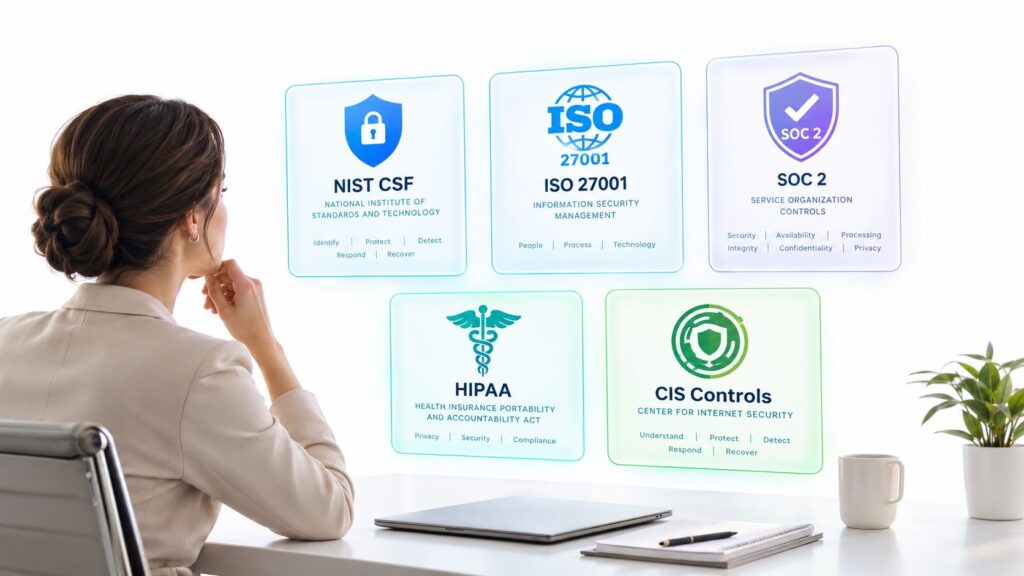
Only 52% of organizations prioritize automation even though they identify it as the most impactful incident-response improvement, while 37% failed a compliance audit because of cloud-security issues during the previous 12 months. The practical answer is clear: choose frameworks for the evidence and operating discipline they create, then continuously test whether controls work in production.
A framework on paper won't protect a cloud workload, restore a critical service, or prove that a supplier's access is controlled. It gives leaders a shared structure for managing risk, assigning accountability, and demonstrating control effectiveness. The hard work begins when policies meet fast-changing infrastructure, DevOps pipelines, legacy technology, outsourced services, and overlapping legal obligations.
Why Framework Choice Is Only Part of the Problem
The wrong question is, “Which cybersecurity compliance framework should we select?” The better question is, “Which governance structure and evidence model will let us prove that important controls operate continuously?”
Cybersecurity compliance frameworks generally help organizations manage risk and demonstrate control effectiveness. They don't guarantee security, and they don't automatically satisfy every law or contractual requirement. A documented access policy, for example, says little if nobody can show current access reviews, approval records, privileged-account monitoring, and timely removal of unnecessary permissions.
Practical rule: Treat a framework as the operating language for security, not as a certificate of safety.
This distinction matters across cloud environments and software delivery teams. Infrastructure changes faster than annual audit cycles, suppliers introduce new dependencies, and engineers can deploy services outside the original control boundary. An organization may have a polished policy library while lacking reliable asset inventories, tested recovery procedures, current supplier evidence, or telemetry that demonstrates control performance.
The decision lens that matters
Evaluate frameworks against four operating questions:
- Governance maturity: Can executives assign accountability, approve risk decisions, and track progress?
- Evidence quality: Can the organization produce complete, current, traceable evidence without a last-minute collection exercise?
- Operational outcomes: Are coverage, remediation time, exception aging, and continuity improving?
- External obligation: Which laws, customer contracts, sector rules, or attestations apply?
NIST CSF 2.0, ISO/IEC 27001, SOC 2, HIPAA, and CIS Controls answer different parts of this problem. NIST provides an outcome-based governance structure. ISO/IEC 27001 formalizes an auditable management system. SOC 2 gives customers assurance about a service organization's controls. HIPAA establishes sector-specific duties for protected health information. CIS Controls turns broad security objectives into prioritized implementation work.
The strongest programs don't force one framework to do every job. They establish a primary governance reference, maintain one control library, map applicable obligations to that library, and collect reusable evidence. That approach reduces duplicated audits while making weaknesses visible between assessment periods.
Comparing Major Cybersecurity Compliance Frameworks
Frameworks differ first by what they were designed to accomplish. NIST CSF 2.0 is a flexible taxonomy of cybersecurity outcomes, not a prescriptive checklist. ISO/IEC 27001 defines requirements for a certifiable information security management system. SOC 2 produces an attestation report about controls relevant to a service organization, while HIPAA imposes privacy and security obligations on organizations handling protected health information.
CIS Controls v8.1 sits closer to implementation. Its safeguards help teams decide what to secure first, especially when they need a practical baseline rather than an executive risk taxonomy. For a useful explanation of the evidence and scope issues that accompany service-organization attestations, review these SOC 2 compliance requirements.
| Framework | Primary Purpose | Governance Style | Typical Audience |
|---|---|---|---|
| NIST CSF 2.0 | Organize cybersecurity risk and desired outcomes | Flexible, outcome-based, executive-friendly | Organizations of every size and sector |
| ISO/IEC 27001 | Establish and certify an information security management system | Formal, documented, risk-based, independently certifiable | Organizations needing structured international assurance |
| SOC 2 | Report on controls relevant to service-organization trust | Attestation-driven and scoped to systems and services | SaaS, cloud, managed service, and technology providers |
| HIPAA | Safeguard electronic protected health information | Legal, sector-specific, risk and accountability focused | Covered entities and business associates |
| CIS Controls v8.1 | Prioritize practical security safeguards | Prescriptive, implementation-oriented, risk-based | Teams building or strengthening operational defenses |
NIST CSF 2.0 organizes outcomes into Govern, Identify, Protect, Detect, Respond, and Recover. Govern is especially important because it makes leadership accountability, legal obligations, supply-chain risk, and oversight explicit rather than leaving security as a purely technical responsibility. Organizations can align the framework with existing controls and regulatory requirements without treating it as a fixed checklist.
ISO/IEC 27001 is more demanding as a management-system artifact. It requires defined scope, risk treatment, documented responsibilities, measurement, internal review, and continual improvement. Certification can be valuable when customers or regulators need formal assurance, but the certificate only covers its stated scope.
SOC 2 answers a different buyer question: can a service provider demonstrate that relevant controls were designed and, depending on the engagement, operated effectively? Buyers must inspect the system boundary, examination period, exceptions, complementary user-entity controls, and subservice dependencies.
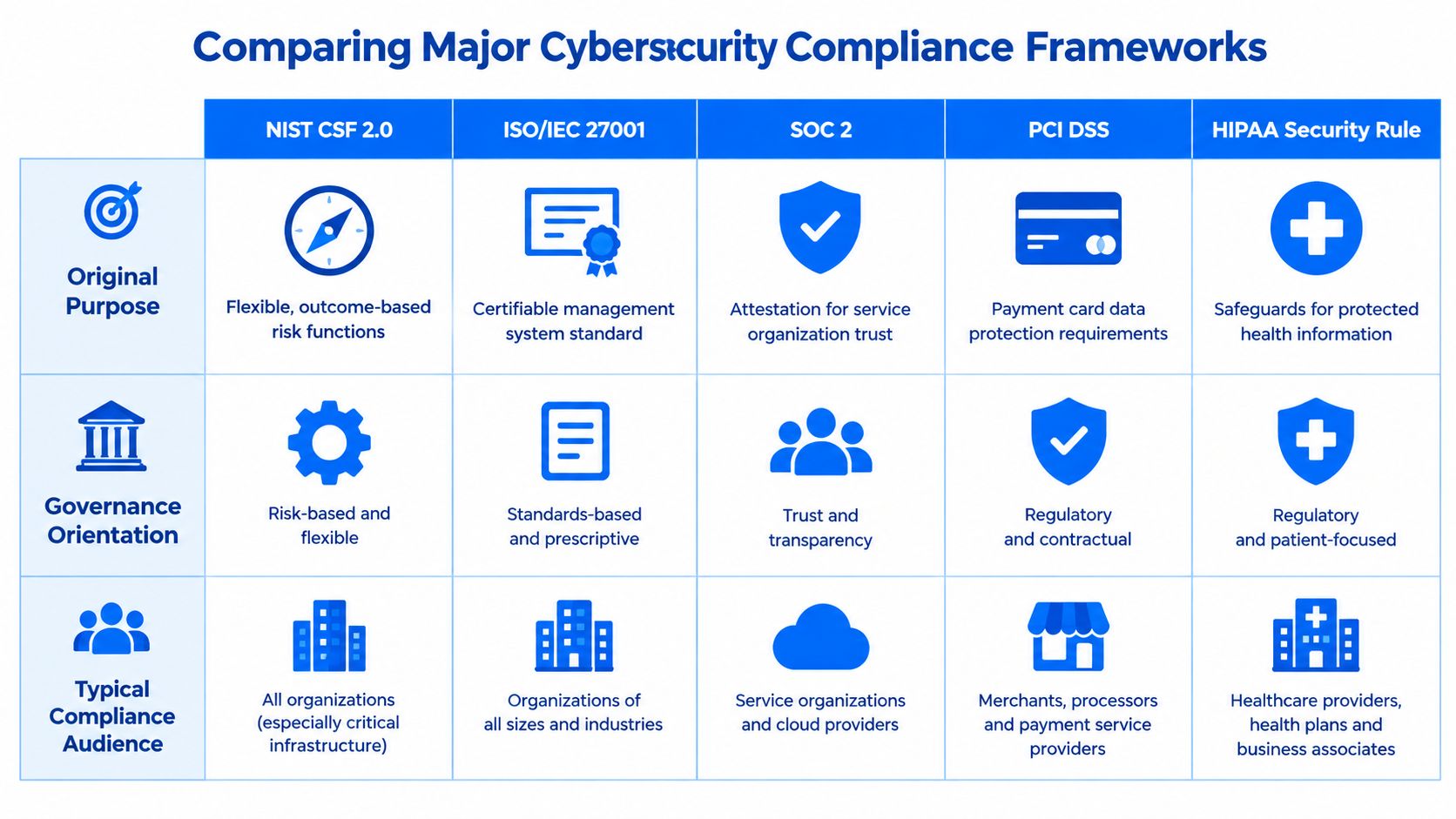
HIPAA isn't a certification framework. It's a U.S. regulation with requirements for administrative, physical, and technical safeguards around electronic protected health information. CIS Controls can help an organization implement practical protections, but safeguard completion alone doesn't establish regulatory compliance.
Evaluating Operational Compliance Outcomes
Control count is a weak measure of compliance strength. A smaller set of controls with clear ownership, regular testing, current evidence, and defined remediation can produce stronger assurance than a large library that nobody maintains. Select a framework by the operating outcomes it can support, not by the number of safeguards it lists.
The implementation gap appears in survey findings. Only 52% of organizations prioritize automation, although respondents identified it as the most impactful incident-response improvement. 58% say compliance checks remain too manual, and 63% cite tool complexity as a primary compliance-management challenge (Trend Micro cloud security research).
The same Trend Micro survey found that 37% of organizations failed a compliance audit because of cloud-security issues during the preceding 12 months, while 78% used cloud-governance frameworks. Framework adoption leaves the operating gap unresolved when teams cannot produce reliable evidence, assign accountable owners, or test controls continuously.
Measure operational performance through outcomes that executives and auditors can examine:
| Metric | NIST CSF 2.0 | ISO/IEC 27001 | SOC 2 | CIS Controls v8.1 |
|---|---|---|---|---|
| Coverage | Measures outcome coverage through Current and Target Profiles | Measures the in-scope ISMS and selected controls | Measures controls within the examination scope | Measures applicable safeguards implemented within an Implementation Group |
| Evidence freshness | Flexible, depending on the organization's evidence model | Formal records and review evidence are central | Evidence is tied to the examination period and scope | Technical evidence can be collected around safeguard performance |
| Remediation time | Tracks gaps and progress toward the target state | Managed through risk treatment and corrective-action processes | Exceptions and control findings require resolution | Supports prioritized remediation work |
| Exception aging | Useful executive metric, although no universal score is prescribed | Managed through risk acceptance and corrective-action governance | Reviewed through findings, exceptions, and management responses | Tracked alongside safeguard gaps and ownership |
| Business continuity | Explicit through Respond and Recover outcomes | Managed through the ISMS and relevant continuity controls | Included only where relevant to the engagement and criteria | Supported through recovery, response, and resilience safeguards |
Use each framework for its strength
NIST CSF 2.0 gives executives a practical way to compare current and target posture. Organizational Profiles describe both positions against Core outcomes. Its four Tiers, Tier 1 Partial, Tier 2 Risk Informed, Tier 3 Repeatable, and Tier 4 Adaptive, describe the rigor of risk governance and management. They are not certification levels, and reaching a higher Tier does not by itself prove compliance (NIST CSF 2.0).
CIS Controls v8.1 gives teams more direct implementation guidance. It contains 18 top-level safeguards and 153 total safeguards, organized into Implementation Groups. IG1 contains 56 foundational safeguards and is defined as essential cyber hygiene. IG2 and IG3 add safeguards for more complex, sensitive, or critical environments (CIS Implementation Groups).
For audit preparation, connect every control to an owner, system, evidence source, test method, review date, and remediation path. Lighthouse Consultants audit guidance offers context for structuring this discipline. A TBaaS operating model should also make evidence collection repeatable, assign exceptions to named owners, and report remediation time and aging rather than merely reporting control completion.
Real-World Scenarios for Framework Selection
A mid-market healthcare provider should begin with its legal exposure and patient-care risks. HIPAA defines safeguards for electronic protected health information, while NIST CSF 2.0 can organize executive oversight, supplier risk, incident response, and recovery outcomes. The provider should inventory clinical systems and business associates, link safeguards to evidence, and test whether clinicians can reach required records without excessive standing privilege.
The combination matters more than either label. HIPAA sets the regulatory boundary. NIST gives the board and security team a shared way to describe current posture, target posture, remediation, and operating performance. Organizations assessing implementation support can review cybersecurity solutions for healthcare during provider evaluation.
A SaaS vendor selling trust
A SaaS company under enterprise procurement pressure may use SOC 2 as its primary external assurance artifact. Its internal operating model can apply ISO/IEC 27001 principles to structure risk assessment, policy ownership, supplier management, internal review, and continual improvement.
Scope discipline determines whether that assurance holds up in practice. A SOC 2 report cannot answer every buyer question when support processes, cloud services, or development environments fall outside the examination boundary. The vendor should map customer commitments to one control library, collect evidence throughout the examination period, and state complementary customer responsibilities plainly.
A manufacturer with legacy operational technology
A manufacturer with legacy operational technology must address supply-chain demands, continuity pressure, and regulatory expectations across jurisdictions. A framework alignment statement will not fix unsupported systems, patching constraints, recovery dependencies, or incomplete software inventories.
Start with critical services and their dependencies. Then prioritize compensating protections, recovery tests, supplier evidence, and monitoring that can function around legacy limitations. ENISA research found that EU organizations identified regulatory compliance as a main cybersecurity investment driver, while vulnerability and patch management, business continuity and disaster recovery, and supply-chain risk remained leading implementation difficulties (ENISA industrial cybersecurity research).
Across these cases, framework selection follows the strongest external obligation. Operational compliance determines whether the choice works: owners must maintain controls, teams must produce evidence, and testing must show that safeguards operate under real service and technology constraints.
How to Sequence Framework Adoption and Control Mapping
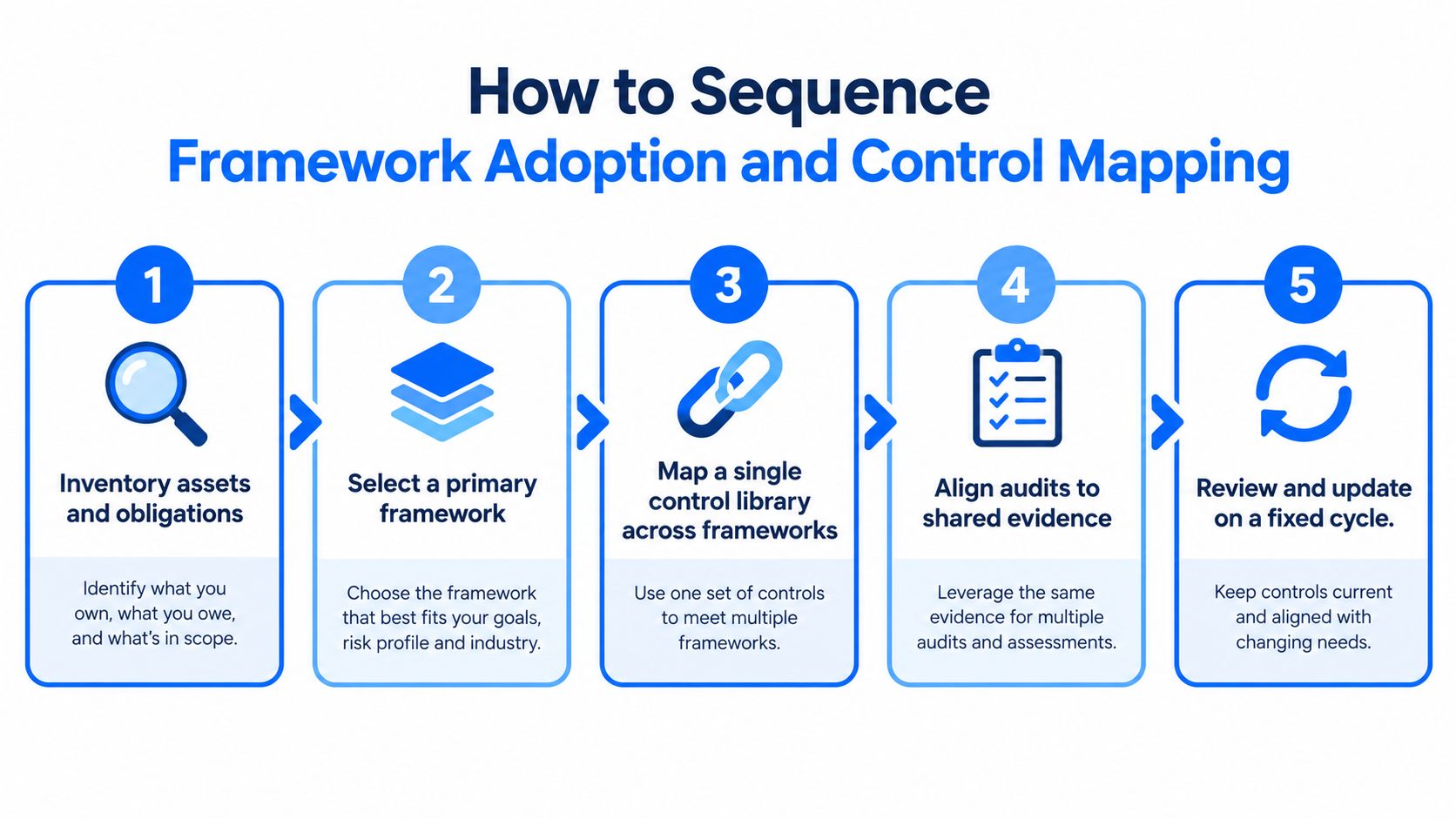
Do not import every control catalog at the outset. Begin with the operating environment and external obligations, then sequence the work so early activity produces evidence that teams can reuse.
- Inventory assets and obligations. Identify critical services, data flows, cloud accounts, software, suppliers, jurisdictions, contracts, and sector rules. Include operational technology and dependencies absent from the central IT inventory. An incomplete inventory weakens every later mapping decision.
- Select a primary framework. Use NIST CSF 2.0 when leadership needs flexible outcome governance. Choose ISO/IEC 27001 when a certifiable management system is the main requirement. Where market access depends on a regulation or customer attestation, make that obligation the primary external driver.
- Build one control library. Map each obligation to a reusable control statement, accountable owner, system boundary, evidence source, test method, and review frequency. Keep distinct legal requirements visible rather than forcing false equivalence.
- Establish the operational baseline. CIS IG1 provides a practical starting point for asset and software inventories, secure configurations, account and access controls, vulnerability management, logging, and incident response. Move to higher groups only after ownership and evidence remain stable through review.
- Run a recurring improvement cycle. Use Current and Target Profiles to prioritize gaps, assign remediation, review exceptions, test recovery, and refresh evidence as systems and responsibilities change.
Map once, reuse carefully
One control can support several requirements, but its evidence may differ. An access-control procedure might support NIST, ISO/IEC 27001, HIPAA, and PCI DSS mappings, while each obligation can impose different scope, testing, retention, or accountability requirements.
Cross-border programs require the same discipline. As noted earlier, ENISA research identified infrastructure constraints, including legacy and operational-technology limitations, as the largest obstacle to NIS2 implementation, followed by cross-jurisdiction regulatory complexity. The research also found limited visibility into software used in connected devices and systems, alongside early-stage Cyber Resilience Act compliance activity. These findings reinforce a practical rule: mapping cannot replace asset inventory, recovery testing, or supplier assurance.
Organizations building an evidence model can consult compliance in IT security for a useful reference point. Implementation must remain tied to actual systems, accountable owners, test results, and current records.
A spreadsheet that lists controls without live evidence remains a catalog; an operating model ties each row to current, traceable evidence.
Decision Criteria for Selecting a Primary Framework
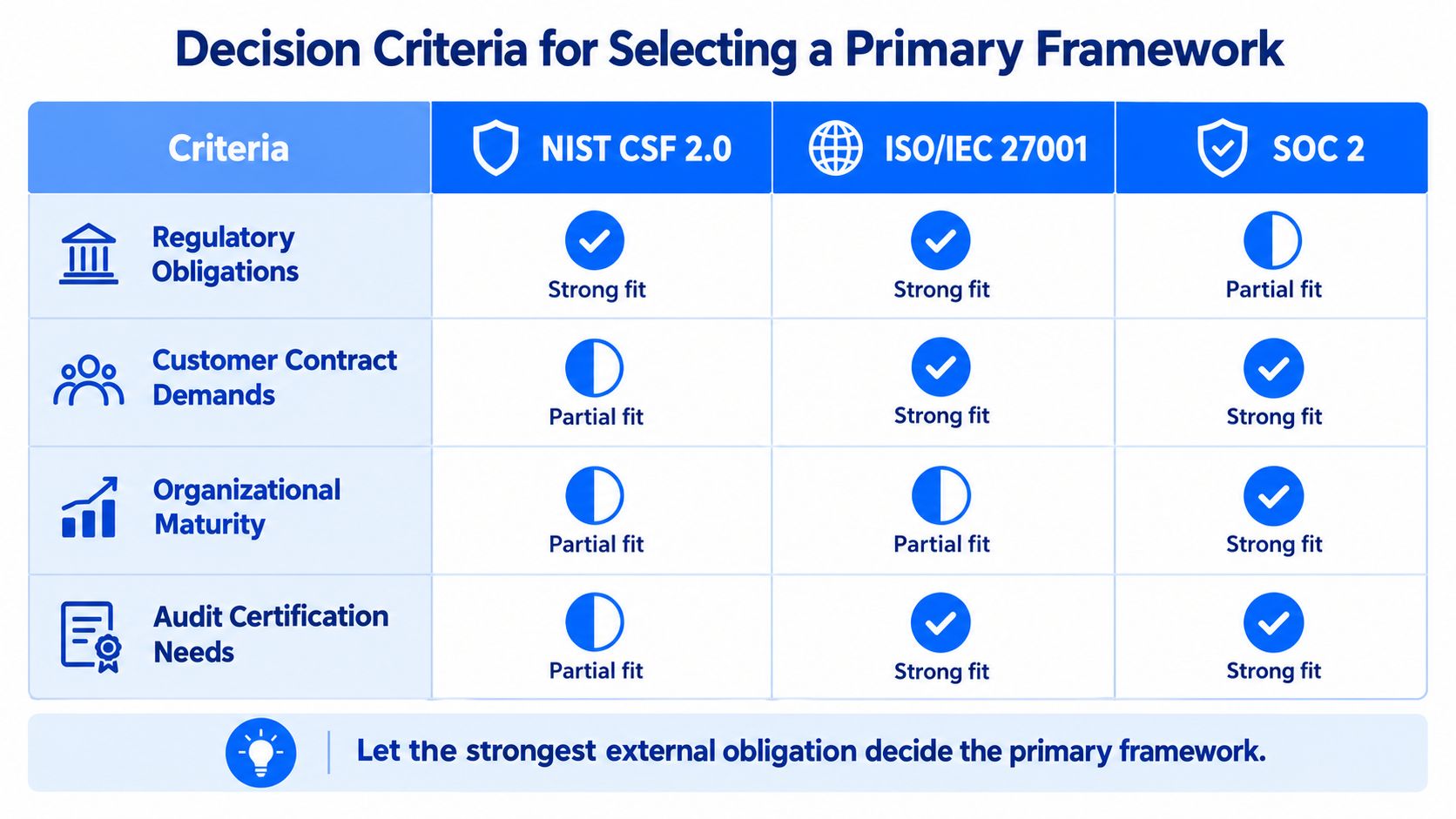
Select the primary framework by external obligation and governance need, not by popularity. If a law or contract requires a specific artifact, that requirement takes priority. If no single mandate dominates, choose the framework that gives leadership the clearest operating structure and gives customers the assurance they request.
NIST CSF 2.0 is usually the strongest governance reference when the organization must align executives, security teams, suppliers, and multiple requirements. ISO/IEC 27001 is the stronger choice when independent certification of a defined management system is commercially important. SOC 2 is the practical external assurance artifact for many service organizations selling trust to enterprise customers. CIS Controls should support implementation when teams need a concrete baseline and prioritized work plan.
Decision principle: The primary framework should organize accountability. Supporting frameworks should reduce implementation ambiguity and evidence duplication.
Use the following matrix as a starting point:
| Context Driver | Best-Fit Primary Framework | Key Rationale |
|---|---|---|
| Broad enterprise risk governance | NIST CSF 2.0 | Connects leadership, risk, suppliers, and security outcomes without prescribing one control set |
| International management-system certification | ISO/IEC 27001 | Creates a formal, auditable ISMS with defined scope and continual improvement |
| Customer assurance for a service organization | SOC 2 | Produces an attestation report focused on controls relevant to the delivered service |
| Operational security baseline | CIS Controls v8.1 | Converts broad priorities into measurable safeguards and implementation groups |
| Protected health information | HIPAA supported by NIST or CIS | Legal obligations remain primary, while a framework structures implementation and oversight |
| Payment card environment | PCI DSS supported by NIST or CIS | The payment-card requirement defines scope, with operational controls supporting execution |
Don't use NIST Tiers as a scorecard for executive theater. They describe governance characteristics, not audit certification. Report whether prioritized outcomes have owners, evidence, tests, overdue actions, and accepted exceptions. That tells the board far more than a framework badge.
Building an Operational Compliance Model
A durable compliance program connects requirements to business services, technical controls, evidence, and decisions. Start with critical services and dependencies. Then prioritize patching, recovery testing, supplier assurance, and evidence automation, rather than treating every requirement as an equally urgent documentation task.
Leadership should track a compact set of operating indicators:
- Control ownership: Every requirement has a named accountable owner and an identifiable evidence source.
- Evidence freshness: Evidence reflects the current environment and remains traceable to the control and test.
- Remediation time: Teams can see how long material findings remain open and why.
- Exception aging: Risk acceptances have an owner, expiry or review point, and documented business rationale.
- Continuity readiness: Recovery plans are tested against actual dependencies, suppliers, and critical services.
- Supplier assurance: Third parties provide evidence proportionate to their access and business impact.
The practical workflow is straightforward. Identify obligations, select the primary framework, map them to one control library, automate evidence collection where possible, test effectiveness continuously, and report unresolved risk in business terms. Use the NIST CSF 2.0 Profile to describe current and target posture, and use CIS Implementation Groups to sequence technical work without pretending that safeguard completion alone equals compliance.
Mid-market organizations that lack full-time security leadership may use fractional CISO services to coordinate governance, audit scope, evidence ownership, remediation priorities, and executive reporting. The right operating model may combine NIST, ISO/IEC 27001, SOC 2, HIPAA, PCI DSS, or CIS Controls, but it should not create separate evidence universes for each one.
Cybersecurity compliance frameworks are complementary governance components, not competing trophies. Choose the primary reference based on the strongest obligation, build one evidence-and-control model, and judge success by whether controls work continuously across the environments that matter.
MR2 Solutions helps organizations evaluate and govern cybersecurity, compliance, cloud, and infrastructure decisions through a vendor-neutral brokerage model and fractional security leadership. Visit MR2 Solutions to connect framework selection with control mapping, evidence operations, implementation, and ongoing governance.