
CMMC Compliance Requirements: Levels and How to Meet Them

In 2024, the U.S. Department of Defense estimated that 8,350 medium and large entities would need a CMMC Level 2 third-party assessment as a condition of contract award, according to the Federal Register notice on the CMMC program. That's a lot of companies discovering at the same time that a certificate isn't the deliverable. Eligibility is.
The requirement is narrower and harder than "get certified." It's the ability to show, at any point in a contract's life, that the specific systems touching defense data meet the level your solicitation names, that your affirmation is current, and that everyone below you in the supply chain can say the same. CMMC compliance requirements are built to be lived with, not passed once.
What CMMC Requires and Who Must Comply
A prime contractor bidding a sustainment contract, a machine shop quoting a subcontract, and a cloud provider hosting an engineering repository can all fall under the same rulebook. What separates them is the level each one must prove.

CMMC began as a Department of Defense effort to standardize how defense contractors demonstrate that they protect Federal Contract Information (FCI) and Controlled Unclassified Information (CUI), as the DoD CMMC program office sets out. It measures two things at once: whether the security requirements are implemented, and whether the processes behind them are mature. DoD describes the framework as a DoD-wide assessment methodology, not a checklist and not a voluntary best-practice program.
The technical spine is NIST Special Publication 800-171, which addresses protection of CUI in nonfederal information systems. Level 2 aligns with the 110 security requirements in that publication. Level 1 covers organizations handling FCI. Level 3 applies to the most sensitive CUI environments and adds requirements on top of the Level 2 baseline.
Treat the level as a badge rule for a secure building. Your badge is issued according to what you carry through the door, not according to how careful your own office feels. A team with excellent firewalls and no CUI in scope may need nothing beyond Level 1. A team with modest tooling but one engineering share holding drawings marked CUI is in Level 2 territory on day one.
Two clauses carry the obligation in practice. DFARS 252.204-7012 requires contractors to safeguard covered defense information. DFARS 252.204-7021 requires an annual affirmation of continuous compliance in the Supplier Performance Risk System (SPRS) for each applicable CMMC unique identifier. Neither is satisfied by holding a general security certification.
Working rule: the solicitation sets the level, the contract clause carries it, and the information you handle decides which one applies. You don't get to pick.
Because the requirement is contract-driven, two contractors with near-identical technology can carry different obligations. Cybersecurity regulatory compliance work starts with the clause set on the page in front of you, then works backward into scoping, evidence and ownership.
CMMC Levels Compared Side by Side
Three levels, three different proof burdens. The table is the fastest way to locate yourself.
| Level | Information protected | Practices required | Assessment method |
|---|---|---|---|
| Level 1 (Foundational) | Federal Contract Information (FCI) | Basic safeguarding requirements drawn from FAR 52.204-21 | Annual self-assessment with annual affirmation |
| Level 2 (Advanced) | Controlled Unclassified Information (CUI) | 110 practices from NIST SP 800-171 Rev 2 | Self-assessment or C3PAO assessment every 3 years, set by the contract |
| Level 3 (Expert) | Highest-sensitivity CUI | Level 2 baseline plus additional enhanced requirements from NIST SP 800-172 | Government-led assessment every 3 years |
How the levels stack
Each level builds on the one below. A contractor assessed at Level 2 has also met the Level 1 controls, because the Level 2 baseline contains them. Nobody starts at the top.
The practices column grows in a predictable direction. Level 1 is basic safeguarding: limit system access to authorized users, sanitize media before disposal, control physical access to equipment. Level 2 turns those basics into a documented program with configuration baselines, retained audit logs, multifactor authentication for privileged accounts, an incident response capability, and a current system security plan. Level 3 asks what changes when the adversary is persistent and well resourced.
The misreading that costs contractors money
The expensive misreading is that every Level 2 contract requires a C3PAO. It doesn't. The solicitation decides, and the two designations you'll meet in writing are Level 2 (Self) and Level 2 (C3PAO). Budgeting a third-party assessment for a contract that calls for self-assessment wastes money. Bidding a self-assessment against a contract that names C3PAO wastes a bid.
Pricing a bid before you've read the assessment column is how contractors win work they cannot legally accept.
The information test usually takes a minute to apply. A contractor that receives only basic contract administration data, purchase orders and delivery schedules is handling FCI and generally sits at Level 1. A contractor that receives technical drawings, test reports or maintenance manuals marked CUI is at Level 2. If the package includes CUI from a sensitive program and the contract says so, Level 3 enters the picture.
Find your row by information type, then read across to the assessment column. That column, not the practices column, sets your next step and your timeline.
How to Match Contracts and Systems to a Level
Most CMMC budget surprises come from scope, not from tooling. A company scopes one file server, then discovers CUI moving through email, a project share, and a managed service provider's backup platform.
CMMC compliance is contract- and system-specific rather than a blanket enterprise designation. The DFARS Subpart 204.75 cybersecurity requirements state it plainly: the CMMC level specified in a solicitation must be achieved before contract award for each contractor information system that will process, store or transmit FCI or CUI. That phrase, "each contractor information system," is where the work begins.
The sequence below keeps the decision in the right order, so you choose technology last.
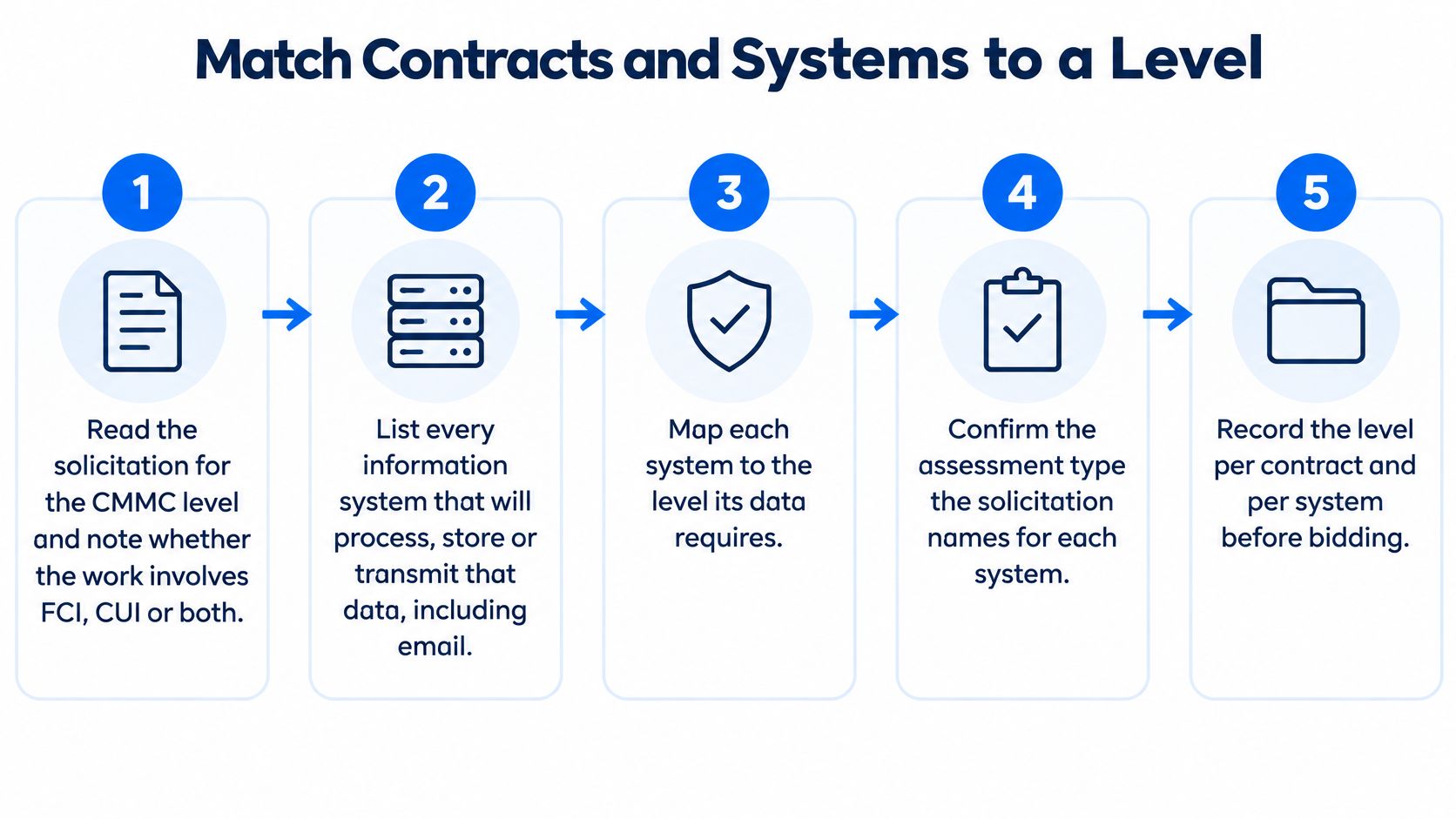
- Read the solicitation for the level and the data. Note whether the work involves FCI, CUI or both, because that determines the practices you'll be measured against, not your existing security budget.
- List every system that touches the data. Include email, cloud file sharing, managed file transfer, line-of-business applications and laptops, because an assessor tests the systems you declare and the ones you forgot.
- Draw the data flows. Show where information moves, who touches it and which outside providers see it, since unmanaged movement is what breaks a scoped boundary.
- Set the boundary and build the asset inventory. Use enclaves and separation controls where they fit, because one unmanaged copy of CUI in a noncompliant environment can undermine an otherwise clean enclave.
- Map each in-scope system to its CMMC unique identifier and its SPRS status. Identifier-level mapping keeps the affirmation accurate when one environment changes and another doesn't.
- Compare in-scope systems against the target level's requirements. This sizes the gap in practices, not in products, and it's the number that drives your remediation plan.
- Decide whether to narrow scope or upgrade specific environments. Do this before buying tools, because segmentation, identity governance, logging, vulnerability management and any managed-service arrangement must all support the exact environment that holds the data.
The lesson is that scope comes first and stays first. A control that's perfectly implemented outside the boundary counts for nothing, and a boundary that expands after the assessment counts against you.
When you screen opportunities at volume, a government RFP database that surfaces the CMMC level and clause set for each listing saves you from reading every package in full before you know whether it's even in your range.
Assessment Types and How Long Certification Lasts
A CMMC status has a shelf life, and it's shorter than most contractors assume when they first read the clause.
| Assessment or status | Valid for | Affirmation rule |
|---|---|---|
| Level 1 self-assessment | 1 year | Annual affirmation of continuous compliance |
| Final Level 2 self-assessment | Generally not older than 3 years | Affirmation not older than 1 year |
| Final Level 2 C3PAO certification | Generally not older than 3 years | Affirmation not older than 1 year |
| Conditional Level 2 status | 180 days | Confirm no compliance changes since the conditional status date |
| Conditional Level 3 status | 180 days | Confirm no compliance changes since the conditional status date |
The current DFARS CMMC contract clause text sets those windows: final Level 2 self-assessments and certified third-party assessments are generally not older than 3 years, while the related affirmation cannot be older than 1 year. Conditional statuses run for 180 days and require confirmation that there have been no compliance changes since the conditional status date.
The change that most often invalidates a status
It isn't an attacker. It's a migration nobody re-scoped. Move a workload to a new cloud tenant, add a subcontractor, reorganize a shared drive, or complete a merger, and the assumptions behind your last affirmation may no longer hold even though every security tool is still running.
Employee turnover does the same damage more slowly. The engineer who maintained the configuration baseline leaves, the new hire keeps the system running and stops updating the system security plan. Six months later the plan describes an environment that no longer exists.
A status that was accurate on the day it was posted can be wrong today without anyone doing anything wrong.
Contracting officers may not award a covered contract, task order or delivery order when the offeror lacks the CMMC status the solicitation requires. An expired status is therefore a bid problem before it becomes an audit problem.
The phased rollout described in the Federal Register publication of the CMMC final rule began on November 10, 2025, with additional phases scheduled for November 10, 2026 and November 10, 2027, and full contract incorporation planned by November 2028. Those dates are a plan, not a guarantee, and the schedule has been subject to review, so confirm the current phase status on the DoD CMMC program page before you build a bid calendar around them.
What an assessor actually tests
Each required practice is checked against evidence in your control-to-evidence register: a policy, a configuration export, a log sample, a completed access review. A Level 2 contract decides whether that evidence is reviewed by your own team or by a C3PAO. Level 3 status comes from a government-led assessment, not an assessor you select.
Before any review starts, confirm the assessed scope in writing. The boundary tested has to match your data-flow diagrams and your asset inventory, or you'll spend the assessment arguing about what's in it.
Put every status date in a renewal tracker with 90-day reminders. That single practice prevents most lapses.
How to Prepare Controls, Evidence and Ownership
Controls rarely fail because a tool wasn't purchased. They fail because nobody can prove the tool was configured a certain way, reviewed on schedule, and still operating that way months later.
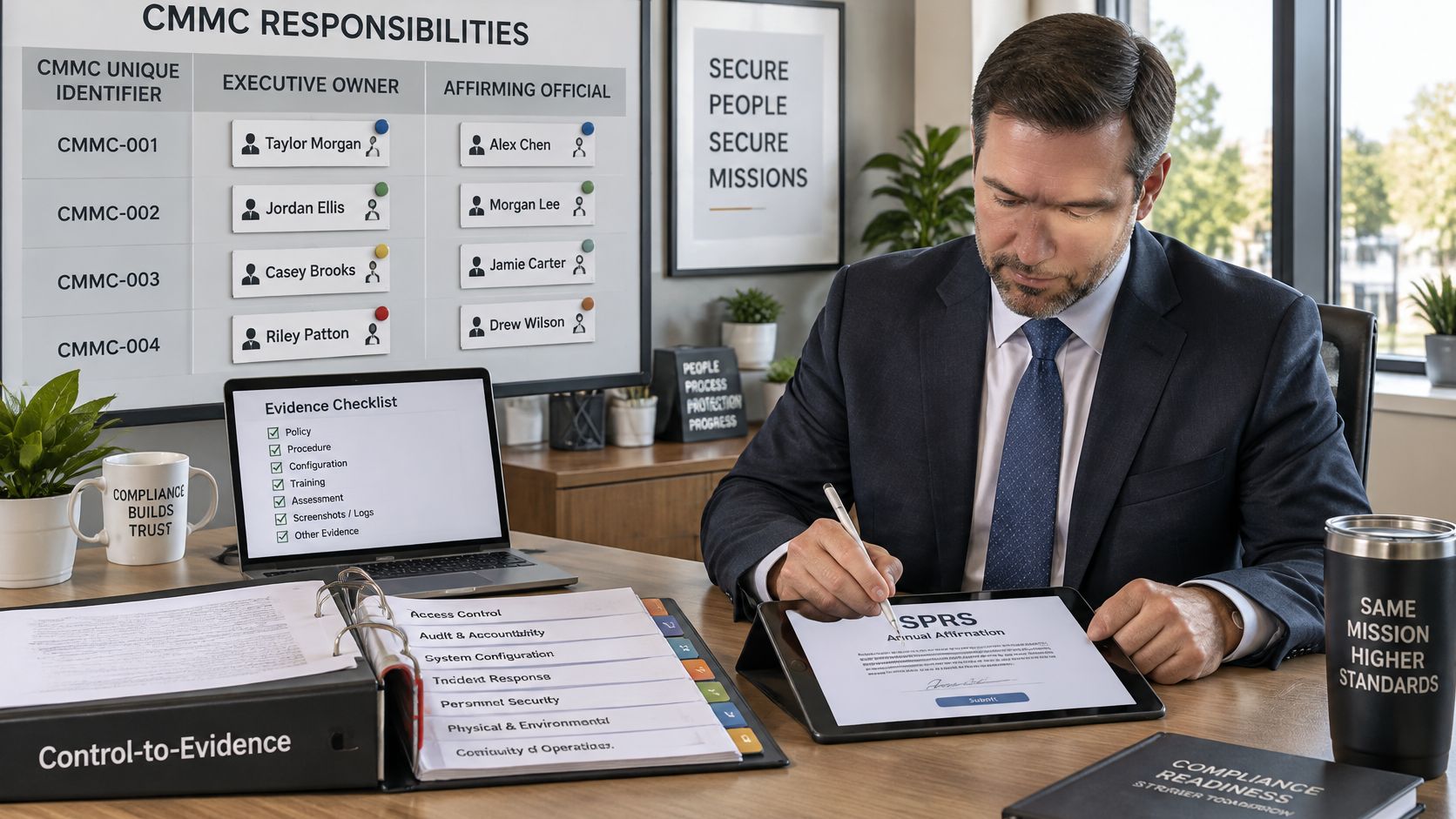
Under DFARS 252.204-7021, an affirming official completes and maintains an annual affirmation of continuous compliance in SPRS for each applicable CMMC unique identifier. The affirmation must remain current and, where applicable, represent that nothing affecting compliance has changed since the assessment or status date. That's why the annual signature is the endpoint of monitoring rather than an administrative renewal.
- Name two people. An executive owner who decides remediation priorities and an affirming official who signs for each identifier. Without named ownership, gaps get discussed and never closed.
- Build a control-to-evidence register. One row per practice, mapped to the artifact that proves it: a signed policy, a configuration export, a log sample, a completed access review. If you can't point to the file, the control isn't demonstrated.
- Run an internal assessment against the target level. Mark every practice met, partial or not met, and record the reason. Partial credit is fine internally; silence isn't.
- Remediate in a defensible order. Access control, multifactor authentication, audit logging, incident response, vulnerability management and backup protection first, because they carry the most weight across domains and close the widest gaps fastest.
- Wire change management into the program. Configuration changes, cloud migrations, new subcontractors, altered data flows and control exceptions should trigger a register review. This is the mechanism that keeps the affirmation honest.
- Retain evidence on a schedule and repeat internal reviews. Keep the artifacts for the full assessment cycle so a later review can reconstruct what was true on a given date.
- Prepare the assessment package before a C3PAO arrives. Confirm scope with the assessor in advance so the boundary under review matches your diagrams and inventory.
Where programs break
- Policy without practice. A written access control policy that nothing enforces is a finding, not a control.
- Audit-only evidence. Artifacts generated the week before the review look exactly like what they are.
- Vendor certification as cover. A provider's generic security certificate says nothing about your system boundary.
- Orphaned exceptions. A control exception granted for a migration that finished two years ago is still an open gap.
A compliance matrix walkthrough applies the same discipline to the solicitation itself: every requirement gets an owner, a status and an artifact, so nothing survives on memory alone.
Procurement teams should also require providers to define who owns evidence, incident records, access reviews, logging, backup protection and subcontractor dependencies. Getting that in writing is part of compliance in IT security, not a separate exercise.
Flowing CMMC Requirements Down to Subcontractors
A machine shop receives engineering drawings marked CUI from a prime. Before the prime can release those drawings, the shop needs at least Level 2 (Self). If the prime's own contract requires a C3PAO assessment, the shop generally has to meet Level 2 (C3PAO) as well, because a prime can't flow down less than it owes.
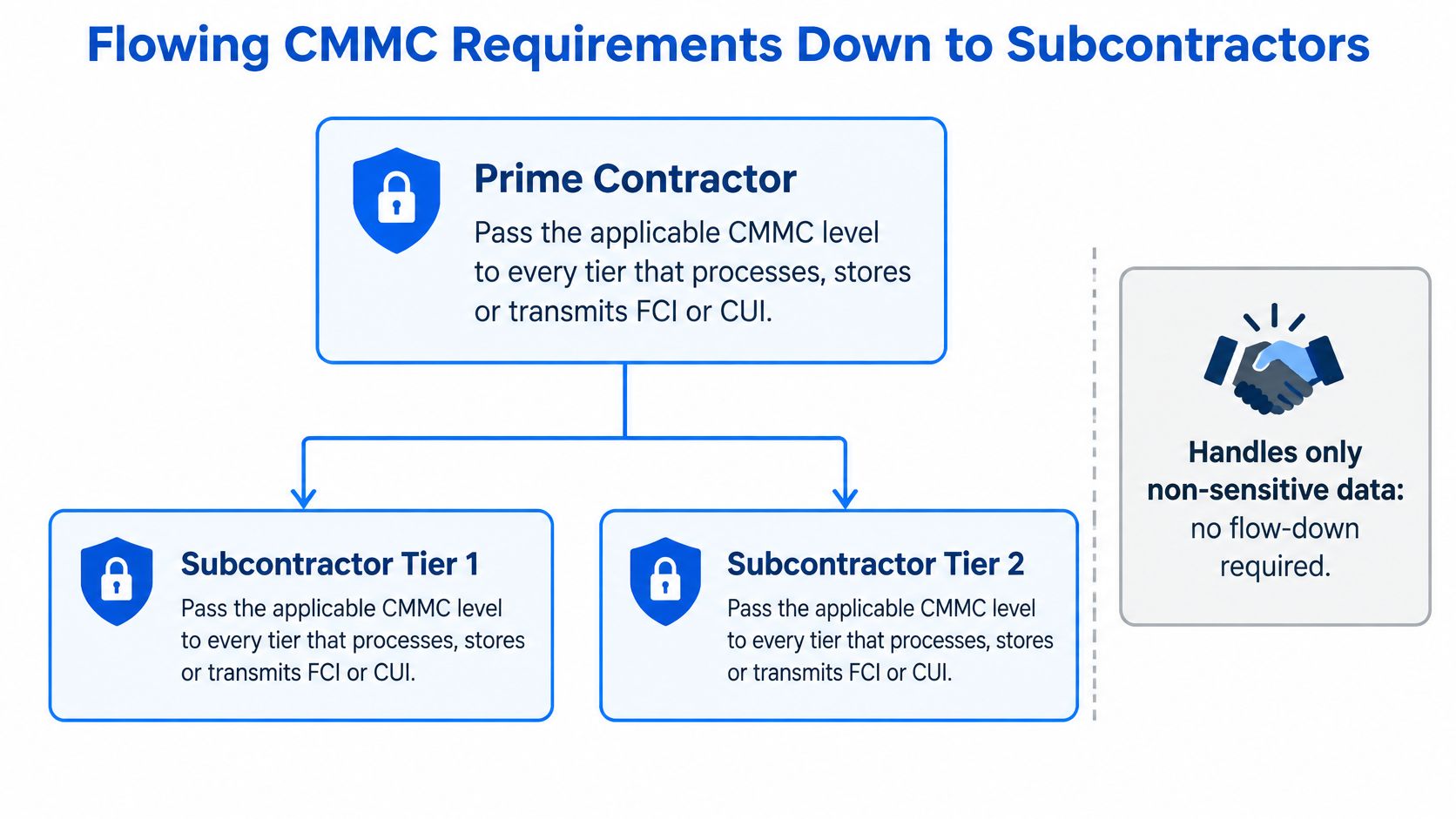
That's the part most readiness projects underweight. CMMC is a continuing supply-chain governance obligation, and the DoD CIO CMMC overview confirms that primes must flow the applicable level down to subcontractors at every tier that process, store or transmit FCI or CUI.
The flow-down level in practice
A subcontractor handling only FCI generally requires Level 1 (Self). One handling CUI requires at least Level 2 (Self). One supporting a prime that must meet Level 2 (C3PAO) generally needs Level 2 (C3PAO) too.
The operational work is unglamorous and it's where primes get caught. Verify subcontractor status before award. Keep annual affirmations on file. Track which subcontractor systems hold FCI or CUI and the CMMC identifiers attached to them, because a supplier swap mid-contract changes your scope.
Four moves cover most of it:
- Map data flows to every supplier. Know which vendors see which data before you sign, not after performance starts.
- Set the flow-down level supplier by supplier. One supplier may need only Level 1 while another needs Level 2 (C3PAO), and treating them uniformly either overcharges or under-protects.
- Validate status before award. A certificate claimed in a proposal needs to be current and matched to the right system.
- Monitor through the contract lifecycle. Recheck at renewal and whenever a supplier changes systems, ownership or subprocessors.
The contrarian point worth sitting with: a prime can hold its own certification and still create award or performance risk through a supplier ecosystem it never governed.
Vendor governance is the control here, not cybersecurity theater. A structured cyber security vendor management process that records status, scope and renewal dates turns flow-down from a scramble into a checklist.
Confirm Your CMMC Level Before You Bid
Treat bid readiness as a set of checks, not a single certificate. The solicitation, the systems in scope, current affirmations, and accountable signatories all need to align.
- Check the level and assessment type in the solicitation. Read the clause itself, and confirm whether it specifies Level 2 (Self) or Level 2 (C3PAO).
- Match the systems to the required scope. Confirm that systems processing CUI are mapped and have the appropriate CMMC identifiers.
- Check current status and affirmations. Confirm they will remain valid at award, including for subcontractors.
- Identify the official who will affirm. That person needs the authority and information to attest to the organization's status.
Check SAM registration in the same bid review. Addressing issues early can prevent an administrative problem from surfacing near the solicitation deadline. Use this eligibility checklist to clear SAM registration issues early.
Before buying tools or committing remediation funds, assess gaps against the level named in the solicitation. The findings help determine whether the organization needs changes to system boundaries, logging, identity management, or other controls. Starting with purchases can lead to spending on solutions that do not address the actual gaps.
MR2 Solutions provides cybersecurity services to help businesses protect their systems and meet compliance requirements. Its Security Assessment benchmarks a client's security posture and identifies gaps. As a vendor-neutral advisor representing the client's interests rather than a vendor's quota, MR2 can help align recommendations with the organization's needs.
This week, review the solicitation you are pursuing. Confirm its CMMC level and assessment type, then request a gap assessment against that target before setting a remediation budget.
CMMC eligibility depends on evidence that the organization can produce when required. Scope, documented ownership, and subcontractor status remain part of supply-chain governance after the bid, so keep them aligned as contract requirements and systems change. If the applicable level or remaining gaps are unclear, MR2 Solutions can help assess the security posture against the contract's requirements.