
What Is Microsegmentation and How It Works

Microsegmentation is a cybersecurity approach that breaks a company’s network, apps, devices, and workloads into small, tightly controlled zones. Each zone gets its own rules, so only specifically approved traffic can pass between systems, users, and workloads. It’s a sharp departure from old-style VLANs, subnets, and large firewall zones. Learn more about microsegmentation in Fortinet’s white paper.
How Microsegmentation Differs From Traditional Network Controls

Think of a classic office with a guard at the front desk but wide-open hallways inside. Once someone talks their way past reception, nearly every department is within reach.
That’s exactly how a traditional flat network behaves. Microsegmentation flips the model by putting a badge reader on every single door. Steal one badge and you might get into one room — not the whole floor.
Core idea: Microsegmentation permits only the connections your workloads actually need, so an early intrusion can’t quietly turn into a company-wide breach.
The real difference comes down to detail. Traditional segmentation tends to draw big lines, like keeping servers apart from users or production apart from development.
Microsegmentation goes much finer. It can set least-privilege rules around:
- An individual virtual machine or container
- A specific cloud workload or application
- A single user identity or endpoint device
That precision matters more now because attackers rarely smash through the perimeter. More often they slip in with stolen credentials, malware, or an exposed app, then ride normal internal connections to reach what they want.
Microsegmentation Vocabulary at a Glance
Here’s a quick cheat sheet for the terms you’ll see throughout this guide. No security architecture background needed.
| Term | Plain-English Meaning | Why It Matters |
|---|---|---|
| Microsegment | A tiny security zone around one workload, app, user, or device | Shrinks the routes an attacker can use |
| East-west traffic | System-to-system chatter inside your environment | Shows activity perimeter tools usually miss |
| Lateral movement | An intruder hopping sideways from one system to another | Gets much harder when extra paths are closed |
| Least privilege | Giving each thing only the access its job requires | Cuts down on risky or accidental access |
| Policy enforcement | Actively applying rules that allow or block traffic | Turns good intentions into day-to-day control |
East-west traffic is just internal conversation. A web server querying a database, a laptop opening an app server, one container calling another — all of that counts.
Lateral movement is what happens when an attacker abuses those conversations. Without microsegmentation, a compromised laptop might reach a sensitive database freely. With it, that path stays shut unless there’s a clear business reason to leave it open.
The rest of this guide walks through how microsegmentation works, how it stacks up against traditional segmentation, where it pays off in practice, and how it fits with zero-trust security. You’ll also get a practical way for technology leaders to weigh the coverage against the effort and cost.
A good place to start? Pick the one workload that would hurt most if it were compromised. Then map every legitimate path that touches it. That small exercise turns a big idea into a concrete starting point for policy, testing, and phased rollout.
An attacker phishes an employee’s credential and lands on a web-facing application server inside the data center. The next move is east toward the database tier, but a microsegmentation policy can deny that path even when both workloads sit in the same facility.
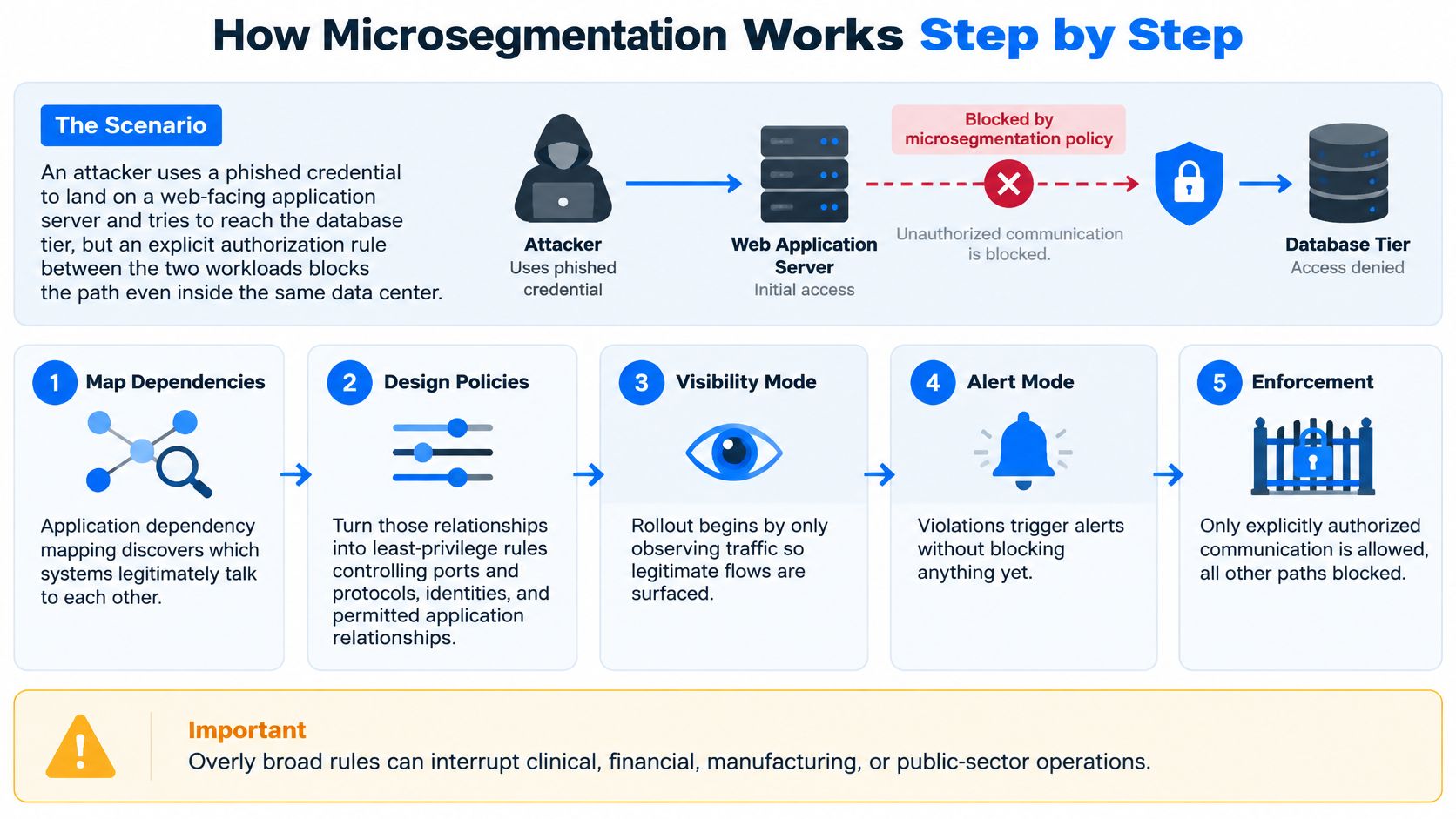
The graphic walks through the five-stage rollout, the three policy controls, and the blocked route from the compromised server to the database. The sequence matters: dependency discovery and staged testing come first, and enforcement closes the door last.
Set the Policy Levers
- Ports and protocols define the technical channels a workload may use, such as a database connection over a designated port.
- Identities establish which workload, user, or service is asking for access and whether that entity should be allowed to connect.
- Application relationships limit permission to a documented interaction, such as a web server querying its database, instead of permitting broad east-west access.
Follow the Rollout in Order
- Map dependencies. Learn which systems legitimately communicate, then record the workload, identity, port, protocol, and business purpose behind each flow.
- Design policies. Turn observed dependencies into least-privilege rules that allow required communication and reject everything else.
- Enter visibility mode. Watch traffic without blocking it so legitimate flows, missed dependencies, and surprise destinations surface for review.
- Activate alert mode. Flag policy violations while enforcement stays off, giving teams room to validate exceptions and close gaps.
- Enforce the policy. Permit only explicitly authorized communication and block every other path, including the attacker’s attempt to reach the database.
Only explicitly authorized communication is allowed.
Protect Operations During Enforcement
A rule that is too broad can interrupt real work. Blocking every database connection, for example, could stall clinical records, payment processing, factory controllers, or public-sector case handling.
Start with a narrow set of workloads, confirm observed dependencies with application owners, and document temporary exceptions instead of handing out blanket access.
Treat Segmentation as Governance
Microsegmentation is an ongoing discipline, closer to change management than a one-time control. It converts business-critical communication needs into measurable rules that get reviewed as applications, identities, and environments change.
Teams should track coverage, blocked east-west connections, unresolved exceptions, and time to isolate critical assets. Those measures show whether policy reflects how services actually run.
The strongest programs keep ownership clear, revisit rules on a schedule, and test exception handling before pressure hits. Pick one critical workload, map its dependencies, and define a visibility-mode pilot before enforcement begins, then ask MR2 Solutions for a vendor-neutral segmentation assessment to compare control options and build a phased enforcement plan.
Existing VLANs and firewall zones still have a job when microsegmentation enters the picture. The real question is whether their boundaries are precise enough for the systems you need to protect.
Comparing Microsegmentation With Traditional Segmentation

Think of macro-segmentation as putting departments on separate office floors. Microsegmentation adds permissions at individual doors, so movement between rooms can be restricted even when everyone shares the same floor.
That distinction answers a practical version of “what is microsegmentation?” It is finer control inside boundaries you already have, and it can complement wider zones instead of forcing a redesign. Fortinet's microsegmentation overview explains the shift from broad network zones toward workload-level protection.
Traditional Segmentation and Microsegmentation Compared
Use this table as a decision aid: it shows where each approach usually fits, so infrastructure and security leaders can judge whether workload-level controls add coverage that existing zones miss.
| Dimension | Traditional Segmentation | Microsegmentation |
|---|---|---|
| Granularity | Departments, subnets, zones | Individual workloads or applications |
| Policy attachment | Network location and boundaries | Workload identity, labels, relationships |
| Cloud portability | Often requires environment-specific redesign | Can follow workloads where supported |
| East-west visibility | Depends on traffic crossing monitored boundaries | Can expose communication between workloads |
| Day-two effort | Maintain zones and firewall rules | Maintain dependencies, exceptions, workload policies |
The takeaway is comparative, not absolute. Cloud portability and visibility depend on enforcement coverage, while operating effort depends partly on automation and application change rates. Cisco's workload-security discussion describes distributed enforcement across mixed environments.
Understand Coverage Before Comparing Adoption
A segmented department can still contain an open hallway. Layered protection addresses both scales.
VLANs can keep separating user networks from production infrastructure while microsegmentation restricts application-to-database communication inside production. These controls do different jobs, so keeping both can be a deliberate architectural choice.
The supplied adoption finding, 33% fully implementing both macro- and micro-segmentation, shows why one layer alone does not prove complete coverage. Still, without the underlying survey methodology, treat that figure as context rather than a benchmark for your organization.
Adoption percentages are rarely interchangeable because surveys can differ in:
- Definitions, counting pilots, partial coverage, or complete enforcement.
- Respondents, surveying different industries, organization sizes, or security roles.
- Questions, asking about purchases, deployment, plans, or operational maturity.
A common trap follows: protecting several data-center applications can create confidence while cloud workloads and user devices remain effectively flat. Product deployment alone does not prove that every relevant lateral path is controlled.
Use these questions in your next architecture review, and ask MR2 Solutions to help assess any uncertain boundaries:
- Which systems have individual communication restrictions, rather than only shared zone boundaries?
- Does protection extend to cloud workloads and user devices?
- Can we demonstrate blocked unauthorized connections within each protected zone?
Nearly half of the security leaders surveyed said they dealt with a lateral-movement attack during the previous year, based on the data provided for this guide. A second analysis puts average attacker dwell time at 24 days before ransomware gets deployed. Both figures frame the problem clearly enough, though the research methods behind them weren't shared.
Benefits and Real-World Microsegmentation Use Cases

When leadership asks what microsegmentation actually buys them, the honest answer is straightforward: one compromised machine gets far fewer chances to disrupt services it has no business touching. Limiting which ports, protocols, and pathways stay open shrinks the ground an attacker can cross, a point Cisco makes in its workload security write-up.
A ship's sealed bulkheads work the same way. Water can still enter through a breach, yet the flooding stays trapped inside one compartment instead of sinking the whole vessel.
The real payoff is containment. No control can guarantee breaches will never happen.
According to the containment data supplied, companies running microsegmentation contained breaches 66% faster than peers without comparable controls. Read that figure as specific to one study. Your results depend on how well policies are written, how much of the environment falls under enforcement, and whether monitoring and response keep pace.
Protect Critical Services From Lateral Movement
The scenarios below show what containment looks like in practice. Each begins with a compromised asset, then identifies the connection policy should refuse and the service worth defending.
- Hospital: An attacker lands on an administrative workstation and tries to reach clinical application servers. Cutting off unauthorized administrative-to-clinical traffic keeps patient records available and lowers the chance that care gets interrupted.
- Financial services: Malware on a staff laptop attempts a direct connection into payment systems. Isolating those workloads closes that route while approved transaction traffic keeps flowing, so payment processing stays online.
- Manufacturing: An infected office server reaches toward production management systems. Refusing unapproved IT-to-production connections keeps a routine compromise from halting scheduling, supervisory functions, or the factory floor.
Each of these works because legitimate dependencies stay open. Microsegmentation can tighten the perimeter around critical systems, yet application security, recovery planning, and incident investigation still matter.
- Name the service being protected, whether payments or clinical records.
- Identify which path gets blocked instead of tallying deployed tools.
- Measure what happened, covering isolation time and service availability during testing.
Build a Defensible Security Investment
The budget data supplied indicates 68% of enterprises intended to raise their microsegmentation spending. That reflects buying plans. It says nothing about results, and matching another company's budget is a poor reason to spend.
| Budget Question | Evidence to Request |
|---|---|
| What stays protected? | Named critical workloads |
| Does containment work? | Tested blocked connections |
| Can auditors verify controls? | Policies, logs, reviews |
Have MR2 Solutions evaluate one critical service and tie its cybersecurity services to your regulatory requirements. Begin with its guidance on compliance in IT security, then ask for a scoped conversation that covers containment goals, evidence requirements, ownership, and acceptable operational risk before any technology gets selected.
Zero Trust Is the Plan, Microsegmentation Is How You Build It
People mix up zero trust and microsegmentation constantly. It's an easy mistake, but it causes a lot of confusion.
Think of it this way. Zero trust is the strategy — the decision to stop trusting any connection by default, inside or outside the network. Microsegmentation is one enforcement mechanism that puts that idea into practice at the workload and network level.
To extend the building analogy, zero trust is the company rule that you need a badge everywhere. Microsegmentation is the actual locks on every door that make people follow it.
Zero trust without enforcement is a policy document. Microsegmentation is where that policy becomes architecture.
Why Hybrid Environments Need More Than One Form
This is shifting fast. Gartner estimates that 60% of enterprises pursuing zero-trust architecture in 2026 will use more than one deployment form of microsegmentation, up from less than 5% just three years earlier, as reported in the Zero Networks guide to microsegmentation and zero trust.
A related forecast puts organizations using multiple microsegmentation strategies at fewer than 5% in 2023, rising to 25% by 2027.
The reason is straightforward. Hybrid and multi-cloud setups force teams toward multiple approaches because policies must follow the workload rather than a physical data-center location.
A payment app might live on-premises today. Next quarter it moves to containers. After that, to a managed cloud service. No single enforcement method handles all three cleanly.
Two Misconceptions Worth Correcting
- Microsegmentation alone does not deliver zero trust. Identity checks, device posture, and continuous monitoring are still separate work.
- A zero-trust roadmap does not require identical segmentation everywhere. Tiered coverage based on risk is solid design, not cutting corners.
Where to Start Your Sequencing
Bring workloads under policy in this order:
- Crown-jewel systems with the highest business impact, like payment or clinical platforms.
- Internet-facing applications that attackers probe first.
- Flat internal zones where lateral movement currently goes unblocked.
For distributed sites, segmentation has to travel across the WAN too. Check out our guide on SD-WAN security to see how multi-site networks carry these controls.
Implementation really comes down to discovery quality, not which product you pick first. Check those dependency maps against how the business actually runs — overnight backups, month-end payment jobs, all of it — before you let anyone turn on enforcement.
Implementation Considerations and Choosing an Approach
Think of a missing connection like an unmarked doorway on a building plan. Lock it, and you might strand the very people who need to get through. Cisco’s implementation guidance makes the same point: learn your application dependencies first, then tighten controls without breaking critical services.
The next step is getting clear on decision rights across security, networking, and application teams. Who writes the policies? Who confirms the business dependencies? Who signs off on exceptions and emergency changes?
Don’t approve enforcement until someone owns both the security decision and its operational consequences.
A vendor-neutral assessment helps here. It forces you to decide where controls actually belong — on servers, cloud workloads, user devices, or IoT systems. In healthcare and financial services, factor in application uptime, device limits, and what evidence auditors will want to see.
- Check compatibility: Can this approach protect legacy systems without installing unsupported software?
- Test portability: What happens when workloads move to another environment?
- Examine exit options: Can your team export policies and dependency records if you leave?
That’s how “what is microsegmentation” stops being abstract and becomes a scoped buying decision, not a premature commitment to one vendor.
Connect Selection to Delivery
MR2 Solutions’ five-step enterprise networking approach gives this decision some useful structure. Its curated ecosystem of more than 400 solution providers is built around matching the requirement to the right fit, rather than picking a provider up front.
For segmentation, turn each stage into something tangible:
| Stage | Segmentation Deliverable |
|---|---|
| Assess | Critical workload inventory, dependency gaps, and risk priorities |
| Design | Policy boundaries, ownership assignments, and availability requirements |
| Evaluate | Provider comparison against coverage, compatibility, and operating costs |
| Deploy | Scoped enforcement pilot, rollback plan, and acceptance evidence |
| Optimize | Coverage dashboard, exception reviews, and updated policies |
It’s also worth asking whether your in-house team can maintain cloud policy architecture long-term. Teams planning to hire cloud security architects can use that role description to spell out architectural ownership before handing out implementation tasks.
Keep the evaluation hands-on. Have each shortlisted provider show one approved application connection, one denied connection, and one emergency rollback. Bring application owners into the room to watch and sign off on the acceptance criteria.
Confirm Readiness and Measure Coverage
Before you expand enforcement, make sure these basics are in place:
- Inventory: Every critical workload has a named business owner.
- Dependencies: Application teams have validated the communication data.
- Ownership: Security, networking, and application responsibilities are agreed.
- Pilot: Enforcement and rollback have passed operational testing.
- Exceptions: Every request needs approval, justification, and an expiry date.
From there, track percentage of critical workloads covered, unauthorized east-west connections blocked, outstanding policy exceptions, time to isolate an incident, and rules reviewed on schedule.
Ask MR2 Solutions to scope one critical application, assign accountable owners, and lock in those governance metrics before you start comparing providers.
The final call usually comes down to four practical questions.
Frequently Asked Questions About Microsegmentation
Does Microsegmentation Replace Firewalls and VLANs?
No. Think of it as an added layer on top of macro-segmentation, not a swap.
VLANs still set the broad boundaries. Firewalls still control what crosses those lines. Microsegmentation goes one step further and limits how individual workloads talk to each other inside those zones, as explained in Fortinet’s microsegmentation overview.
Is Microsegmentation Only for Large Enterprises?
Not at all. A mid-sized team can start small with a defined group of critical workloads instead of trying to cover everything on day one.
Healthcare, financial services, and government teams often have compliance reasons to look at granular access early. Segmentation alone won’t make you compliant, though. These compliance considerations help frame that review.
Start with business risk, not organization size.
How Disruptive Is Enforcement?
It depends on how accurate your policies are and how carefully you roll them out.
Visibility and alert-only modes help you spot legitimate traffic before anything gets blocked. Clinical, financial, and manufacturing systems deserve an even narrower pilot, with application-owner sign-off and a tested rollback plan. Application dependency planning supports that careful approach.
Measure Results Within Your Environment
How Can Leaders Verify Progress When Adoption Surveys Disagree?
Survey numbers alone don’t prove your controls are working. Figures from 24% to 73% aren’t comparable unless the definitions, samples, and deployment scope match.
Instead, track what matters in your own environment:
- Critical-workload coverage
- Tested blocked connections
- Unresolved exceptions with named owners and expiry dates
Ask MR2 Solutions to scope a critical-workload assessment through its consultation process, agree on pilot acceptance criteria, and assign clear ownership for reviewing policy coverage as applications, dependencies, and environments change over time.