
How Does SD WAN Work Explained Simply for IT Teams

Your branch teams still get the same complaints. The video call to headquarters stutters, SaaS apps feel fine one minute and sluggish the next, and someone in finance asks why a backup MPLS circuit sits idle while the broadband link everyone distrusts is carrying half the business. That's usually the moment IT managers start asking how does SD-WAN work, because the old answer, “keep adding bandwidth,” doesn't solve the problem.
The shift is bigger than transport choice. SD-WAN turns WAN routing from box-by-box configuration into centralized policy, with controllers maintaining a network-wide route view and pushing decisions across the overlay fabric, as Cisco documents in its policy framework for the controller layer (Cisco policy framework). That's why SD-WAN isn't just cheaper connectivity. It's a living control system that keeps measuring links, comparing policies, and steering traffic as conditions change.
Introduction Why Traditional WAN Struggles Today
Legacy WANs were built for a world where most traffic returned to a data center and paths changed slowly. That model breaks down when one branch user joins a cloud meeting, another opens a SaaS app, and a third team needs local internet breakout without losing control. For IT leaders managing MPLS, VPNs, and split tunneling at the same time, the network starts to feel like a set of exceptions instead of one operating model.
The pain is not only technical. It shows up as branch inconsistency, too many manual changes, and too much dependence on static routes that do not react well when a link degrades. Cisco's SD-WAN documentation describes centralized policies that are provisioned on controllers and applied network-wide, which shifts the operating model from device-by-device tuning to centrally defined intent (Cisco policy overview).
That pressure is what drives SD-WAN adoption. Teams want fewer fragile assumptions, more predictable application behavior, and a way to use mixed transport links without treating every outage like a fire drill.
Core shift: legacy WANs ask each device to make local routing decisions, while SD-WAN uses centralized policy to guide the whole overlay.
If you are comparing options, the operational difference between SD-WAN and VPN-based designs is a useful starting point, which is why many teams review SD-WAN vs VPN guidance before changing architecture. For retail-heavy environments, software-defined WAN for retail can also help frame branch performance and guest traffic concerns in plain language.
What SD WAN Actually Is and How It Differs from Legacy WAN
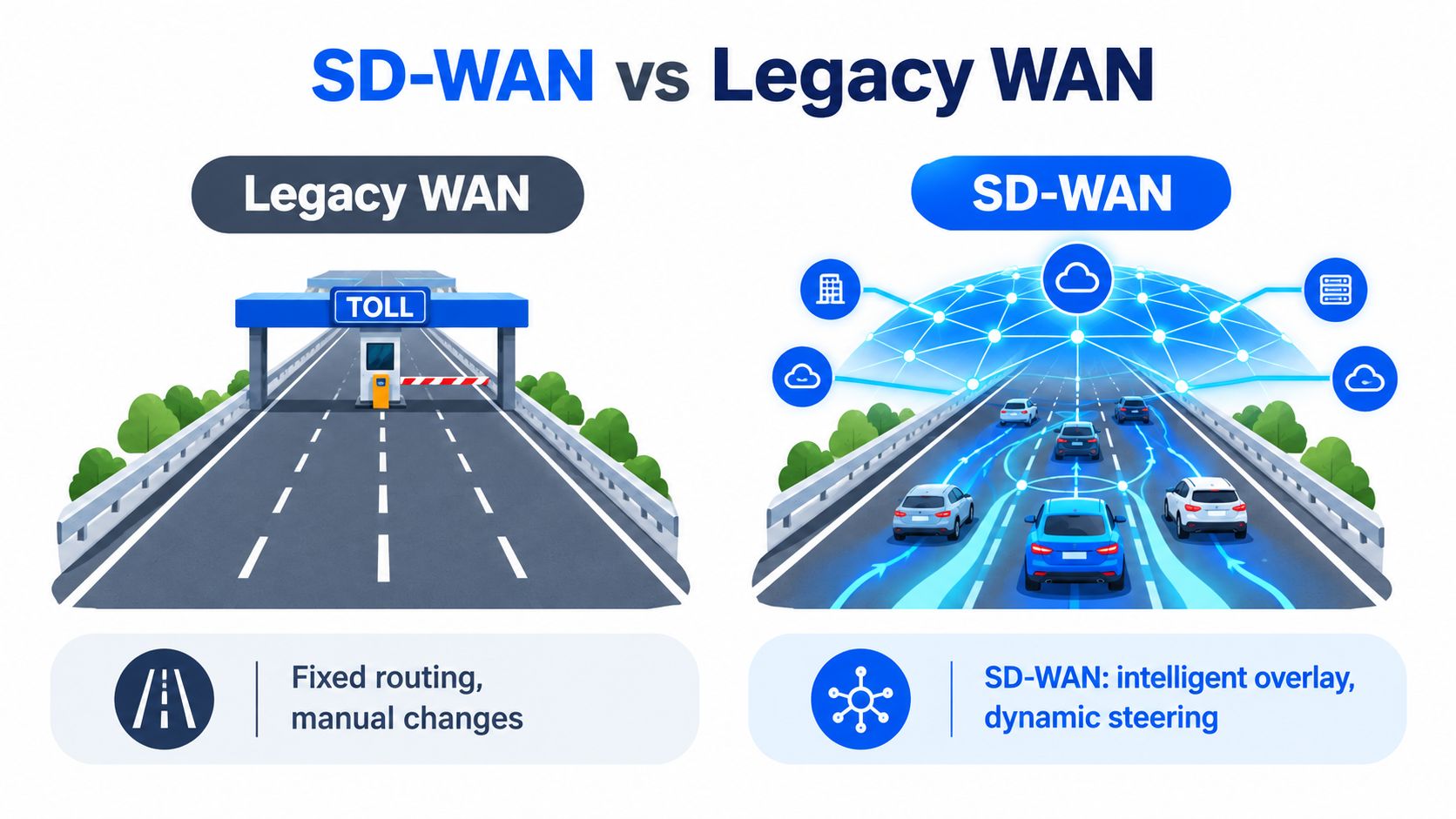
A branch outage during a busy morning makes the difference visible fast. In a legacy WAN, the site depends on fixed circuit choices and local routing behavior. In SD-WAN, the transport links still exist, but the network also has a control system that decides how traffic should use them.
The simplest definition
The underlay is the physical path, broadband, MPLS, metro Ethernet, LTE, or 5G. The overlay is the logical layer that steers packets across those paths according to policy.
Overlay in one sentence: it is the virtual path layer that tells traffic where to go while the physical links underneath stay unchanged.
That distinction matters because legacy WAN behavior is tied to the device and the circuit. SD-WAN separates policy from forwarding, so centralized intent can change without reworking every branch router. Cisco's policy framework describes this controller-driven approach, where policy influences routing behavior and traffic handling across the network (Cisco policy framework).
A VPN encrypts traffic, but encryption alone does not decide which link should carry a voice call, a SaaS session, or a backup job. MPLS offers carrier-managed predictability, yet it still behaves like a circuit-first design. SD-WAN can use MPLS where it fits, broadband where it is acceptable, and multiple links together when policy allows it.
That is why many teams review SD-WAN vs VPN guidance before they change architecture. For retail-heavy environments, software-defined WAN for retail helps frame branch performance and guest traffic concerns in practical terms.
The practical difference is control. Legacy WAN asks which interface a router should prefer. SD-WAN asks which path best matches the application's policy right now, using link quality, application detection, and steering rules as part of one control loop. If the app says one thing and the link telemetry says another, the controller has to resolve that conflict instead of blindly following a static route.
That is what makes SD-WAN more than a feature list. It behaves like a living traffic system for the WAN, with policy deciding the rules and the overlay carrying them out.
Inside SD WAN Architecture and Key Components
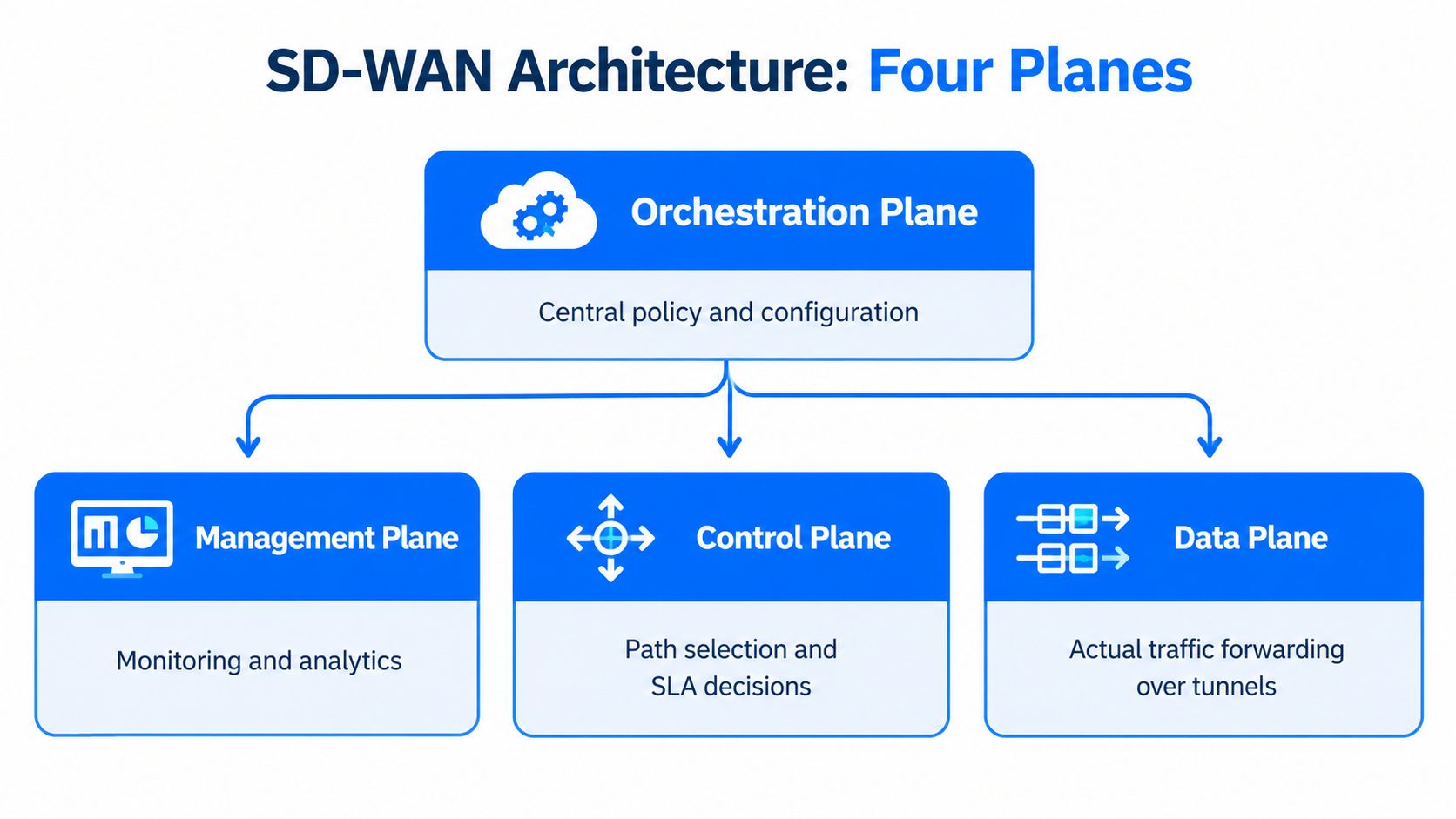
A branch router that tries to do everything in one place has to guess. SD-WAN breaks that habit by separating the tunnel fabric from the logic that decides how traffic should move. Cisco describes the design as four planes, orchestration, management, control, and data, which lets policy be defined centrally and enforced consistently at the edge. The result is less dependence on site-by-site quirks and more predictable behavior across branches.
What each plane does
- Orchestration plane: sets initial policy and configuration.
- Management plane: gives operators visibility, monitoring, and analytics.
- Control plane: maintains route state and applies SLA-aware decisions.
- Data plane: forwards live traffic through encrypted tunnels.
The clean separation matters because the planes answer different questions. Orchestration says what the business wants. Management shows what the network is doing. Control decides which path fits the current conditions. Data plane carries the packets once that decision is made. Like a control tower directing aircraft and the runway moving them, the policy layer and forwarding layer work together but do not do the same job.
Edge devices sit at the boundary between the enterprise and the transport network. They are the enforcement points, so they turn policy into forwarding behavior. The controller influences routing updates and the traffic that moves between branch devices, which is why it sits at the center of the fabric's day-to-day operation.
The policy model is easier to understand if you separate intent from transport. A policy can say that one application should prefer a cleaner path, while another can tolerate broader conditions. If telemetry and app classification disagree, the control system has to resolve that mismatch instead of following a static route.
For a branch-level view of how that handoff looks in practice, the MR2 Solutions SD-WAN edge page is a useful reference. The same separation of duties is also discussed in the Streamkap control plane guide. The key point is the handoff between centralized control and local packet forwarding.
How Data Flows Through an SD WAN From App to Destination
A branch user starts a video call or opens a SaaS app, and the control system begins working at once. First it identifies the flow, then it checks policy, then it decides which tunnel should carry the traffic. The key point is that the overlay is not the same thing as the decision logic. The tunnels provide reachability across mixed transports, while the policy layer decides how each flow should move.
From app detection to encapsulation
The sequence usually looks like this:
- The edge identifies the application. It inspects traffic and applies policy rules to separate one flow from another.
- The flow gets classified. Business intent decides whether the app needs premium treatment, local breakout, or a different mix of transports.
- Policy is checked against the current conditions. The device looks at what the overlay should do for that application and site.
- Traffic is encapsulated into tunnels. The packet is wrapped so it can cross the underlay securely.
- The packet is sent to the chosen destination. That destination may be another branch, a data center, or a cloud service.
The tunneling fabric and the steering logic do different jobs. One creates the secure paths. The other chooses which path fits the flow at that moment.
Why the step order matters
Researchers describe SD-WAN as combining tunnel-fabric management with application-aware traffic steering, so the system does more than build encrypted paths. It identifies applications, tracks flows, enforces SLA thresholds, and selects a path per flow. That is why SD-WAN behaves like a living control system rather than a static VPN overlay.
A simple branch example makes the difference clear. If a voice call and a bulk file transfer share the same site, the edge can keep the call on the cleaner path while sending the transfer elsewhere. The device is acting on central policy, then enforcing that decision locally at the edge, which is why changes in conditions can alter forwarding without a manual reset.
What happens when the signals disagree? If app classification says one thing, telemetry says another, and policy points in a third direction, the control system has to resolve the mismatch. That resolution is the work behind SD-WAN data flow, and it is what keeps forwarding aligned with business intent rather than with a fixed route table.
How SD WAN Chooses the Best Path in Real Time
A branch link can look fine on paper and still perform badly for a voice call. SD-WAN handles that gap by making path choice a continuous control loop, not a one-time routing decision. The edge devices measure latency, jitter, packet loss, and available bandwidth, then compare those readings with policy and application needs (Politecnico di Milano survey). If a link starts to degrade, the controller can move traffic before users feel the break.
SLA-driven steering in practice
Different applications place pressure on the network in different ways. Voice and video react quickly to delay variation. SaaS traffic usually needs steady response more than raw throughput. Bulk transfers can often tolerate more variation if policy allows it.
| Application Type | Key SLA Metric | Preferred Transport | Failover Behavior |
|---|---|---|---|
| Voice calls | Low latency and low jitter | The cleanest available path | Move quickly if quality slips |
| Video meetings | Low jitter and acceptable loss | The path that best preserves consistency | Re-route when quality degrades |
| SaaS apps | Balanced latency and loss | Broadband, MPLS, or cloud exit depending on policy | Shift to the better performing tunnel |
| Bulk transfers | Throughput and stability | Lower-cost links when allowed | Continue on alternate capacity if needed |
That table is the right mental model for SD-WAN. The question is not which circuit is best in the abstract. The question is which circuit fits this application, on this branch, under these conditions.
A comparative study of AI-assisted traffic engineering reported that latency dropped from 52.5 ms to 41.9 ms, and packet loss dropped from 4.9% to 2.0% in failure scenarios. Those results show what faster path decisions can do under stress, especially when a preferred link begins to wobble.
The control loop only works if the signals stay fresh. If telemetry lags, policy can point one way while the branch sees a different reality. A voice call may stay on the path the controller prefers, then shift as soon as loss or jitter crosses the threshold. That is why SD-WAN acts more like a living control system than a fixed route table. It keeps the tunnel fabric in place, then steers each flow according to what the network is doing at that moment.
If app classification, policy, and link telemetry disagree, the platform has to resolve the mismatch rather than guess. That resolution is the work behind SD-WAN path selection, and it is what keeps forwarding aligned with business intent instead of a static preference.
Security Cloud Integration and What SD WAN Does Not Do
A branch can have clean overlay tunnels and still be exposed. That is the gap many teams miss when they hear SD-WAN described as “secure.” It centralizes routing and encrypts traffic in transit, but it does not automatically add identity controls, east-west inspection, or zero-trust policy.

What it secures, and what it doesn't
Neutral and security-focused sources note that SD-WAN handles routing centralization and tunnel encryption, but it does not by itself provide identity-based access, workload-level segmentation, or full protection against lateral movement after compromise (FortaRisks SD-WAN security issues). That is why many buyers pair SD-WAN with SASE or SSE instead of treating it as a complete security answer.
Cloud integration adds another decision layer. Traffic can exit locally, pass through a cloud gateway, or be sent through centralized inspection, depending on policy and destination. Routing and security are harder to separate once path choice includes both performance and security intent.
For branch or guest environments, secure guest network access is a useful reminder that access policy must match the user type. Guest access, workforce access, and application access do not always need the same controls.
The operational question buyers should ask
The better question is which security gap remains after deployment. Managed SD-WAN is often sold as a single accountability model that brings the appliance, licensing, connectivity, and support together, which reflects how many teams now buy networking and security as one operating bundle rather than separate line items.
That is the right lens for IT leaders. SD-WAN can simplify connectivity, enforce routing policy, and improve visibility. It cannot replace every security layer by itself.
Putting SD WAN Knowledge Into Action for Your Organization
If you need to explain how does SD-WAN work to a team already comfortable with MPLS and VPNs, start with the control model. SD-WAN keeps the tunnel fabric in place, then uses centralized policy, application detection, and link telemetry to decide which path each flow should take. It behaves like a control system, not a fixed circuit plan. When those signals agree, traffic follows policy cleanly. When they disagree, the platform has to choose whether to trust the app label, the measured link state, or the policy priority.
That distinction matters in real deployments. A branch can have broadband, MPLS, and internet links, but the useful question is which applications are sensitive to jitter or loss, where users feel the pain, and which sites still rely on manual routing changes. Those answers should shape policy, not just circuit selection.
A vendor-neutral review process helps here, especially when design, operations, security, and lifecycle support all need to line up. MR2 Solutions offers SD-WAN services within a broader brokerage model, which can help when you want evaluation, implementation, and governance coordinated by one advisor.
Decision filter: if a platform cannot show continuous measurement, clear policy enforcement, and clear security boundaries, it is not ready for a serious branch rollout.
Start with current WAN pain, define the applications that matter most, and ask every provider how the controller, telemetry, and security stack behave when the network gets messy. That is where the differences appear.