
Managed Services Azure: Scope, Cost and Who Owns What

The usual advice about Azure managed services is to compare monitoring coverage, response times, and monthly fees. That's necessary, but it misses the harder question: who can authorize a change that affects your production systems or your cloud bill? A provider can reduce your operational workload while weakening financial accountability if its engineers recommend changes but your organization retains the invoice and the risk.
Buying well means defining more than support coverage. You need an operating agreement that connects technical work, spending authority, application requirements, and business ownership.
What Managed Azure Operations Cover
Managed Azure isn't a help desk watching a portal. It's the ongoing monitoring, management, maintenance, and support of Azure and related systems through a dedicated provider. In the customer-owned subscription model, your organization keeps the subscription, the invoice, and the business rules.
Say a manufacturer moves its scheduling application into Azure. The provider receives alerts, patches the operating systems, checks backups, and investigates slow responses. The manufacturer still decides whether production can stop for maintenance, how much scheduling data it can afford to lose, and whether a cheaper configuration creates unacceptable disruption.
That distinction should be visible in the service agreement, not discovered during an outage.
Azure managed scope and who still decides
| Area | Provider typically runs | Customer still owns |
|---|---|---|
| Monitoring and incidents | Alert rules, dashboards, triage, escalation | Severity model, business impact, major-incident authority |
| Patching and change | Patch windows, standard changes, runbooks | Production change approval and freeze rules |
| Backup and disaster recovery | Backup jobs, restore tests, failover drills | Recovery time and recovery point targets |
| Optimization | Rightsizing, idle-resource findings, commitment advice | Whether a saving may reduce resilience or performance |
| Security operations | Hardening checks, vulnerability follow-up, detection response | Risk acceptance, data classification, compliance sign-off |
| Identity and policy | Drift detection, baseline policy, access-review support | Who may grant access and which policies are mandatory |
| AI and data workloads | Consumption alerts, platform health, change logging | Model quality, data use, and sovereignty constraints |
| Microsoft 365 beside Azure | Tenant administration, licensing hygiene, collaboration support | Business process owners and retention rules |
Read the table as a starting allocation, not a universal promise. A provider may operate backup jobs without owning application recovery, or administer Microsoft 365 without managing retention policy. A service name doesn't establish its boundaries.
For the manufacturer, a successful backup job doesn't prove that scheduling can resume after an outage. The provider needs a restore procedure, while the application owner needs to validate that the restored software and data support production.
Include the surrounding systems
Azure operations rarely stop at the subscription boundary. Network faults, endpoint issues, identity dependencies, and third-party software can all affect the application. Vendor coordination therefore needs an owner who gathers evidence, opens support cases, and keeps the incident moving rather than handing the customer a list of suppliers to call.
Our managed-services scope can include help desk support, network monitoring, infrastructure and endpoint management, cybersecurity, cloud management, backup and disaster recovery, Microsoft 365 administration, vendor management, and strategic IT planning. Use the managed-services operations overview to frame that broader discussion; the actual responsibilities belong in the service agreement or statement of work.
AI and data platforms need equally explicit boundaries. An idle-resource finding is a proposal to investigate, not permission to delete a component that might support recovery or restricted data processing.
Ownership test: If a failure, a cost spike, or a policy drift has no named owner, that item isn't yet managed.
Who Owns Cost Decisions After Outsourcing
Outsourcing operations can blur financial accountability precisely when everyone believes they've improved control. Engineers gain dashboards and optimization tools, but nobody establishes who may change architecture, allocate shared platform costs, or validate a claimed saving.
The scale makes that omission consequential. Microsoft's FinOps guidance includes an enterprise illustration assuming $12.5 million in annual Azure spending growing 5% year over year, and treats optimization as an ongoing discipline encompassing rates, utilization, exports, alerts, and resource governance.
That illustration isn't a typical customer benchmark. It demonstrates why an organization shouldn't leave spending authority implicit.
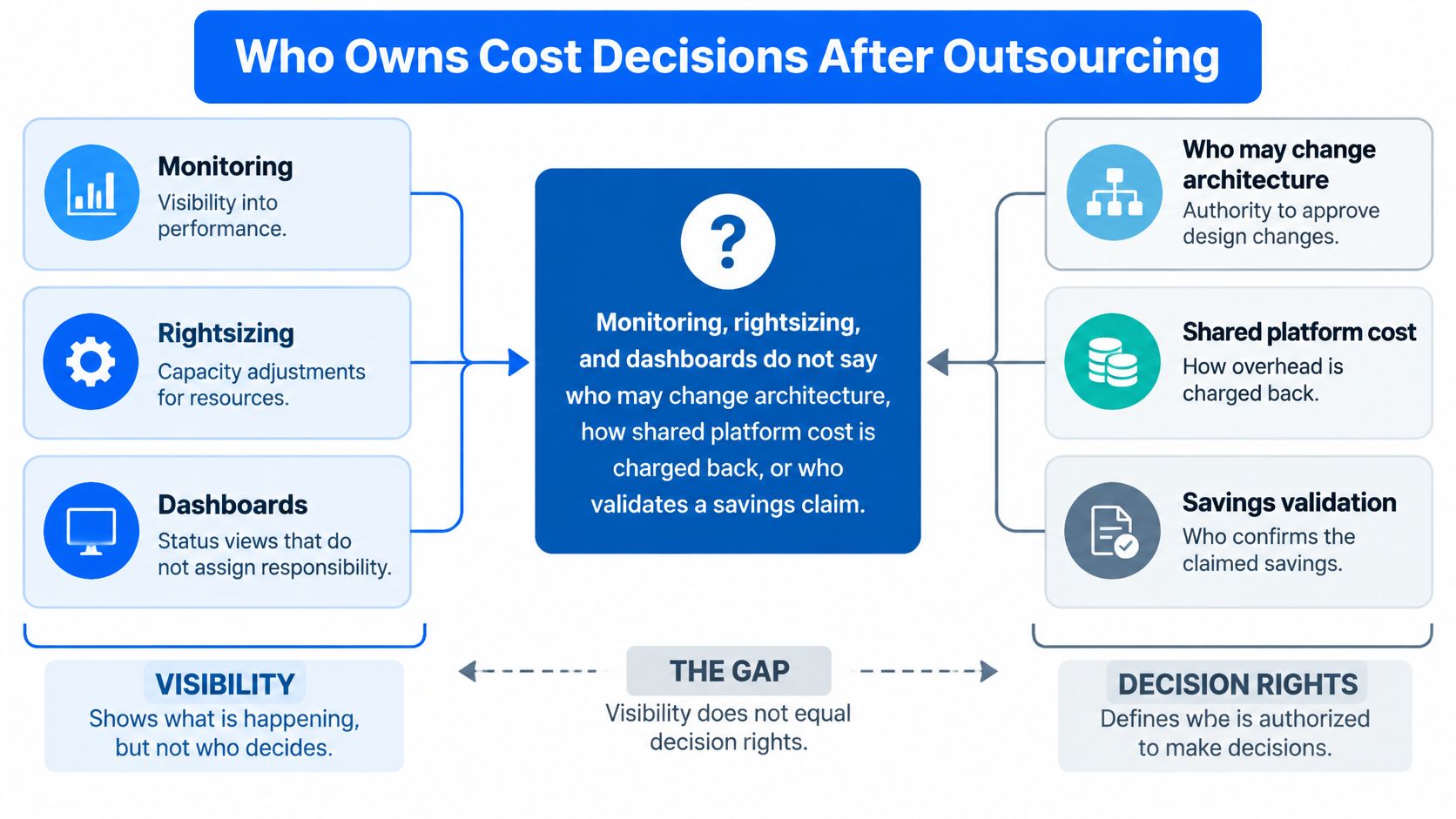
Separate recommendations from authority
Assign distinct responsibilities before introducing savings targets:
- The provider identifies and proposes. Engineers detect waste, explain utilization patterns, and recommend rate or capacity changes. Each proposal should identify affected workloads and operational consequences.
- Finance owns financial interpretation. Finance reconciles the bill, reviews amortized cost, defines chargeback, and checks whether claimed savings reflect an actual reduction rather than a budget assumption.
- Architecture and application owners decide technical acceptability. They approve or reject changes that affect availability, security, application behavior, or data residency.
Consider a shared analytics platform. The provider proposes reducing capacity because average utilization is low. Finance wants the saving, but the application owner knows that the platform must absorb an unpredictable processing deadline. A useful recommendation includes peak demand, queueing behavior, and a rollback plan, not just an average-utilization chart.
Put the commercial consequences in writing
The contract should distinguish guaranteed savings from advisory opportunities. It should also identify who bears unused commitments, how shared networking and security costs are allocated, and who verifies the baseline against which savings are measured.
Define the rejection path too. When an application owner rejects an optimization for resilience or residency reasons, record the rationale and the resulting cost decision. Otherwise, finance may treat a legitimate engineering constraint as an unexplained failure to optimize.
A managed IT services cost evaluation should separate the provider's fee from cloud consumption, transition work, and retained internal responsibilities. A lower service fee doesn't automatically mean a lower operating cost.
FinOps continues after migration because workloads, business priorities, and consumption change. Schedule joint reviews around decisions that need approval, not merely a presentation of dashboard screenshots.
Recommendations without an approval path are advice, not management.
How Commitment Choices Change the Azure Bill
The same Azure estate can produce different financial outcomes depending on whether commitments match actual workload behavior. Buying a discount before understanding demand can turn an optimization exercise into a long-lived obligation.
Microsoft's Azure Reservations guidance states that reservations can reduce eligible resource costs by up to 72% versus pay-as-you-go with a one- or three-year commitment. That's an eligible-resource discount, not a promised reduction in your total Azure bill.
Reservations are configuration- and region-specific. Their usefulness depends on sustained demand for the selected SKU, instance family, and location, so right-size before purchasing. A lower rate doesn't remove excess capacity.
Azure commitment instruments by workload behavior
| Instrument | Best workload | What you commit | Main risk |
|---|---|---|---|
| Reservation | Stable baseline on a known SKU, family, and region | Eligible resource configuration for the selected term | Idle committed capacity still costs money |
| Savings plan | Variable compute across eligible services and regions | Hourly spending commitment, with more flexibility than a fixed reservation | Unused commitment is still paid |
| Pay-as-you-go | Uncertain, bursty, or transitional workloads | No term commitment | Remaining uncommitted after demand becomes predictable |
| Right-size before commit | Every estate, as a prerequisite | No purchasing commitment by itself | Applying a discount to oversized resources |
Azure savings plans offer a different tradeoff. They apply an hourly spending commitment across eligible compute services and regions, making them more flexible than a fixed reservation. Flexibility still doesn't make an unsupported spending commitment safe.
A practical buying method starts with workload segmentation:
- Stable baseline: Consider reservations where configuration and location are unlikely to change.
- Variable compute: Evaluate savings plans when eligible consumption changes across services or regions.
- Transitional workloads: Retain pay-as-you-go while migration, retirement, or application redesign makes future usage uncertain.
Measure what the commitment actually delivers
Suppose a reporting application runs steadily, but its team plans to replace it. Historical utilization may look perfect for a reservation while the application roadmap makes the purchase inappropriate. The provider needs both telemetry and a conversation with the application owner.
Finance and operations should examine amortized cost, utilization, coverage, and underutilization, not just the invoice total. Amortized cost spreads a commitment across its benefit period; utilization shows whether you're consuming what you bought; coverage shows how much eligible demand receives the commitment benefit.
Those measures answer different questions. Strong coverage can coexist with waste if the underlying resources are oversized, while a seemingly attractive discount can increase effective cost when committed capacity sits idle.
Require a purchase recommendation to include its demand assumptions, relevant roadmap changes, and the owner who will review performance after purchase. The provider may recommend the instrument, but the customer accepts the commitment.
Reliability Security and Day to Day Control
Monitoring supplies evidence. It doesn't decide whether an incident is serious, authorize a risky change, or prove that recovery works.
Microsoft's Azure Monitor documentation describes the collection of metrics, logs, and traces from Azure and on-premises environments. That telemetry helps teams detect degradation, correlate related failures, and check service-level objectives.
The operating model should also reflect Microsoft's Well-Architected pillars: Reliability, Security, Cost Optimization, Operational Excellence, and Performance Efficiency. Operational excellence connects observability with automation, standardized tools and processes, and safe deployment practices.
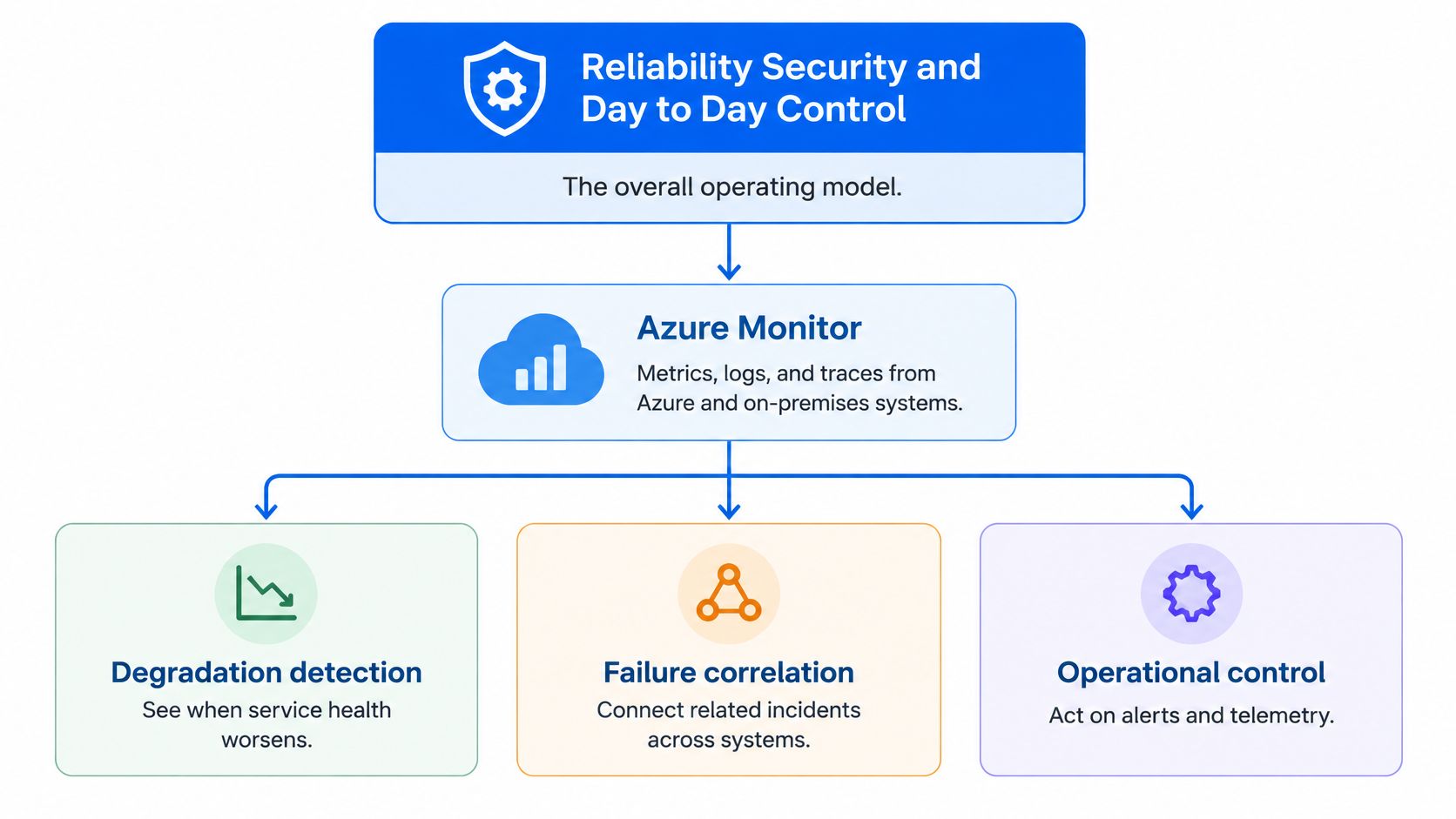
Turn telemetry into an operating procedure
For each production workload, define measurable indicators for availability, latency, error rate, recovery time, and capacity. Choose indicators that describe the service users receive, not merely whether a virtual machine is running.
Then connect every actionable alert to an owner and a runbook. Document who maintains alert rules, sets dashboard standards, assigns incident severity, leads escalation, approves changes, and completes the post-incident review.
The monitor is the instrument panel, the runbook is the checklist, and the named owner is the pilot; a dashboard without a pilot is noise.
A slow order-processing service illustrates the difference. CPU utilization may look healthy while database waits increase and requests fail. Engineers need correlated application and infrastructure evidence to identify the cause rather than repeatedly restarting the application.
Make incidents change the system
Review operational indicators alongside deployment and change records. If latency rises after a release, the investigation should consider the release immediately rather than treating application and infrastructure evidence as separate queues.
Centralized telemetry reduces diagnostic fragmentation across sites and teams. Automation and repeatable runbooks reduce manual variation, but policy exceptions still require human approval.
A closed incident ticket proves that someone completed a workflow. It doesn't prove that the underlying failure is less likely to recur.
Use the post-incident review to assign engineering actions: correct an alert, remove a fragile dependency, revise a deployment check, or update the recovery procedure. Give each action an owner and a completion condition.
The initial operating baseline should include:
- Alert accountability: Named owners and routing for production alerts.
- A severity scale: Business-impact criteria and escalation authority.
- Recovery evidence: A tested restore with application validation.
- Architecture review: An assessment of critical workloads against the Well-Architected pillars.
These controls make monitoring useful because they connect what engineers observe to what they're authorized and prepared to do.
Migration Hybrid and AI Workload Patterns
Azure's scale provides context for the range of environments a provider may need to operate. Microsoft's fiscal 2025 annual report disclosed Azure and other cloud-services revenue exceeding $75 billion, up 34% year over year.
That category includes Azure consumption and related cloud offerings. It isn't an isolated managed-services revenue figure, and platform scale alone doesn't establish a provider's competence with your applications.
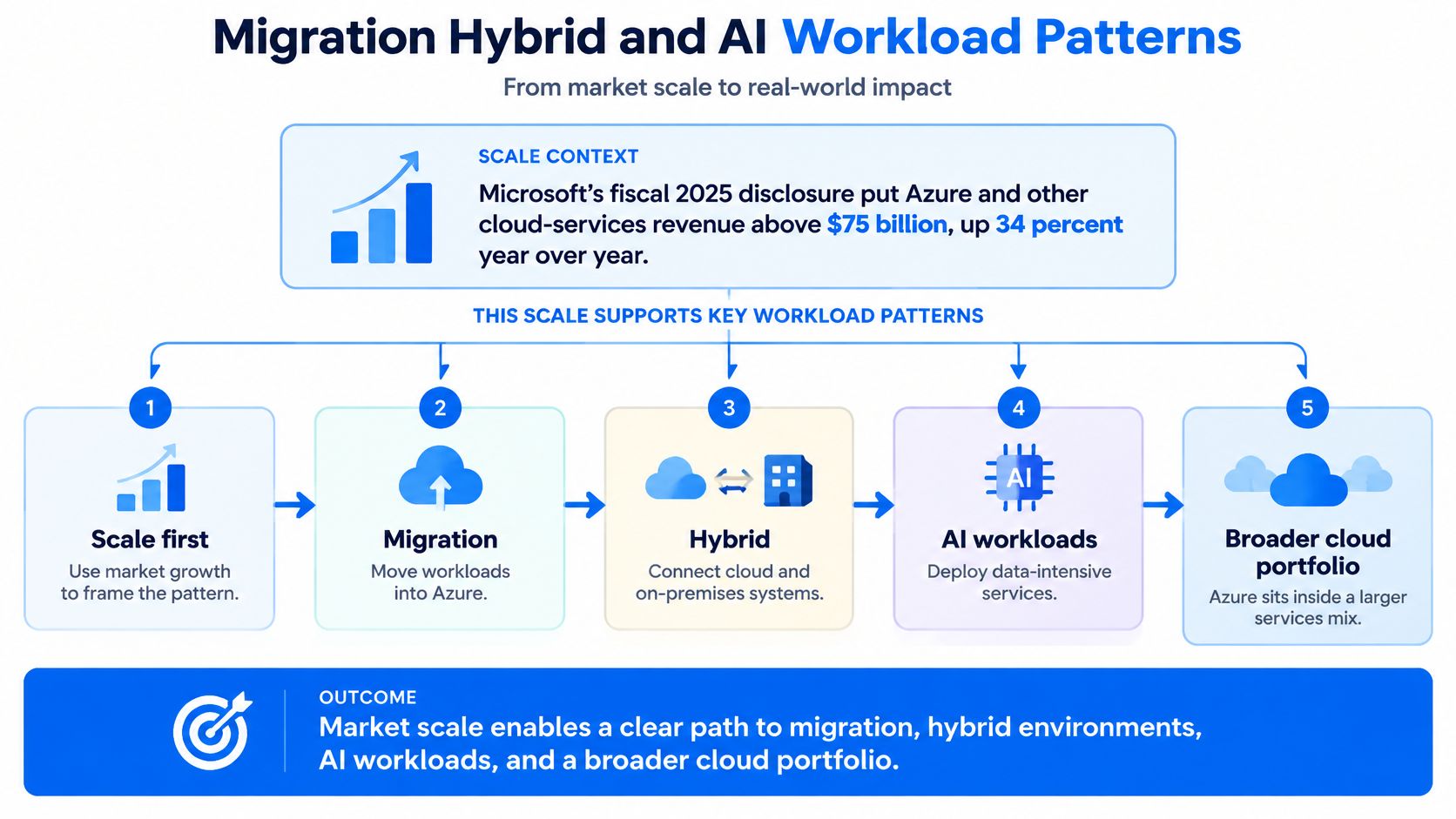
Migration preserves application responsibilities
A lift-and-shift migration retains virtual machines and familiar operating tasks. The provider can manage patching, backup, monitoring, and infrastructure incidents while the application team continues to own software behavior and releases.
Define the handoff with acceptance evidence. Record which incidents the provider resolves independently, when application engineers join, and how a restored workload is validated. Migration completion shouldn't leave temporary access privileges or undocumented recovery procedures behind.
Hybrid operations need a boundary owner
Hybrid estates retain identity, data, or latency-sensitive systems on premises while other components run in Azure. A cloud application may appear unavailable because of an on-premises identity failure or a broken network path.
The incident process must span those dependencies. Assign someone to coordinate cross-boundary diagnosis, policy drift, and disaster-recovery tests without waiting for separate teams to prove that their own component is healthy.
Our Cloud & Platform Experts work with Microsoft Azure, Amazon Web Services, and Google Cloud Platform. That breadth is relevant when hybrid cloud management involves several platforms rather than administration of a single Azure subscription.
AI operations require quality and data decisions
AI and data platforms, including Fabric, add responsibilities beyond infrastructure uptime. Consumption can change quickly, while model behavior and data changes may affect whether the service remains useful or acceptable.
An Azure managed-services overview from Kanerika provides context for the wider service scope. For procurement, translate that scope into workload-specific boundaries rather than assuming that platform administration includes model governance.
- Consumption escalation: Define when engineers notify finance and the workload owner about unexpected usage.
- Model and data change control: Identify who approves changes and validates quality.
- Identity and policy drift: Specify detection, remediation authority, and exception handling.
- Recovery and portability: Document recovery tests, data export, and operational handover.
An automation tool can flag expensive or idle resources. It can't decide whether pausing, resizing, or relocating them violates a model-quality requirement, recovery objective, or sovereignty constraint.
Managed means governed outcomes across the complete environment, not administration of a subscription alone.
Provider In House or a Split Model
Choose a provider when operating coverage is thin. Keep operations in-house when a mature cloud team already owns runbooks, FinOps, and security response, and outside involvement would mainly add application-learning overhead. Use a split model when the business must retain architecture, model quality, or risk acceptance while another team handles routine operations and incident coverage.
The financial test isn't estate size alone. Compare the service fee with the consequences of missed alerts, inconsistent patching, untested recovery, and unattended commitments, while accounting for the internal work you'll still retain.
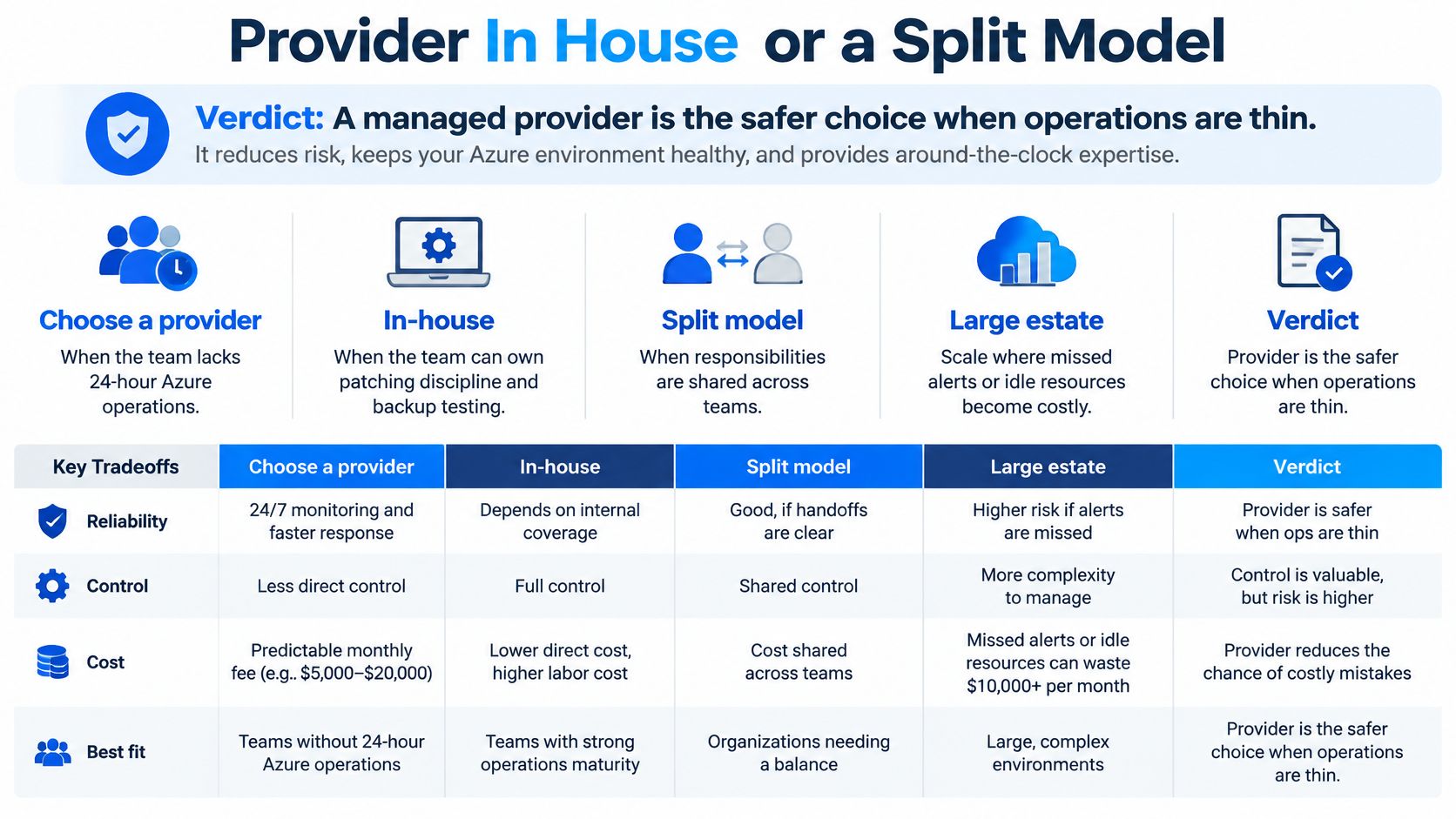
When to manage Azure in house or with a provider
| Condition | Lean provider | Lean in-house | Split that usually works |
|---|---|---|---|
| Mature runbooks and FinOps | Optional | Yes | Provider handles overflow only |
| Stable, well-sized estate | Suitable with clear scope | Suitable if the team is staffed | Provider executes; customer approves commitments |
| Rapid AI or data spend | For alerts and platform health | If a strong data team owns quality | Customer keeps model and sovereignty decisions |
| Regulated residency | For operational evidence | For policy exceptions | Provider runs operations; customer accepts risk |
| Weak exit or portable backups | Avoid until exit is written | Prefer | Contract exit rights before go-live |
Skills and coverage should be evaluated separately. An excellent Azure architect may not be available during an overnight incident, while a staffed service desk may lack the authority or expertise to recover a complex application. A split model works only when the handoff is explicit.
Compare operating evidence and commercial terms
For a useful contractual perspective, Kagool's resource on cloud managed services governance and SLAs can help frame the distinction between service coverage and accountable delivery. Translate the discussion into evidence requirements: incident records, restore results, change approvals, and cost-decision documentation.
Commercial evaluation should identify advisory savings, ownership of unused commitments, shared-service chargeback, and exit arrangements. Establish how the customer retains control of subscriptions, identities, configuration, and backups when the relationship ends.
Selection rule: Don't accept a provider's ability to recommend and bill as a substitute for customer approval rights.
Through our TBaaS™ model, we help organizations objectively evaluate managed service providers, negotiate vendor relationships, optimize service delivery, and align technology investments with business goals. Comparing architecture, pricing models, and integration capabilities before committing helps organizations avoid vendor lock-in.
Useful evaluation outputs include vendor comparisons, evaluation summaries, solution recommendations, cost insights, and an implementation roadmap aligned with business priorities. They give procurement and technical leaders a shared basis for selection rather than a single reseller quote.
Use a practical situation test: if nobody internally can authorize an urgent production change, establish delegated operational authority. If a provider can't explain why a proposed saving was rejected, keep that decision with an accountable internal owner.
Confirm Owners Before You Sign
Leave procurement with a concise operating agreement, not another feature list. It should let an engineer, finance lead, and application owner reach the same conclusion about who acts and who approves.
Complete these checks before comparing final proposals:
- Name accountable owners. Assign incidents, production changes, backup tests, security exceptions, and cost commitments to specific roles. Include deputies so absence doesn't suspend decision-making.
- Classify workloads before purchasing commitments. Mark each workload as stable, variable, or transitional, and have its application owner confirm the classification against the roadmap.
- Write the savings terms. Distinguish guaranteed outcomes from recommendations and state who bears unused commitments. Require a clear baseline for validating savings.
- Record production service indicators. Map critical workloads to availability, latency, error rate, recovery time, and capacity. Make sure business and technical owners agree on what those indicators mean.
- Confirm exit and portability. Document control and handover of subscriptions, identity, configuration, and backups. Include the evidence needed to demonstrate that another team can take over.
- Choose the operating model. Decide provider, in-house, or split responsibilities before launching the vendor comparison. Otherwise, you'll compare proposals that solve different problems.
Keep procurement support separate from approval rights
If internal procurement capacity is the bottleneck, a vendor-neutral brokerage can organize provider comparisons and prepare an implementation roadmap while your team retains approval authority. Our TBaaS™ approach works alongside internal IT teams to reduce evaluation and selection workload without replacing their business judgment.
Managed Azure is worth buying when the operating agreement makes someone accountable for both the alert and the financial consequence. Those responsibilities don't need to sit with the same organization, but they must connect through a clear decision process.
MR2 Solutions offers vendor-neutral provider evaluation, managed-services guidance, and TBaaS™ deliverables that include cost insights and an implementation roadmap. Visit MR2 Solutions to compare Azure operating models and define service scope, spending authority, and exit requirements before you sign.